


Vie di Romans
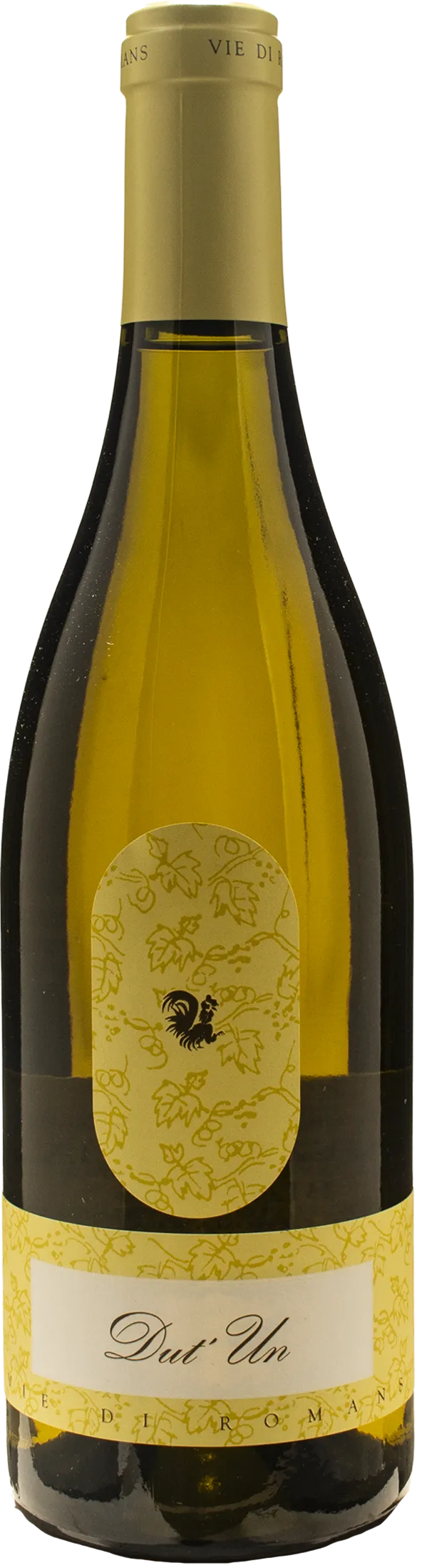
Dut'Un Bianco 2024
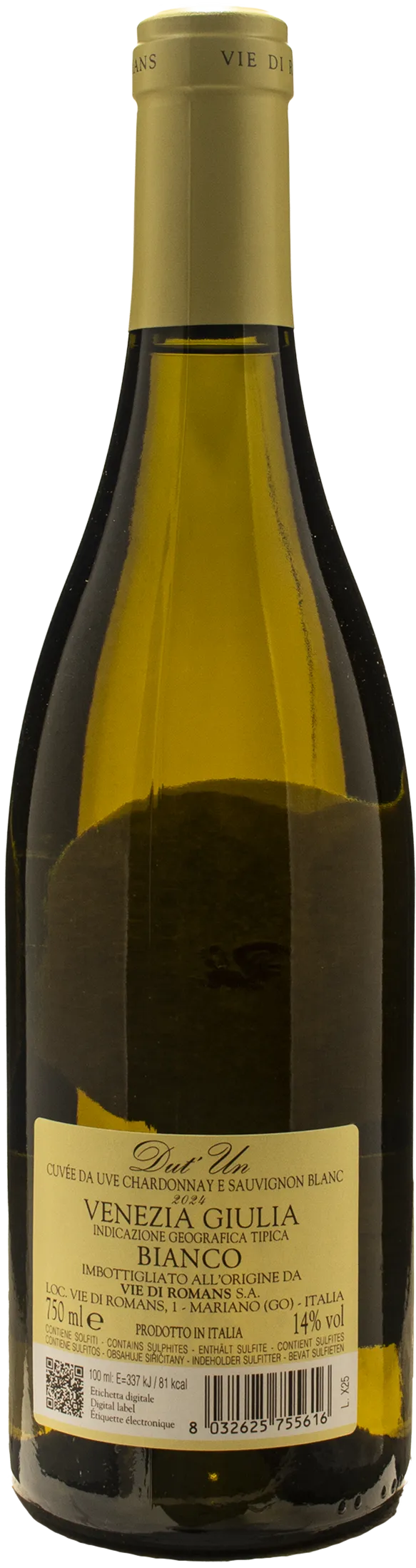
| Denomination | IGT Venezia Giulia |
|---|---|
| Size | 0,75 l |
| Alcohol content | 14.0% by volume |
| Area | Friuli-Venezia Giulia (Italy) |
| Grape varieties | 50% Chardonnay, 50% Sauvignon |
| Aging | Aged for 10 months on the lees, followed by 20 months in the bottle |
- Name and composition: Venezia Giulia IGT; 50% Chardonnay and 50% Sauvignon
- Vinification process: cold maceration and fermentation for 53 days at 16–19 °C
- Maturation: 10 months on the lees and 20 months in the bottle for greater complexity
- Aromatic characteristics: notes of fruit preserve and citrus, high olfactory finesse
- Finish and awards: velvety and savoury finish; 5 Grappoli Bibenda and 5 stars FIS
Description
What kind of wine it is
Dut’Un Bianco by Vie di Romans is a still white wine created from a skilful blend of Chardonnay and Sauvignon. Classified as Indicazione Geografica Tipica Venezia Giulia, it appears in the glass with an intense straw yellow colour. The aromatic profile is dense and enveloping, with jammy fruit and citrus notes that blend harmoniously with the hints imparted by barrel ageing. On the palate, the rich extractive structure finds an ideal balance with freshness, leading the tasting towards a velvety and savoury finish of great persistence.
Where it comes from
The grapes are carefully cultivated in the vineyards of Mariano del Friuli, trained using the simple Guyot and spur cordon systems. The vine roots delve into well-drained soils rich in stones, with varying depths. The particular silty-clay composition of the land displays a distinctive reddish hue, due to the natural concentration of iron and aluminium oxides. These specific pedoclimatic conditions ensure balanced ripening of the bunches, imparting the intense savouriness and aromatic precision typical of this wine-growing area to the glass.
How it is produced
The vinification process begins with a cold skin maceration at eight degrees, designed to gently extract aromatic precursors. Alcoholic fermentation takes place very slowly over fifty-three days at a strictly controlled temperature. To preserve the integrity of the natural freshness, malolactic fermentation is not carried out. The wine then matures for ten months on the lees, completing its refinement with a period of rest in the bottle, an essential step for perfect taste balance.
History and Curiosities
Dut’Un Bianco by Vie di Romans, a prestigious expression of Venezia Giulia IGT, is a blend of Chardonnay and Sauvignon of rare elegance. The grapes, harvested in September in Friuli, undergo a delicate cold skin maceration. A slow fermentation lasting fifty-three days enhances its aromatic profile, followed by a long ageing on the lees for ten months and a further rest in the bottle for another twenty months. This wine has been awarded the Bibenda 5 bunches and 5 stars from the Italian Sommelier Foundation.
Tasting notes

Perfume

Color

Taste
Serve at:
12 - 14 °C
Longevity:
10 - 15 years

- Start up year: 1900
- Oenologist: Gianfranco Gallo
- Bottles produced: 300.000
- Hectares: 67
Since 1978, the winery has been run by Gianfranco who, through rigorous and daring viticultural choices, combined with careful oenological interpretation, has affirmed a qualitative style of great personality, which has distinguished the Vie di Romans winery over the last twenty years.
Important milestones in this last historical journey have been: 1978 first bottling and first commercial label, 1982 start of a cycle of viticultural modernisation aimed at high quality, 1989 construction of the new cellar built on three floors, 1990 vinification of grapes separated according to cru of origin, 1992 commercial release of the 1990s vintage and from this date onwards white wines will always be marketed two years after the harvest. Read more


| Name | Vie di Romans Dut'Un Bianco 2024 |
|---|---|
| Type | White still |
| Denomination | Venezia Giulia IGT |
| Vintage | 2024 |
| Size | 0,75 l |
| Alcohol content | 14.0% by volume |
| Grape varieties | 50% Chardonnay, 50% Sauvignon |
| Country | Italy |
| Region | Friuli-Venezia Giulia |
| Vendor | Vie di Romans |
| Story | History and Curiosities Dut’Un Bianco by Vie di Romans, a prestigious expression of Venezia Giulia IGT, is a blend of Chardonnay and Sauvignon of rare elegance. The grapes, harvested in September in Friuli, undergo a delicate cold skin maceration. A slow fermentation lasting fifty-three days enhances its aromatic profile, followed by a long ageing on the lees for ten months and a further rest in the bottle for another twenty months. This wine has been awarded the Bibenda 5 bunches and 5 stars from the Italian Sommelier Foundation. |
| Origin | Mariano del Friuli (GO) |
| Climate | Exposure: East - West and North - South. |
| Soil composition | Shallow to moderately deep with abundant skeleton, reddish silty-clay fraction due to the presence of iron and aluminium oxides, well drained. |
| Cultivation system | Simple Guyot, spurred cordon |
| Plants per hectare | 6,000 vines/ha |
| Yield per hectare | 4.854 kg/ha |
| Harvest | 17 and 24 September |
| Fermentation temperature | 16–19 °C |
| Fermentation | 53 days |
| Production technique | Cold skin maceration, 53-day fermentation, ageing for 10 months on the lees and 20 months in the bottle |
| Wine making | Crushing and destemming, cold skin maceration at 8°C, cold static clarification, fermentation for 53 days at a controlled temperature of 16–19°C; malolactic fermentation not carried out. Aged for 10 months on the lees and 20 months in bottle. |
| Aging | Aged for 10 months on the lees, followed by 20 months in the bottle |
| Total acidity | 5.8 gr/L |
| PH | 3.3 |
| Allergens | Contains sulphites |