


Tiefenbrunner
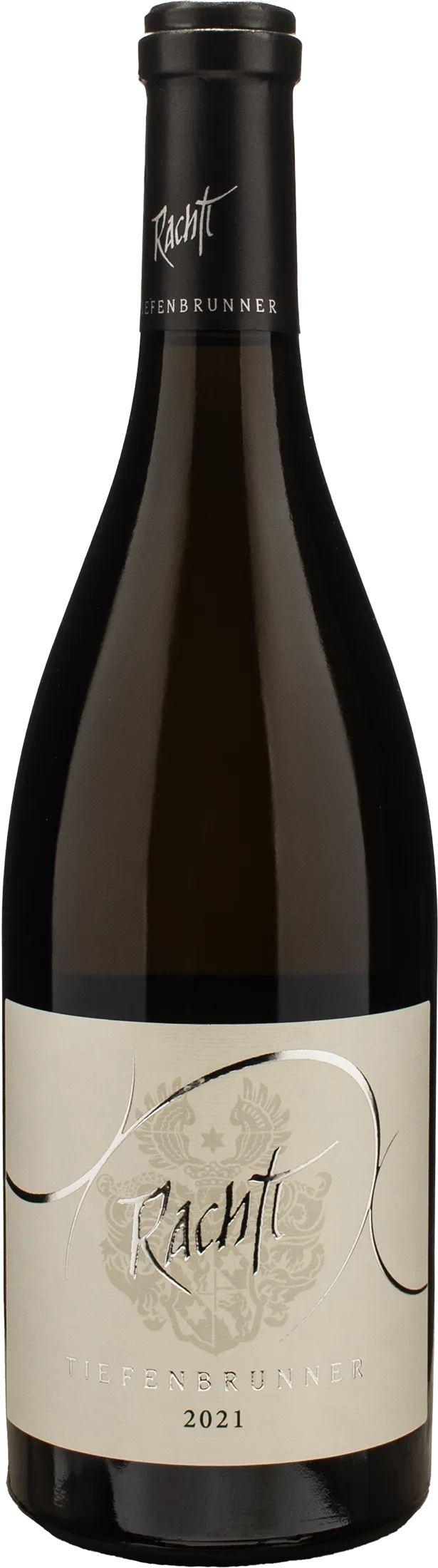
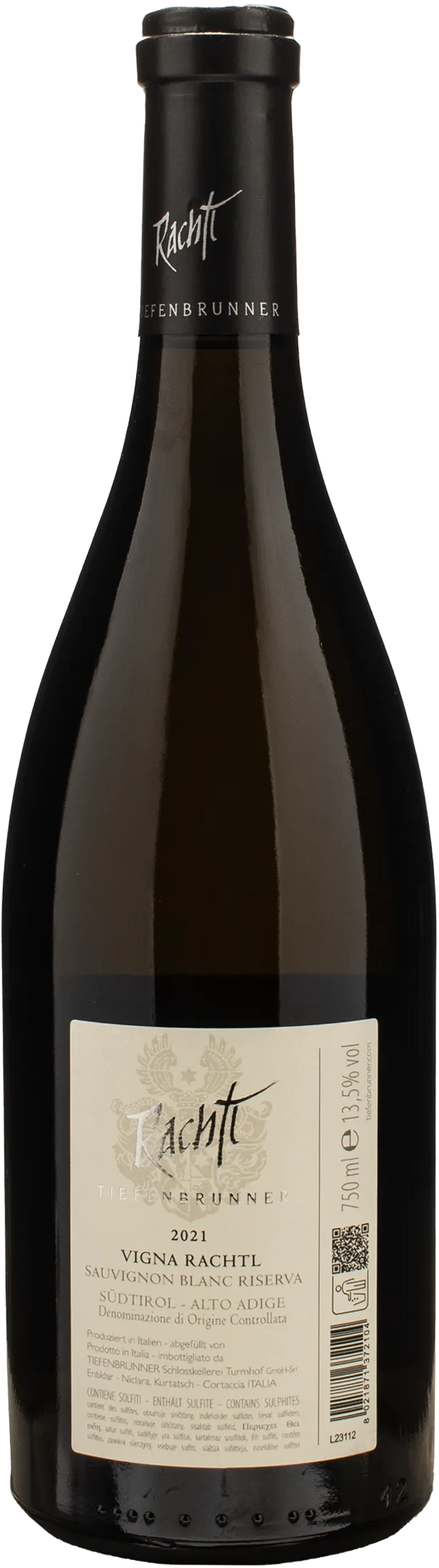
Sauvignon Riserva Vigna Rachtl 2021
| Denomination | DOC Alto Adige Sauvignon Riserva |
|---|---|
| Size | 0,75 l |
| Alcohol content | 13.5% by volume |
| Area | Trentino Alto Adige (Italy) |
| Grape varieties | 100% Sauvignon |
| Aging | After assembly in steel tanks, the wine naturally clarifies for 6 months; after bottling, it matures for a further 12 months in the bottle (with partial fermentation and maturation in new tonneaux and large wooden casks for about a year). |
- Grape variety and vintage: 100% Sauvignon Blanc, Riserva Vigna Rachtl, harvested in 2021
- Aromatic profile: notes of flint, graphite, schist, hay, exotic fruit and flowers
- Taste: full and velvety palate, lively acidity, slight tannic presence, long finish
- Vinification: 8–12 hours maceration, fermentation in wood, no malolactic fermentation
- Origin and serving: Alto Adige DOC, vineyards at 590–630 metres, serving temperature 12–14 °C
Description
What kind of wine it is
Tiefenbrunner Sauvignon Riserva Vigna Rachtl is a still white wine that showcases the elegance of Sauvignon Blanc grown at high altitude. Produced in the Alto Adige region, it stands out for its straw yellow colour enhanced by bright green highlights. On the nose, it opens with intense mineral notes of flint, graphite and schist, then evolves into enveloping hints of hay, exotic fruit and delicate floral essences. On the palate, it is full-bodied and balanced, offering a silky tactile sensation accompanied by a subtle tannic texture. The tasting concludes with a decisive and persistent finish, in perfect harmony with a vibrant acidity.
Where it comes from
The grapes are grown in the mountain vineyards of Aica di Sotto, in the landscape of Fiè allo Sciliar. The vines grow between 590 and 630 metres above sea level, benefiting from a south-east exposure that encourages full phenolic ripeness while maintaining a fresh aromatic profile. The soil composition alternates surface layers of sand and silt, rich in saline elements and grey porphyry, with a base of calcareous sandy rock at depth. This specific mountain terroir imparts a strong vertical component to the wine, giving it its characteristic savouriness and pronounced taut nuances.
How it is produced
Harvesting takes place when the grapes reach perfect ripeness. In the winery, a brief skin maceration is followed by an extremely gentle pressing. Fermentation takes place entirely in wood, skilfully distributed between small and large barrels, where the wine rests for almost a year. To preserve freshness, malolactic fermentation is carefully avoided. Afterwards, a harmonious blend is created in steel tanks for a natural clarification lasting six months. The process concludes with bottle ageing for a year, which perfects the balance of flavours before release.
History and Curiosities
Born from the experience of Tiefenbrunner, a historic winery founded in 1848, this pure Sauvignon Blanc encapsulates the authentic essence of Alto Adige DOC. Produced with grapes grown in the mountain vineyards of Fiè allo Sciliar at an altitude of 590 metres, it is a masterpiece crafted by oenologist Stephan Rohregger. The careful vinification in wood excludes malolactic fermentation, thus preserving the precious minerality of the region. Maturation in barrels, tonneaux and steel gives the wine a velvety structure, appreciated by sommeliers for its elegance.
Awards
-
2021
 4
4Italian Sommelier Foundation (FIS) guide This has been one of the most prestigious wine guides in Italy for over 10 years.
-
2021
 2
2This guide is highly respected and offers the most comprehensive review of Italian wines. It has a long tradition and is based on blind tastings carried out by over 100 experts.
-
2021
 3
3One of the most prestigious wine guides in Italy.
Tasting notes
Perfume
Color
Taste
Serve at:
12 - 14 °C
Longevity:
05 - 10 years
- Start up year: 1848
- Oenologist: Stephan Rohregger
- Bottles produced: 650.000
- Hectares: 88
It is both an honor and a responsibility to carry on the legacy and to continue writing the story of the Tiefenbrunner family, chapter by chapter, year after year, vintage after vintage. Read more


| Name | Tiefenbrunner Sauvignon Riserva Vigna Rachtl 2021 |
|---|---|
| Type | White still |
| Denomination | Alto Adige DOC |
| Vintage | 2021 |
| Size | 0,75 l |
| Alcohol content | 13.5% by volume |
| Grape varieties | 100% Sauvignon |
| Country | Italy |
| Region | Trentino Alto Adige |
| Vendor | Tiefenbrunner |
| Story | History and Curiosities Born from the experience of Tiefenbrunner, a historic winery founded in 1848, this pure Sauvignon Blanc encapsulates the authentic essence of Alto Adige DOC. Produced with grapes grown in the mountain vineyards of Fiè allo Sciliar at an altitude of 590 metres, it is a masterpiece crafted by oenologist Stephan Rohregger. The careful vinification in wood excludes malolactic fermentation, thus preserving the precious minerality of the region. Maturation in barrels, tonneaux and steel gives the wine a velvety structure, appreciated by sommeliers for its elegance. |
| Origin | Aica di Sotto, hamlet of Fiè allo Sciliar |
| Climate | Altitude: 590 to 630 m a.s.l. Exposure: south-east. |
| Soil composition | In the more superficial layers, sand with a medium silt content, high salt levels and a low humus content prevails, with the presence of grey porphyry; in the lower layers, calcareous sandy rock dust predominates. |
| Cultivation system | Espalier |
| Plants per hectare | 8000 |
| Yield per hectare | 42 hl/ha |
| Production technique | Maceration for 8–12 hours and gentle pressing; alcoholic fermentation 25% in new tonneaux and 75% in large wooden casks; malolactic fermentation avoided; natural clarification in steel tanks and bottle ageing. |
| Wine making | After a maceration of 8–12 hours and a gentle pressing, 25% of the must ferments in new tonneaux and the remaining 75% in large wooden barrels, where alcoholic fermentation takes place and the wine remains for almost a year; malolactic fermentation is carefully avoided to preserve the mineral notes. The two parts are then reassembled in stainless steel tanks, where the wine naturally clarifies for 6 months; after bottling, it matures for a further 12 months in the bottle. |
| Aging | After assembly in steel tanks, the wine naturally clarifies for 6 months; after bottling, it matures for a further 12 months in the bottle (with partial fermentation and maturation in new tonneaux and large wooden casks for about a year). |
| Total acidity | 7.1 gr/L |
| Residual sugar | 0.6 gr/L |
| Allergens | Contains sulphites |