


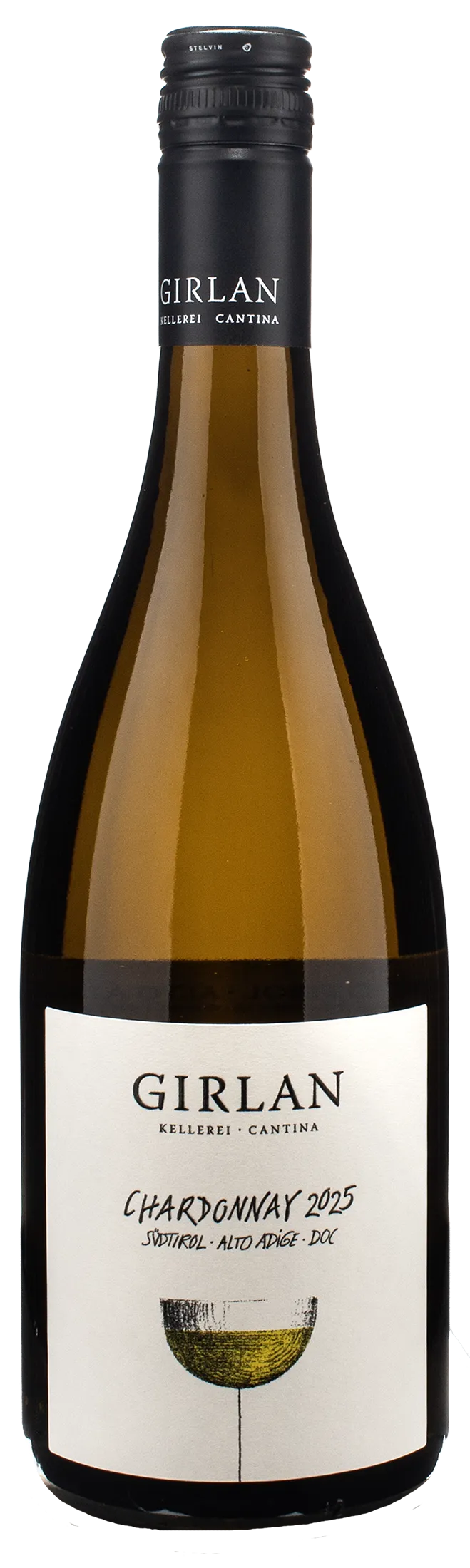
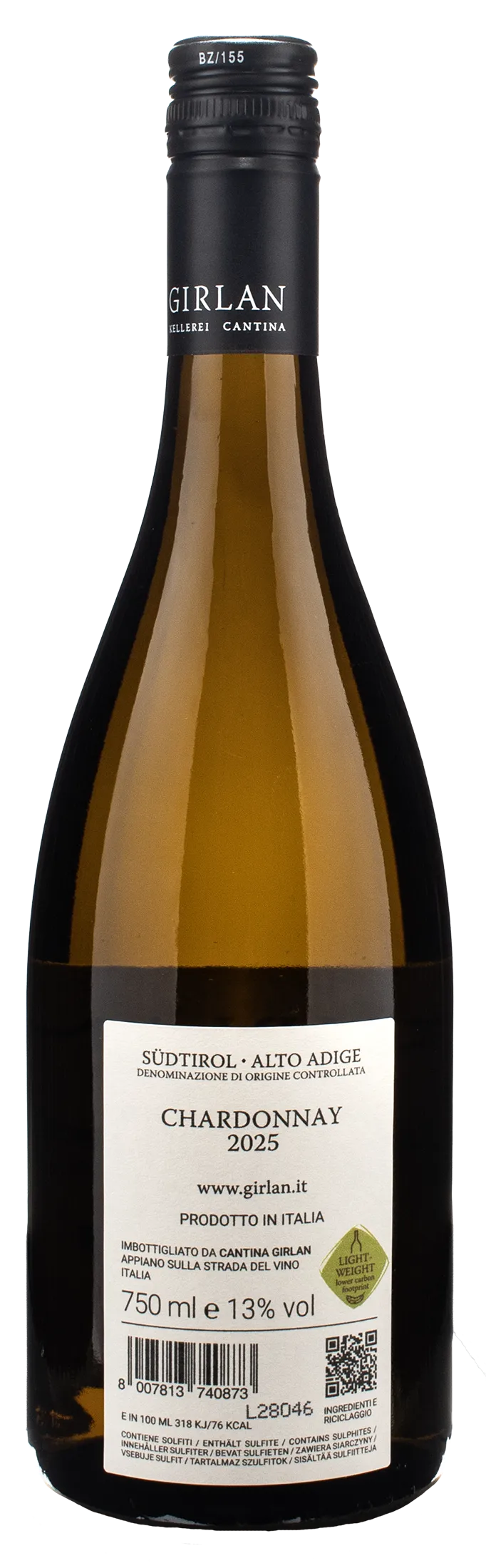
Girlan
Chardonnay 2025
| Denomination | DOC Alto Adige Chardonnay |
|---|---|
| Size | 0,75 l |
| Alcohol content | 13.0% by volume |
| Area | Trentino Alto Adige (Italy) |
| Grape varieties | 100% Chardonnay |
| Aging | Ageing on fine lees in stainless steel tanks (approximately 3–6 months) |
- Profile: Still dry white Alto Adige DOC at 13% vol, 100% Chardonnay.
- Aromas: White peach, rosemary honey, tropical notes with a savoury and persistent finish.
- Origin: Oltradige and Egna at 300-500 m, glacial, volcanic and limestone soils.
- Winemaking: Manual harvesting and ageing on the lees in steel for 3-6 months.
- Pairings: Ideal for aperitifs, raw seafood and white meats. Serve at 10-12°C.
Description
What type of wine it is
Girlan's Chardonnay is a still, dry white wine that expresses the authentic character of Alto Adige. This label, certified vegan, is distinguished by its lively freshness and elegant profile, offering a palate that is full yet slender at the same time. In the glass, the Chardonnay reveals a refined bouquet with hints of white peach, rosemary honey, delicate tropical notes and Mediterranean scrub herbs. On the palate, it is vertical and sapid, with an excellent lingering finish. This balance makes it perfect for accompanying raw seafood and fish risottos, as well as white meats and Asian cuisine dishes.
Where it comes from
The grapes ripen on the hills of Oltradige and in the municipality of Egna, in the heart of Alto Adige, at an altitude of between three hundred and five hundred metres. The mountain environment ensures an ideal microclimate for a slow and balanced ripening of the bunches. The wine's distinctive character derives from the soils of glacial origin, rich in mineral components. The combination of volcanic porphyritic rock and well-drained calcareous-gravelly sediments gives the wine a sapid and taut profile, capable of enhancing its natural and vibrant freshness.
How it is produced
Production begins with a meticulous manual harvest, aimed at preserving the integrity of the fruit. Following soft pressing, the must is clarified through a natural sedimentation process. Fermentation takes place in temperature-controlled steel tanks to keep the aromatic finesse of the must intact. This is followed by a period of ageing in steel on the fine lees for several months. This process enriches the structure and defines the sensory profile, resulting in a white wine with a lively taste persistence that faithfully respects the expression of the grape variety.
History and interesting facts
A product of the historic Girlan winery, founded in 1923, the elegant Chardonnay Alto Adige DOC is produced at altitudes between 300 and 500 metres, on the hills of Oltradige and Egna. The vines grow in soils rich in glacial sediments and volcanic porphyry, which give the wine a magnificent mineral backbone. Under the expert guidance of oenologist Gerhard Kofler, the careful manual harvest and ageing on the fine lees in steel tanks preserve its territorial character intact.
Tasting notes
Perfume
Color
Taste
Serve at:
10 - 12 °C
Longevity:
03 - 05 years
- Start up year: 1923
- Oenologist: Gerhard Kofler
- Bottles produced: 1.350.000
- Hectares: 220
Today, about 200 greatly committed and motivated winegrowers and their families farm an area covering about 230 hectares of vineyards in the best production areas of Oltradige and Bassa Atesina. Our enologist, Gerhard Kofler, keeps in close personal contact with the winegrowers and provides his professional advice during the growing season. This beneficial exchange of expertise sets the foundations for producing highest quality wines. The wines are among the most awarded in the region and available in more than 40 countries worldwide. Read more


| Name | Girlan Chardonnay 2025 |
|---|---|
| Type | White green still semi-aromatic |
| Denomination | Alto Adige DOC |
| Vintage | 2025 |
| Size | 0,75 l |
| Alcohol content | 13.0% by volume |
| Grape varieties | 100% Chardonnay |
| Country | Italy |
| Region | Trentino Alto Adige |
| Vendor | Girlan |
| Story | History and interesting facts A product of the historic Girlan winery, founded in 1923, the elegant Chardonnay Alto Adige DOC is produced at altitudes between 300 and 500 metres, on the hills of Oltradige and Egna. The vines grow in soils rich in glacial sediments and volcanic porphyry, which give the wine a magnificent mineral backbone. Under the expert guidance of oenologist Gerhard Kofler, the careful manual harvest and ageing on the fine lees in steel tanks preserve its territorial character intact. |
| Origin | Hills of Oltradige and Egna, South Tyrol, Italy (Bassa Atesina) |
| Soil composition | Glacial sediments, volcanic porphyry rock and calcareous-gravelly soils |
| Cultivation system | Screw cap |
| Yield per hectare | 70 hectolitres per hectare |
| Production technique | Manual harvesting; gentle pressing; clarification of the must via natural sedimentation; fermentation in temperature-controlled stainless steel tanks; ageing on fine lees in stainless steel (approx. 3–6 months) |
| Wine making | Manual harvest; soft crushing/pressing of the grapes; clarification of the must through natural sedimentation; fermentation in temperature-controlled stainless steel tanks; ageing on fine lees in stainless steel (approx. 3–6 months). |
| Aging | Ageing on fine lees in stainless steel tanks (approximately 3–6 months) |
| Total acidity | 6.14 gr/L |
| Residual sugar | 1.4 gr/L |
| Allergens | Contains sulphites |