


Catena Zapata
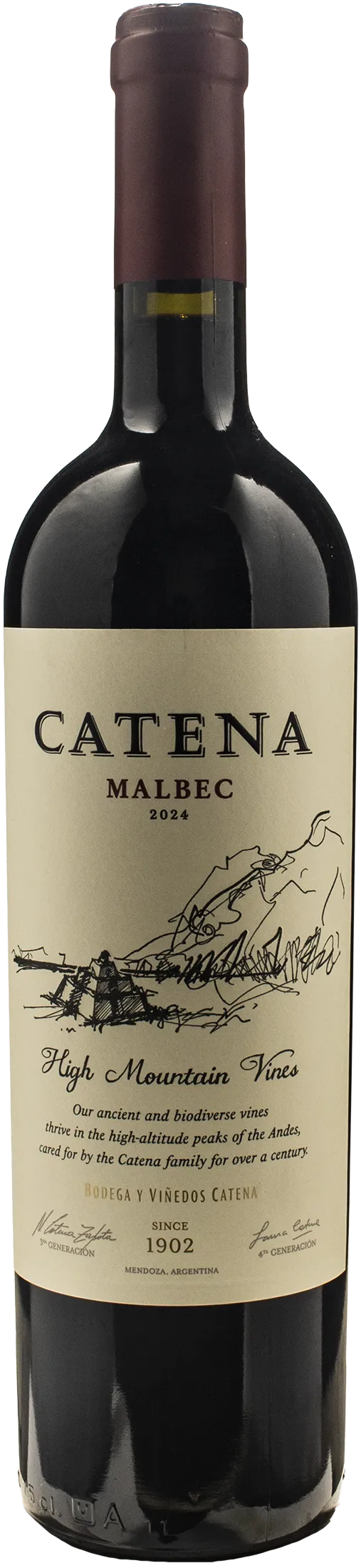
Catena Malbec 2024
| Denomination | N/A |
|---|---|
| Size | 0,75 l |
| Alcohol content | 13.5% by volume |
| Area | Mendoza (Argentina) |
| Grape varieties | 100% Malbec |
| Aging | Aged for 11–14 months in oak barrels, mainly French (first, second and third use; partly American oak). |
- Origin and variety: 100% Malbec from high-altitude vineyards in Mendoza (920–1450 m)
- Intense aroma: notes of plum, cherry, dark fruit, violet, light spices and cocoa
- Taste and structure: full-bodied, silky tannins, lively acidity and a long finish with mineral notes
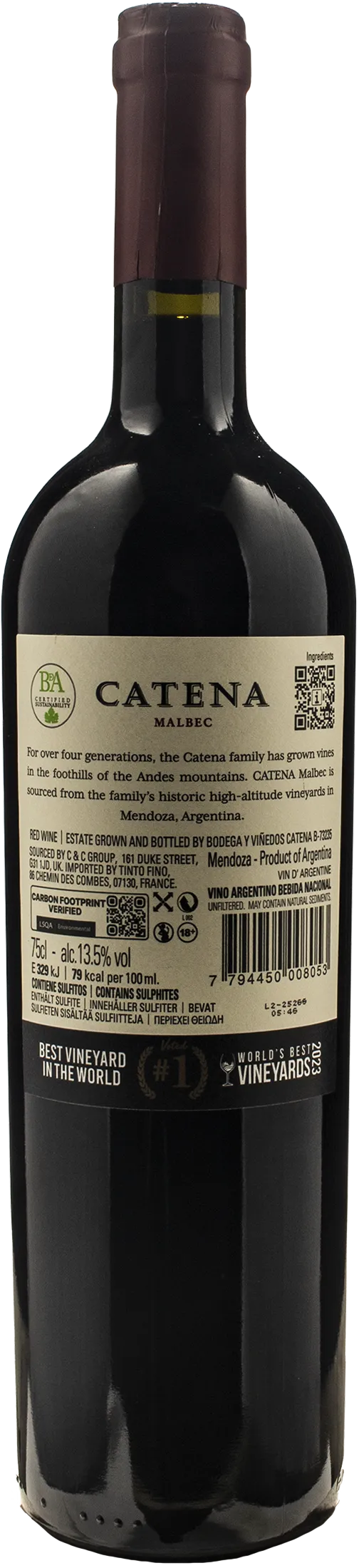
- Natural vinification: cold maceration for 5 days, fermentation with indigenous yeasts, unfiltered
- Ageing and serving: matured for 11–14 months in oak; decant for 1 hour, serve at 14–16 °C
Description
What kind of wine it is
Catena Malbec from the Catena Zapata winery is an Argentinian red wine that expresses the most authentic soul of Malbec. Produced in the renowned Mendoza region, it stands out for its full-bodied and structured style, supported by vibrant acidity and fine-grained tannins. On the palate, it is enveloping and complex, with a clear profile focused on aromas of small dark fruits, delicate floral notes of violet, and subtle spicy hints. The decision not to filter preserves the intense aromatic charge and the natural expression of the grape variety.
Where it comes from
The grapes come from a careful blend of high-altitude vineyards located in Mendoza, including the areas of Lulunta, El Cepillo, and Gualtallary. The high altitudes, ranging from 920 to 1450 metres, promote extraordinary aromatic concentration and the maintenance of excellent freshness. The alluvial soils have varied characteristics: from the gravel and limestone of Gualtallary to the clay and sandy matrices of El Cepillo and Lulunta. The presence of smooth rocks in the subsoil clearly defines the varietal profile, giving a distinctive mineral note to the finish.
How it is produced
Production begins with the manual harvesting of the grapes, followed by a cold maceration of five days to delicately extract colour and aromatic precursors. Fermentation occurs spontaneously thanks to indigenous yeasts, with a subsequent maceration in contact with the skins that consolidates the structure of the tannins. The wine matures for a period between eleven and fourteen months in French and American oak barrels, carefully balancing the contribution of the wood. The result is a wine with a dense texture, characterised by a dry sip and long persistence.
History and Curiosities
Produced by the historic Bodega Catena Zapata, founded in 1902 in Mendoza, this wine is the creation of the family's fourth generation, with Laura Catena and oenologist Alejandro Vigil. Through decades of studying mountain terroirs, the family has identified the most suitable historic plots. A fascinating aspect is its exceptional ageing potential: although enjoyable immediately, it can evolve magnificently in the cellar for ten or twenty years, a quality widely recognised by the world's most authoritative critics.
Tasting notes

Perfume

Color

Taste
Serve at:
14 -16 °C
Longevity:
10 - 15 years
Decanting time:
1 hour
Nicolás Catena would never use the word about himself - a less boastful spirit, it’s hard to imagine - but he has been the quiet revolutionary in the Catena family history book. He has charted the family’s path to the new frontier of winemaking, drawing on lessons learned from the land and in the classroom, then applying his education to dare to challenge the conventional wisdom.
Taking the reigns of the family vineyards and wineries in the mid 1960s, he concentrated on expanding distribution throughout Argentina during years of turmoil in the 1970s. But in the early 1980s, Nicolás left Argentina to become a visiting professor of economics at the University of California, on the world-renowned campus at Berkeley. The political and economic situation in Argentina was difficult, with a military government that had just declared war on the United Kingdom and inflation rates of more than 1000 per cent per year.
Nicolás set out to develop his own selection of Argentine Malbec clones planting 145 clones in the La Pirámide vineyard. Of these, he selected the best five and began to plant them in different terroirs and altitudes.
Read more


| Name | Catena Zapata Catena Malbec 2024 |
|---|---|
| Type | Red green still |
| Denomination | N/A |
| Vintage | 2024 |
| Size | 0,75 l |
| Alcohol content | 13.5% by volume |
| Grape varieties | 100% Malbec |
| Country | Argentina |
| Region | Mendoza |
| Vendor | Catena Zapata |
| Story | History and Curiosities Produced by the historic Bodega Catena Zapata, founded in 1902 in Mendoza, this wine is the creation of the family's fourth generation, with Laura Catena and oenologist Alejandro Vigil. Through decades of studying mountain terroirs, the family has identified the most suitable historic plots. A fascinating aspect is its exceptional ageing potential: although enjoyable immediately, it can evolve magnificently in the cellar for ten or twenty years, a quality widely recognised by the world's most authoritative critics. |
| Origin | Lulunta, El Cepillo and Gualtallary (Mendoza, Argentina) |
| Climate | Lunlunta: 920 m a.s.l.; El Cepillo: 1090 m a.s.l.; Gualtallary: 1450 m a.s.l. |
| Soil composition | Lunlunta: clayey-silty with rounded rocks at the bottom; El Cepillo: alluvial origin, clayey-sandy soil with thick limestone layers and rounded rocks at the bottom; Gualtallary: alluvial origin, gravelly and calcareous soil with rounded rocks at the bottom. |
| Fermentation | 12 days |
| Production technique | Long cold maceration and fermentation with indigenous (wild) yeasts; unfiltered; ageing in oak barrels |
| Wine making | Cold maceration for 5 days (approximately 8.8–10 °C); fermentation for 12 days with indigenous/wild yeasts; long post-fermentation maceration (total maceration 19–22 days); ageing for 11–14 months in oak barrels, mainly French (first, second and third use; partly American oak); unfiltered. |
| Aging | Aged for 11–14 months in oak barrels, mainly French (first, second and third use; partly American oak). |
| Total acidity | 5.0 gr/L |
| PH | 3.7 |
| Allergens | Contains sulphites |