


Bosco del Merlo
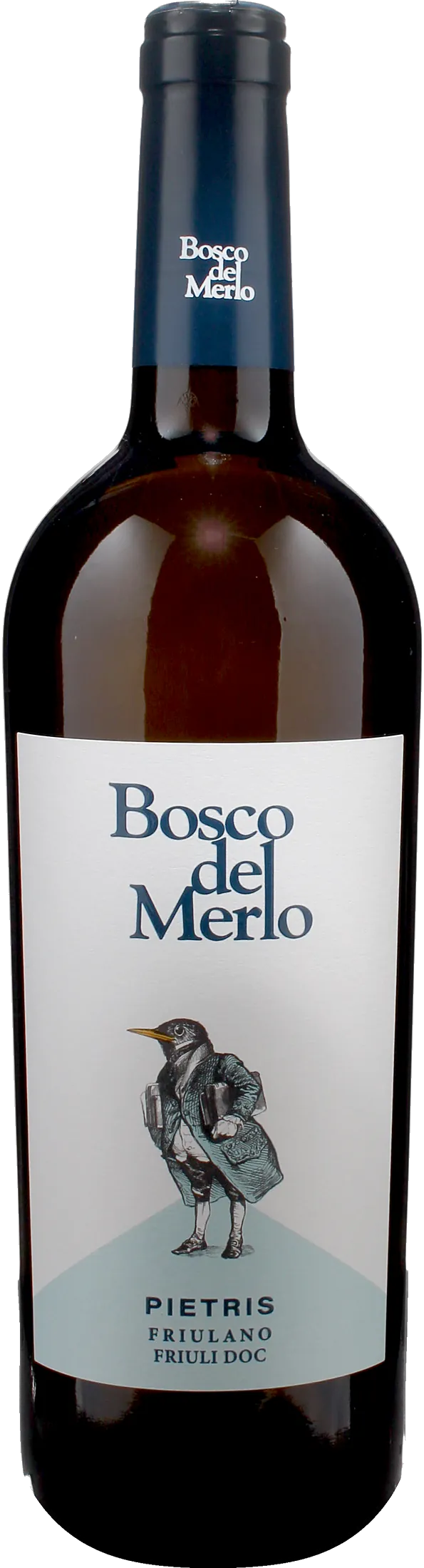
Friulano Pietris 2025
| Denomination | DOC Friuli Friulano |
|---|---|
| Size | 0,75 l |
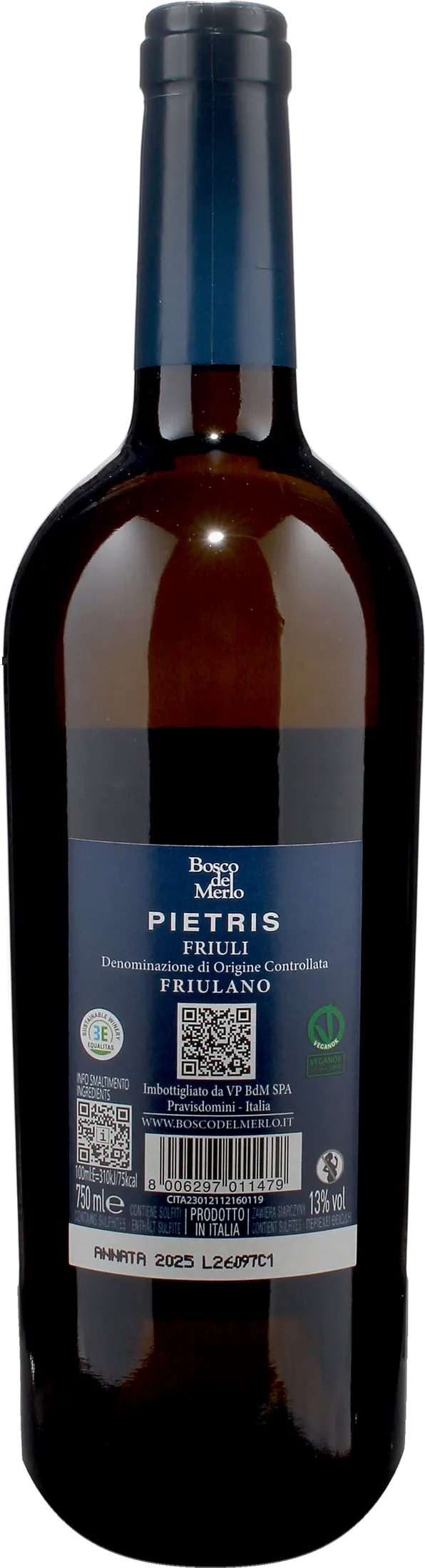
| Alcohol content | 13.0% by volume |
| Area | Friuli-Venezia Giulia (Italy) |
| Grape varieties | 100% Friulano/Sauvignon Vert |
| Aging | Ageing on its own lees for 4 months in stainless steel, with bâtonnage. |
- Type and grape variety: Still white wine Friuli DOC from Friulano grapes, 2025 harvest
- Aroma: Notes of peach, apple and white flowers with light vegetal and herbaceous nuances
- Taste: Dry, fresh, savoury and balanced, with a characteristic bitter almond aftertaste
- Territory: Vineyards at 270m in Sequals, gravelly soils, Alpine climate and diurnal temperature range
- Winemaking: Aged in steel for 4 months; vegan wine, 95 points from Luca Maroni
Description
What type of wine it is
Friulano Pietris by Bosco del Merlo is a still white wine with the Friuli designation. Made from Friulano grapes, also known as Sauvignon Vert, this vegan wine is fermented in steel and presents a bright yellow colour with greenish highlights. The aromatic profile reveals hints of peach, yellow apple and white flowers, enriched by light vegetal notes. On the palate, it proves fresh and savoury, with a balanced structure leading to a persistent bitter almond finish.
Where it comes from
The vineyards grow in Sequals, in Friuli-Venezia Giulia, at an altitude of two hundred and seventy metres. The soil has a morainic origin and is rich in local stones called claps. These reflect daytime heat and encourage a significant night-time temperature range. The climate, influenced by the Alps, allows for balanced ripening of the grapes. These soil and climate conditions give the wine a vibrant mineral freshness and a clear varietal identity.
How it is produced
Vinification begins with a soft pressing to extract only the free-run must. After decanting, fermentation takes place in temperature-controlled steel tanks to preserve the grape variety's aromas. This is followed by four months of ageing on the lees, also in steel. During this phase, bâtonnage is carried out, a technique that gives the wine greater roundness and structural complexity, while keeping its clear taste expression intact.
History and curiosities
The name Pietris, which in Friulian means "stones", pays homage to the "claps", the morainic pebbles of Sequals that reflect heat, encouraging nocturnal temperature variations. At an altitude of 270 metres, the elegant Friuli DOC Bosco del Merlo comes to life, an authentic vegan and sustainable expression of the Friulano grape, also known as Sauvignon Vert. The 2025 vintage, awarded 95 points by Luca Maroni, translates the identity of this rocky territory into a wine of absolute excellence.
Tasting notes
Perfume
Color
Taste
Serve at:
10 - 12 °C
Longevity:
03 - 05 years
- Start up year: 1988
- Oenologist: Antonio Lucarelli
- Bottles produced: 880.000
- Hectares: 70
The Bosco del Merlo estate winery started up in 1977 in Annone Veneto, founded by siblings Carlo, Lucia and Roberto Paladin. Thanks to a profitable collaboration with the Istituto Sperimentale per la Viticoltura di Conegliano, a careful and modern zoning technique was immediately implemented in order to get the best out of the terroir, working the vineyard piece by piece. In the nineties, in the small town of Lison di Portogruaro, the cradle of viticulture in this wine-making region, a further 50 hectares of land was acquired, which therefore doubled capacity, increasing it to around 100 hectares in total.
Over the course of the years Bosco del Merlo has benefited from the advice of famous oenologists and experts from the Faculties of Oenology and Agriculture in Padua and Milan, such as Franco Bernabei and Leonardo Valenti, in its quest to find the most forward-thinking solutions for achieving optimal quality with the lowest environmental impact. Read more


| Name | Bosco del Merlo Friulano Pietris 2025 |
|---|---|
| Type | White green still |
| Denomination | Friuli DOC |
| Vintage | 2025 |
| Size | 0,75 l |
| Alcohol content | 13.0% by volume |
| Grape varieties | 100% Friulano/Sauvignon Vert |
| Country | Italy |
| Region | Friuli-Venezia Giulia |
| Vendor | Bosco del Merlo |
| Story | History and curiosities The name Pietris, which in Friulian means "stones", pays homage to the "claps", the morainic pebbles of Sequals that reflect heat, encouraging nocturnal temperature variations. At an altitude of 270 metres, the elegant Friuli DOC Bosco del Merlo comes to life, an authentic vegan and sustainable expression of the Friulano grape, also known as Sauvignon Vert. The 2025 vintage, awarded 95 points by Luca Maroni, translates the identity of this rocky territory into a wine of absolute excellence. |
| Origin | Sequals, Friuli-Venezia Giulia, Italy |
| Climate | influenced by the Alps |
| Soil composition | Soil rich in pebbles and stones |
| Fermentation temperature | 16–18 °C |
| Production technique | Soft pressing to obtain the free-run must with static settling; fermentation in stainless steel tanks at a controlled temperature (16–18 °C); ageing on the lees in steel for 4 months with bâtonnage. |
| Wine making | The grapes are carefully harvested and gently pressed to obtain the free-run juice; static settling follows. The clarified must ferments in stainless steel tanks at a controlled temperature (16–18 °C). The wine then matures on its lees for four months, also in stainless steel, with bâtonnage. |
| Aging | Ageing on its own lees for 4 months in stainless steel, with bâtonnage. |
| Allergens | Contains sulphites |