


Paolo Leo
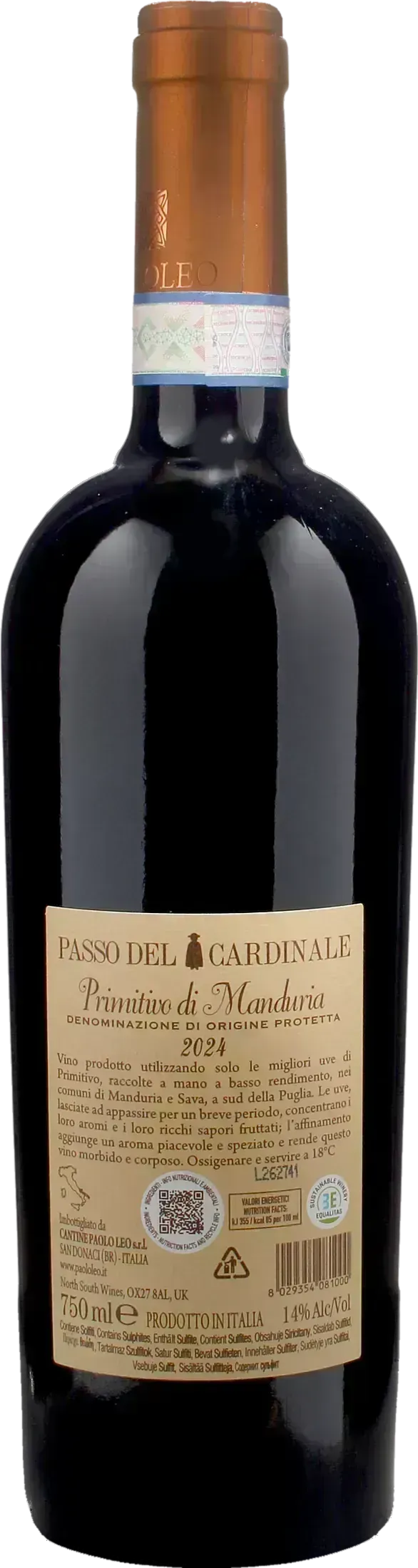
Primitivo Manduria Passo del Cardinale 2024
| Denomination | DOC Primitivo di Manduria |
|---|---|
| Size | 0,75 l |
| Alcohol content | 14.0% by volume |
| Area | Apulia (Italy) |
| Grape varieties | 100% Primitivo |
| Aging | 3 months in American oak barriques and 6 months in stainless steel. |
- Origin: Primitivo di Manduria DOC, from vineyards in Manduria and Sava in Apulia
- Old vines: Puglian Alberello over 40 years old on sandy soils, with low yields
- Maturation: Fermented at 25 °C; aged for 3 months in barrique and 6 months in stainless steel
- Aromas and flavours: Notes of blackcurrant and jam, liquorice and coffee; soft and silky tannins
- Serving: Ideal with grilled meats and mature cheeses; decant for 1 hour

Description
What kind of wine it is
Passo del Cardinale by Paolo Leo is a still red wine made from Primitivo grapes from the Puglia region. This label, belonging to the prestigious Primitivo di Manduria Denominazione di Origine Controllata (DOC), elegantly expresses the potential of its territory. It presents itself as a structured and complex wine, with a bold and full flavour profile, supported by silky tannins and a lively freshness. The production involves meticulous fermentation in stainless steel followed by a measured rest in wood, resulting in a long finish rich in spicy and toasted notes.
Where it comes from
The grapes originate in the rural area of the municipalities of Manduria and Sava, in the province of Taranto. In this territory, the abundant sunshine and constant sea breezes create an ideal microclimate for the ripening of the bunches. The roots delve into sandy soils that are deeply rich in minerals, where forty-year-old vines are grown using the traditional Puglian bush-vine (alberello) system. These historic vines guarantee low yields, encouraging a high concentration of flavours. The early ripening of the grape variety also allows for a singular second production shortly after the main harvest, whose fruits provide natural freshness to the musts.
How it is produced
Production begins with a manual harvest conducted in the early hours of the morning, seeking a slight over-ripeness to maximise the aromatic intensity of the bunches. After careful de-stemming, the crushed grapes ferment in steel at a controlled temperature for approximately ten days. This is followed by attentive maceration on the skins for over two weeks, designed to gently and optimally extract the chromatic and structural components. The wine then matures for three months in American oak barrels, which enrich its profile, and completes its refinement by resting for a further six months in steel.
History and interesting facts
Primitivo is an ancient grape variety grown in Puglia, known for its very early ripening. A unique feature of this variety is its ability to provide a second production just 20 days after the main harvest. The fruits of this second harvest are traditionally used to give greater freshness and balance the acidity of the musts from the first harvest. The grapes for Primitivo di Manduria DOC come from historic Apulian 'alberello' (head-trained) vines, grown on sandy soils in the Manduria and Sava areas.
Tasting notes

Perfume

Color

Taste
Serve at:
18 - 20 °C
Longevity:
05 - 10 years
Decanting time:
1 hour

- Start up year: 1989
- Oenologist: Nicola Leo
- Bottles produced: 5.000.000
- Hectares: 70
Today he is still an heir, the namesake Paolo Leo, son of Nicola, to lead the new winery, together with his wife Roberta and his eldest sons Nicola and Stefano, who are paving the way for the younger brothers Francesco and Alessandro. Read more


| Name | Paolo Leo Primitivo Manduria Passo del Cardinale 2024 |
|---|---|
| Type | Red green still |
| Denomination | Primitivo di Manduria DOC |
| Vintage | 2024 |
| Size | 0,75 l |
| Alcohol content | 14.0% by volume |
| Grape varieties | 100% Primitivo |
| Country | Italy |
| Region | Apulia |
| Vendor | Paolo Leo |
| Story | History and interesting facts Primitivo is an ancient grape variety grown in Puglia, known for its very early ripening. A unique feature of this variety is its ability to provide a second production just 20 days after the main harvest. The fruits of this second harvest are traditionally used to give greater freshness and balance the acidity of the musts from the first harvest. The grapes for Primitivo di Manduria DOC come from historic Apulian 'alberello' (head-trained) vines, grown on sandy soils in the Manduria and Sava areas. |
| Origin | Rural area of the municipalities of Manduria and Sava, in the province of Taranto |
| Soil composition | Sandy |
| Cultivation system | Traditional 40-year-old Apulian bush vine, short-pruned with two-bud spurs. |
| Plants per hectare | 4,000 to 4,500 |
| Yield per hectare | Approximately 1.2 kg of grapes per plant. |
| Harvest | The harvest is carried out in the early hours of the morning at cool temperatures to preserve the typical characteristics of the grape variety. |
| Fermentation temperature | 25 degrees Celsius |
| Fermentation | 8 0 days |
| Production technique | Traditional method |
| Wine making | After harvesting, the grapes are destemmed; the crushed grapes ferment in steel tanks at a controlled temperature of 25 °C for 8–10 days. Skin maceration lasts for 15–18 days to optimise the delicate extraction of tannins and anthocyanins. |
| Aging | 3 months in American oak barriques and 6 months in stainless steel. |
| Allergens | Contains sulphites |