


Cantina Mesa
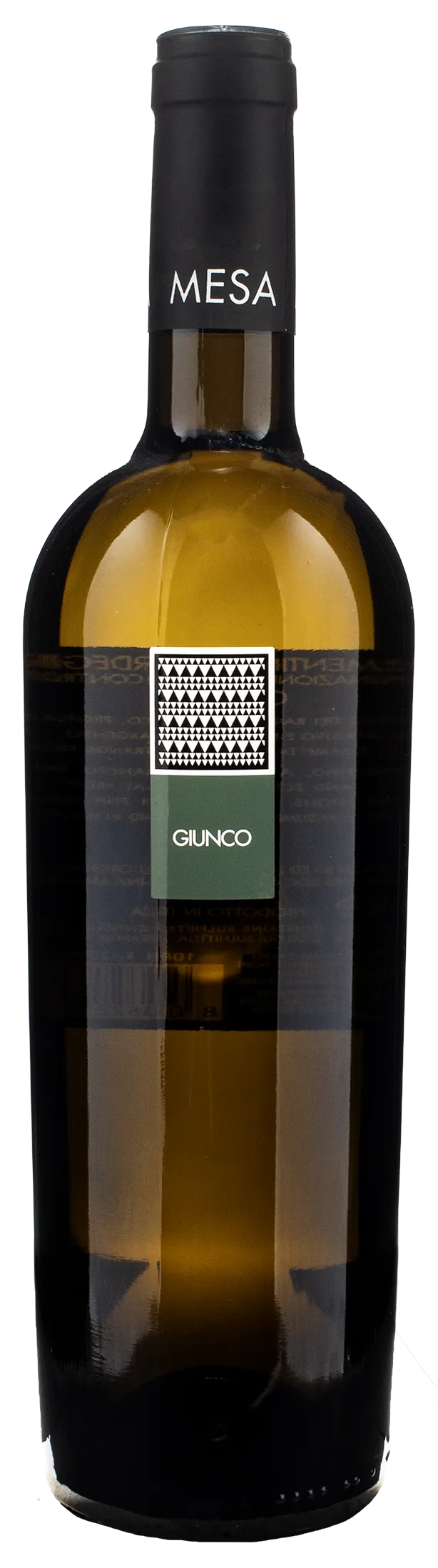
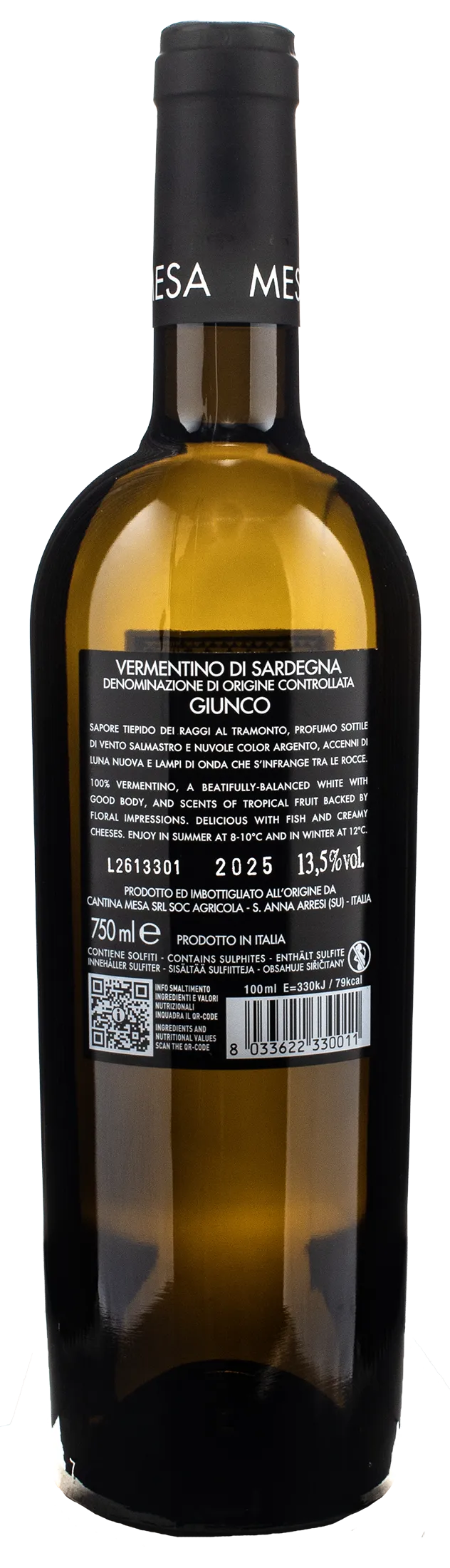
Vermentino di Sardegna Giunco 2025
| Denomination | DOC Vermentino di Sardegna |
|---|---|
| Size | 0,75 l |
| Alcohol content | 13.5% by volume |
| Area | Sardinia (Italy) |
| Grape varieties | 100% Vermentino |
| Aging | The wine remains on the fine lees for at least four months, followed by bottle ageing for at least one month prior to release; some batches may undergo further ageing in new French oak barriques and subsequent maturation in the bottle. |
- Appellation: Vermentino di Sardegna DOC, 100% Vermentino, 2025
- Aromas: Notes of citrus, white fruit, Mediterranean herbs and hints of iodine
- Palate: Dry, fresh and savoury, with distinct minerality and a lively finish
- Vinification: At 15-18°C, aged for 4 months on fine lees and 1 in the bottle
- Specifications: 750 ml, 13.5% vol., served at 8-10°C with fish soups
Description
What type of wine it is
Giunco Vermentino di Sardegna by Mesa is a still white wine with a Denominazione di Origine Controllata (DOC) status, aged on fine lees and partly in oak barrels, which interprets the Vermentino grape variety with extreme clarity. In the glass, it reveals a dry style and a distinct saline character, offering an elegant and mineral profile. The bouquet releases aromas of citrus and tropical fruit, intertwined with clear balsamic notes and hints of iodine. On the palate, it is snappy and enveloping, providing a lively dynamic that closes with a crisp finish, ideal for pairing with seafood soups, shellfish, and creamy cheeses.
Where it comes from
The grapes grow in Sulcis, at the south-western tip of Sardinia, near Sant’Anna Arresi. This coastal territory is marked by its proximity to the sea and constant exposure to the Mistral wind, elements that give the harvest an unmistakable savoury character. The Mediterranean climate, characterised by hot summers and low rainfall, combines with soils rich in alluvial deposits and wind-blown sandstones. The subsoil, enriched with active limestone and a significant mineral component, proves essential for enhancing aromatic precision and supporting the gustatory freshness of the grapes.
How it is produced
The grapes are harvested by hand between late August and early September. After preliminary cooling and soft pressing, the must cold-decants for forty-eight hours, starting fermentation at a controlled temperature. The wine then ages on fine lees for approximately four months, acquiring structure and cleanliness. Selected batches rest in French oak barrels before completing their journey with a final maturation. The entire process is aimed at preserving the dynamism of each sip, enhancing its aromatic elegance without ever altering its balance.
History and curiosities
Founded in 2004 from the intuition of the famous Sardinian advertiser Gavino Sanna, Cantina Mesa was born as a celebration of a deep love for Sardinia. The name itself, which means “table” in Spanish, enhances the value of conviviality and authentic hospitality. Embellished with a minimal label inspired by traditional Sardinian fabrics, Giunco reflects the truest soul of Sulcis Iglesiente. This Vermentino comes to life in this evocative territory near Sant’Anna Arresi, amidst sea breezes and salty winds.
Tasting notes
Perfume

Color

Taste
Serve at:
12 - 14 °C
Longevity:
03 - 05 years
- Start up year: 2004
- Oenologist: Stefano Cova
- Bottles produced: 650.000
- Hectares: 73
In these valleys, characterised by sandy soils, wines of great character and luminosity are born, starting with the most typical grape varieties of the area: Carignano, Cannonau and Vermentino. In the heart of Sulcis, Cantina Mesa now has 73 hectares under vine - 66 of which are its own - where the vines are trained to the head-training or spurred cordon system.
The winery is in the village of Sant'Anna Arresi, the right place to create an ideal contrast with the terroir to create wines in all their nuances. This village is a candid, unusual and minimalist structure, surrounded by gentle hillsides and silhouetted amidst the green Mediterranean scrub.
Then, the winery is about 5,000 square metres, spread over three levels and arranged so that grapes and wine can be treated with the utmost respect and special care: no mechanical pumps, therefore, but movements that take place through the principle of "natural fall". Lastly, the ageing process is carried out in the basement of the cellar. This is how all the wines labelled Mesa are born, with names loaded with meaning such as "Buio", "Giunco", "Buio Buio" and "Opale", to continue with all the others. Territorial, integral, punctual and precise wines are the faithful expression of a region that is second to none when it comes to wine. Read more


| Name | Mesa Vermentino di Sardegna Giunco 2025 |
|---|---|
| Type | White still |
| Denomination | Vermentino di Sardegna DOC |
| Vintage | 2025 |
| Size | 0,75 l |
| Alcohol content | 13.5% by volume |
| Grape varieties | 100% Vermentino |
| Country | Italy |
| Region | Sardinia |
| Vendor | Cantina Mesa |
| Story | History and curiosities Founded in 2004 from the intuition of the famous Sardinian advertiser Gavino Sanna, Cantina Mesa was born as a celebration of a deep love for Sardinia. The name itself, which means "table" in Spanish, enhances the value of conviviality and authentic hospitality. Embellished with a minimal label inspired by traditional Sardinian fabrics, Giunco reflects the truest soul of Sulcis Iglesiente. This Vermentino comes to life in this evocative territory near Sant’Anna Arresi, amidst sea breezes and salty winds. |
| Origin | The Sulcis territory, in the far south-west of Sardinia |
| Climate | Mediterranean, with scarce and irregular rainfall concentrated mainly in autumn and winter, frequent Mistral winds, hot summers and winters varying between dry cold and mild. |
| Soil composition | Alluvial deposits and cemented aeolian sandstones with a sandy-clay texture (Pleistocene origin); sub-alkaline, well-structured soils with a good presence of rock fragments and high levels of calcium, magnesium and potassium. |
| Cultivation system | Guyot |
| Yield per hectare | 90 quintals per hectare |
| Harvest | Manual harvesting in 20 kg crates between the end of August and the beginning of September |
| Fermentation temperature | 15 to 18 °C |
| Production technique | Cooling of the grapes before destemming, gentle pressing, cold settling of the must for 48 hours, fermentation at 15–18 °C, ageing on the fine lees (at least 4 months) and in bottle (at least 1 month); some batches with further ageing in new French oak barriques. |
| Wine making | The grapes are chilled to 10 °C prior to destemming and gentle pressing. The first fractions of the must are cold-settled for 48 hours, then undergo fermentation and are maintained between 15 and 18 °C. The wine rests on the fine lees for at least 4 months, followed by bottle ageing for at least 1 month before release; some batches may undergo further ageing in new French oak barriques and subsequent bottle maturation. |
| Aging | The wine remains on the fine lees for at least four months, followed by bottle ageing for at least one month prior to release; some batches may undergo further ageing in new French oak barriques and subsequent maturation in the bottle. |
| Allergens | Contains sulphites |