


Cantina Mesa
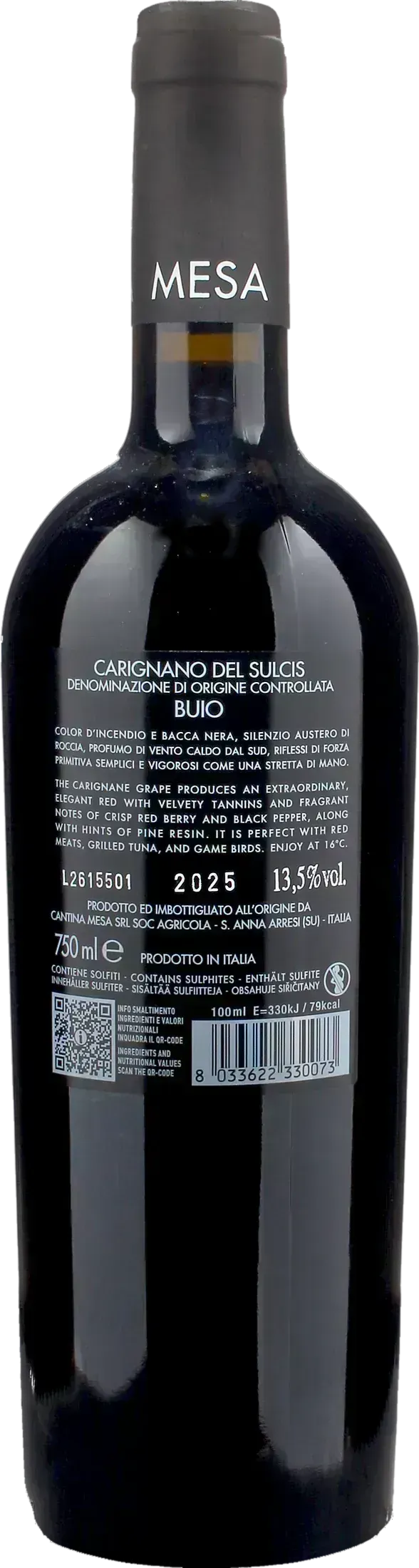
Carignano del Sulcis Buio 2025
| Denomination | DOC Carignano del Sulcis Rosso |
|---|---|
| Size | 0,75 l |
| Alcohol content | 13.5% by volume |
| Area | Sardinia (Italy) |
| Grape varieties | 100% Carignano |
| Aging | Ageing for at least 6 months in concrete and/or steel tanks, followed by a minimum of 2 months of resting in the bottle. |
- Type: Still red wine Sulcis DOC, 100% Carignano, 13.5% vol.
- Nose: Ripe red fruit, geranium, black pepper and mineral notes.
- Palate: Soft and enveloping, sweet tannins and a long balsamic finish.
- Vinification: 8 days of maceration at 26°C, ageing in concrete/steel for 6 months.
- Service and pairings: Excellent with grilled meats and pecorino cheese at 16-20°C.

Description
Wine style
Buio by Cantina Mesa is a still red wine that expresses the character of the Carignano grape variety in south-western Sardinia. Recognised under the Carignano del Sulcis designation, it presents a fresh, smooth and easy-drinking style, with a savoury entry and an enveloping texture. The aromatic profile is distinguished by clear notes of ripe red fruit, geranium and hints of black pepper. On the palate, it reveals well-integrated tannins and a pleasant acidic freshness, leading towards a persistent finish with balsamic echoes. The careful vinification with ageing in concrete and steel enhances these peculiarities, naturally introducing the strong bond with its land of origin.
Origin
This red is born in the Sulcis territory, located in the far south-western tip of Sardinia. The geographical environment is dominated by a Mediterranean climate, characterised by hot summers constantly mitigated by the Mistral wind and low winter rainfall. The Carignano vines grow on sandy and calcareous-clay soils, very rich in stones and precious mineral components. This specific combination of marine ventilation and the physical characteristics of the soil allows the bunches to reach ideal phenolic ripeness, guaranteeing the wine a solid structure while preserving its typical aromatic clarity.
How it is produced
Production starts with the manual harvesting of the grapes, which are subsequently destemmed and softly crushed. To avoid mechanical stress and preserve the integrity of the raw material, the winery strictly adopts gravity-flow movement. Alcoholic fermentation takes place at a controlled temperature, accompanied by maceration on the skins for about eight days, a fundamental phase for the extraction of colour and tannins. After malolactic fermentation, which softens the structure, the wine continues with ageing in concrete and steel tanks for at least six months. The cycle concludes with resting in the bottle for a minimum of two months to stabilise the organoleptic profile.
History and interesting facts
Originating from the south-western tip of Sardinia, Mesa Buio expresses the profound encounter between the Carignano grape and the vision of Cantina Mesa. Founded in 2004 thanks to the intuition of Gavino Sanna, this estate represents the essence of Sulcis, making the most of a Mediterranean climate and sandy soils rich in stony fragments. Guided by oenologist Stefano Cova, the winery adopts traditional methods that avoid the use of mechanical pumps, preferring gentle gravity-fed processes to safeguard the identity of the fruit. A sincere tribute to the Sardinian territory.
Tasting notes

Perlage

Perfume

Color

Taste
Serve at:
14 -16 °C
Longevity:
05 - 10 years
Decanting time:
1 hour
- Start up year: 2004
- Oenologist: Stefano Cova
- Bottles produced: 650.000
- Hectares: 73
In these valleys, characterised by sandy soils, wines of great character and luminosity are born, starting with the most typical grape varieties of the area: Carignano, Cannonau and Vermentino. In the heart of Sulcis, Cantina Mesa now has 73 hectares under vine - 66 of which are its own - where the vines are trained to the head-training or spurred cordon system.
The winery is in the village of Sant'Anna Arresi, the right place to create an ideal contrast with the terroir to create wines in all their nuances. This village is a candid, unusual and minimalist structure, surrounded by gentle hillsides and silhouetted amidst the green Mediterranean scrub.
Then, the winery is about 5,000 square metres, spread over three levels and arranged so that grapes and wine can be treated with the utmost respect and special care: no mechanical pumps, therefore, but movements that take place through the principle of "natural fall". Lastly, the ageing process is carried out in the basement of the cellar. This is how all the wines labelled Mesa are born, with names loaded with meaning such as "Buio", "Giunco", "Buio Buio" and "Opale", to continue with all the others. Territorial, integral, punctual and precise wines are the faithful expression of a region that is second to none when it comes to wine. Read more


| Name | Mesa Carignano del Sulcis Buio 2025 |
|---|---|
| Type | Red still |
| Denomination | Carignano del Sulcis DOC |
| Vintage | 2025 |
| Size | 0,75 l |
| Alcohol content | 13.5% by volume |
| Grape varieties | 100% Carignano |
| Country | Italy |
| Region | Sardinia |
| Vendor | Cantina Mesa |
| Story | History and interesting facts Originating from the south-western tip of Sardinia, Mesa Buio expresses the profound encounter between the Carignano grape and the vision of Cantina Mesa. Founded in 2004 thanks to the intuition of Gavino Sanna, this estate represents the essence of Sulcis, making the most of a Mediterranean climate and sandy soils rich in stony fragments. Guided by oenologist Stefano Cova, the winery adopts traditional methods that avoid the use of mechanical pumps, preferring gentle gravity-fed processes to safeguard the identity of the fruit. A sincere tribute to the Sardinian territory. |
| Origin | Sulcis territory, at the south-western tip of Sardinia. |
| Climate | Mediterranean |
| Soil composition | Sandy and calcareous-clay, rich in stones |
| Cultivation system | Vertical trellis with spur pruning (spurred cordon) |
| Yield per hectare | 70–80 quintals per hectare |
| Fermentation temperature | Approximately 26 °C |
| Fermentation | 8 days |
| Production technique | Gravity-fed handling; maceration/fermentation on the skins at a controlled temperature; malolactic fermentation; ageing in concrete (and/or stainless steel) tanks and resting in the bottle |
| Wine making | Destemmed and lightly crushed grapes, transferred to vats by natural gravity; maceration/fermentation on the skins for 8 days at a controlled temperature (approximately 26 °C). Once malolactic fermentation is complete, ageing for at least 6 months in tanks (concrete and/or steel) followed by a minimum of 2 months of resting in the bottle. |
| Aging | Ageing for at least 6 months in concrete and/or steel tanks, followed by a minimum of 2 months of resting in the bottle. |
| Allergens | Contains sulphites |