


Fritz Haag
Brauneberger Juffer Kabinett 2025
| Denomination | N/A |
|---|---|
| Size | 0,75 l |
| Alcohol content | 8.5% by volume |
| Area | Mosel-Saar-Ruwer (Germany) |
| Grape varieties | 100% Riesling |
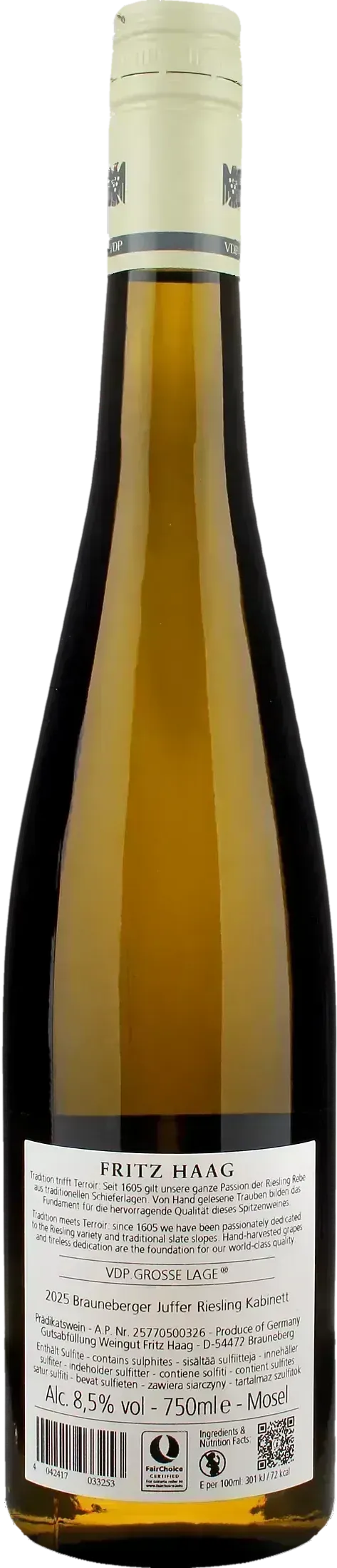
- Kabinett style: off-dry still white Riesling wine (8.5%), fresh and precise
- Moselle Terroir: grapes from the Juffer vineyard on slate, with typical smoky minerality
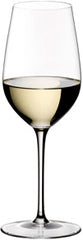
- Profile: straw yellow; notes of white flowers, apricot and yellow apple
- Organic method: vinification in stainless steel and bottling in a protective atmosphere
- Pairings and storage: ideal with fish, white meats and cheeses; can be cellared until 2036

Description
What type of wine it is
The Fritz Haag Brauneberger Juffer Kabinett Riesling from the Fritz Haag winery is a semi-aromatic still white wine, made from Riesling grapes grown in the Mosel. Classified as Kabinett, it is distinguished by its off-dry and light style, capable of offering a perfect harmony between residual sweetness and citrus freshness. In the glass, it is straw yellow with greenish highlights, revealing a juicy, elegant profile with distinct minerality. Vinified exclusively in stainless steel, it offers a pleasant and balanced profile that perfectly introduces its territory of origin.
Where it comes from
This wine comes from the famous vineyards of the Mosel, Germany, and is the exclusive product of the renowned Brauneberger Juffer vineyard. The area is characterised by soil dominated by Mosel slate, a geological element that unequivocally defines the wine's character. The vines sink their roots into these rocks, translating in the glass into a refined mineral signature enriched by delicate smoky nuances. This unique terroir gives the grapes an unmistakable aromatic precision, enhancing clear scents of white flowers, apricot and yellow apple.
How it is produced
The production of this white wine is based on the principles of organic and sustainable agriculture, respecting the natural balance of the plant until the harvest. In the cellar, vinification preserves the purity and energy of the fruit. Fermentation and ageing take place solely in stainless steel tanks, a technique aimed at enhancing the freshness of the grape variety without external interference. The process concludes with bottling in a protective atmosphere, ensuring perfect evolution over time to accompany fish-based dishes, white meats and elegant cheeses.
Awards
-
2025
 94
/100
James Suckling is an influential American wine critic and journalist who worked at Wine Spectator for 30 years. He left the magazine in 2010 to start his own website and guidebook (JamesSuckling.com). He specialises in Italian and Bordeaux wines.
-
2025
 92
/100
Vinous is the online guide from Antonio Galloni, one of the world's leading wine connoisseurs.
Tasting notes
Perfume
Color
Taste
Serve at:
10 - 12 °C
Longevity:
Over 25 years
After a stay at Mont du Toit in South Africa (the project was managed by Bernd Philippi and Bernhard Breuer) he joined the Wegeler family vineyard in Oestrich-Winkel. There, he ran the vineyard as manager for five years before returning to the Mosel in 2005, in order to take over as successor to the traditional vineyard of Fritz Haag.
Oliver Haag will continue the philosophy of his father, which is the production of fine, fruity, delicate Mosel Rieslings of unmistakable character. His father, Wilhelm Haag was born in 1937. In 1957 he interrupted his education abroad and returned home early because his father, Fritz was ill. He only planned to stay for the harvest but it developed into a life of winegrowing until the vineyard was handed over to the next generation.
With ambition and the knowledge that there were very large locations available, the philosophy also developed that the target can only be achieved through quality. Great vintages in 1959, 1964, 1969, 1971, 1976, 1983, 1985, 1990, 1992, 1993 and 1994 followed, to mention but a few. His work and success proved him right: Wilhelm Haag was awarded "Winegrower of the year 1994" for his achievements. His success naturally reinforced that striving for quality and brought the vineyard an outstanding, worldwide reputation as a Riesling producer. Read more


| Name | Fritz Haag Brauneberger Juffer Kabinett Riesling 2025 |
|---|---|
| Type | White green still medium sweet semi-aromatic |
| Denomination | N/A |
| Vintage | 2025 |
| Size | 0,75 l |
| Alcohol content | 8.5% by volume |
| Grape varieties | 100% Riesling |
| Country | Germany |
| Region | Mosel-Saar-Ruwer |
| Vendor | Fritz Haag |
| Origin | Brauneberger Juffer Vineyard, Moselle-Saar-Ruwer, Germany |
| Soil composition | Moselle slate |
| Cultivation system | Screw cap |
| Production technique | Vinification only in stainless steel; bottled in a protective atmosphere |
| Wine making | Vinification exclusively in steel (stainless steel only) |
| Allergens | Contains sulphites |