


Franz Haas
Pinot Bianco Lepus 2024
| Denomination | DOC Alto Adige Pinot Bianco |
|---|---|
| Size | 0,75 l |
| Alcohol content | 13.5% by volume |
| Area | Trentino Alto Adige (Italy) |
| Grape varieties | 100% Pinot Bianco |
| Aging | Before bottling, the wine remains on the lees for about 5 months in order to acquire complexity and fullness. |
- Grape variety and vintage: 100% Pinot Blanc, harvested in 2024, still white wine
- Origin Alto Adige DOC: mountain vineyards between 400 and 800 metres, south and south-west exposure
- Vinification: gentle pressing, fermentation in stainless steel and small oak barrels
- Sensory profile: notes of apple, pear, citrus, wildflowers and bread crust, persistent finish
- Pairings: 12-14 °C, ideal with fish, first courses, Asian cuisine, curry and cheeses

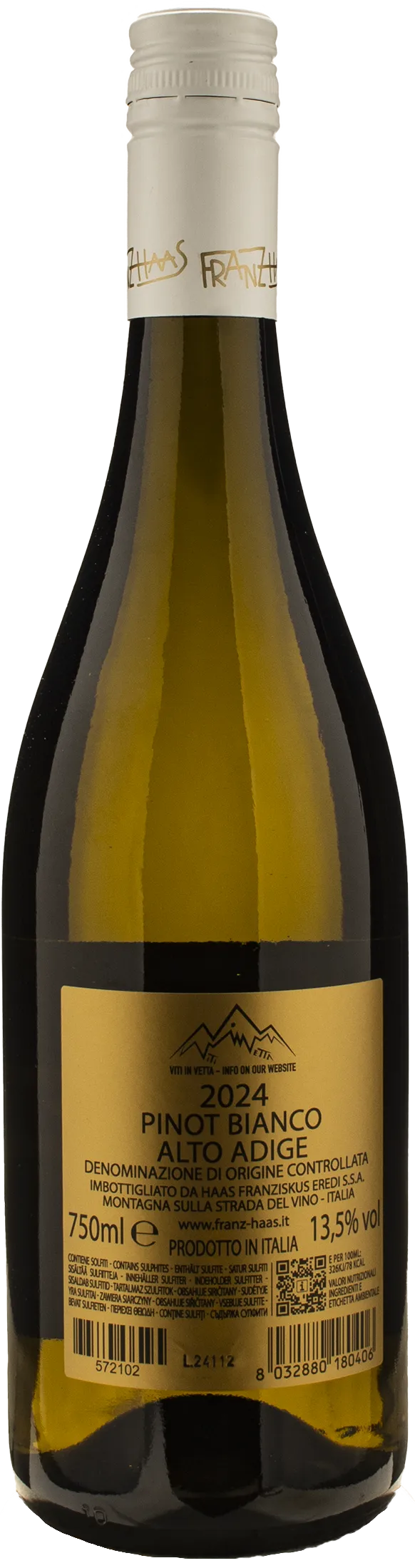
Description
What kind of wine is it
Franz Haas Pinot Bianco Lepus is a still white wine with a bright straw yellow colour, a pure expression of Pinot Bianco from Alto Adige. On the palate, it is fresh and structured, with harmonious acidity that balances a long and enveloping finish. The aromatic bouquet reveals notes of ripe apple and pear, wildflowers, citrus, bread crust and subtle spicy hints. This label, suitable for those following a vegan and vegetarian diet, pairs beautifully with Asian cuisine, spicy curries, cheeses and fish-based dishes.
Where does it come from
The grapes are grown in the hillside vineyards of Montagna, at an altitude between four hundred and eight hundred metres. This privileged position, with south and south-west exposure, ensures optimal ripening and preserves aromatic freshness. The soil ranges from light sands to structured porphyry erosion soils. This richness of soil and climate gives the wine a firm structure and deep consistency, offering a faithful expression of the terroir that enhances the purity of the alpine grape variety.
How is it produced
The process begins with a gentle pressing of the bunches. Fermentation takes place at a controlled temperature in stainless steel tanks, while part of the must matures in small oak barrels to add complexity. This is followed by ageing on the lees for about five months, which is essential for developing fullness and an elegant texture. This technique ensures a balance between freshness and body; the wine expresses itself best after a short rest in the bottle, with excellent potential for evolution over time.
History and Curiosities
The Pinot Bianco Lepus embodies the excellence of Franz Haas, a historic winery founded in 1880. This elegant Alto Adige DOC originates from the hillside vineyards of Montagna, located between 400 and 800 metres above sea level on soils ranging from sandy compositions to porphyry deposits. Under the guidance of oenologist Stefano Tiefenthaler, the estate enhances the pure essence of the grapes, creating a fine vegan wine with a strong personality: a structured white that celebrates the Alpine region with a harmonious aromatic richness.
Tasting notes

Perfume

Color

Taste
Serve at:
12 - 14 °C
Longevity:
03 - 05 years

- Start up year: 1880
- Oenologist: Stefano Tiefenthaler
- Bottles produced: 450.000
- Hectares: 60
Franz Haas is not just a winery, it is not just a brand. Franz Haas is a man, a family who has been producing wine for seven generations, and for seven generations has put into its wines the same philosophy of life: the constant and endless pursuit of perfection. Each Franz Haas with his own touch and style.
According to Franz Haas, science and calculations are indeed necessary to obtain superb wines, but it is love, passion, and determination that are essential to give them character and complexity.
It takes art, the one you have in your blood, a loving creative genius, like the one of Franz Haas VII, who today leads the winery with his team. Read more


| Name | Franz Haas Pinot Bianco Lepus 2024 |
|---|---|
| Type | White still |
| Denomination | Alto Adige DOC |
| Vintage | 2024 |
| Size | 0,75 l |
| Alcohol content | 13.5% by volume |
| Grape varieties | 100% Pinot Bianco |
| Country | Italy |
| Region | Trentino Alto Adige |
| Vendor | Franz Haas |
| Story | History and Curiosities The Pinot Bianco Lepus embodies the excellence of Franz Haas, a historic winery founded in 1880. This elegant Alto Adige DOC originates from the hillside vineyards of Montagna, located between 400 and 800 metres above sea level on soils ranging from sandy compositions to porphyry deposits. Under the guidance of oenologist Stefano Tiefenthaler, the estate enhances the pure essence of the grapes, creating a fine vegan wine with a strong personality: a structured white that celebrates the Alpine region with a harmonious aromatic richness. |
| Origin | Vineyards on the hills surrounding the village of Montagna (South Tyrol, Italy) |
| Climate | Altitude: 400-800 m a.s.l.; south to south-west exposures |
| Soil composition | From the lightest sands to the heaviest soils of porphyritic erosion |
| Cultivation system | Guyot |
| Yield per hectare | 60 hl |
| Production technique | Gently pressed grapes; temperature-controlled fermentation in stainless steel tanks with a portion in small oak barriques; ageing on the lees for about 5 months |
| Wine making | Grapes gently pressed; most of the must ferments at a controlled temperature in stainless steel tanks, with a portion fermented in small oak barriques. |
| Aging | Before bottling, the wine remains on the lees for about 5 months in order to acquire complexity and fullness. |
| Allergens | Contains sulphites |