


Feudo Principi di Butera
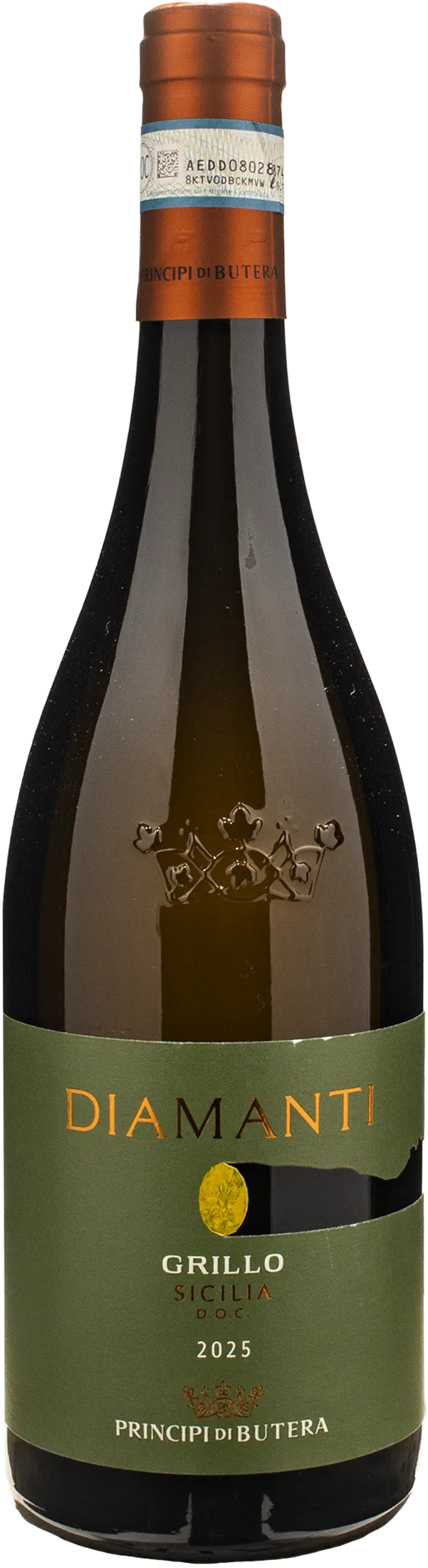
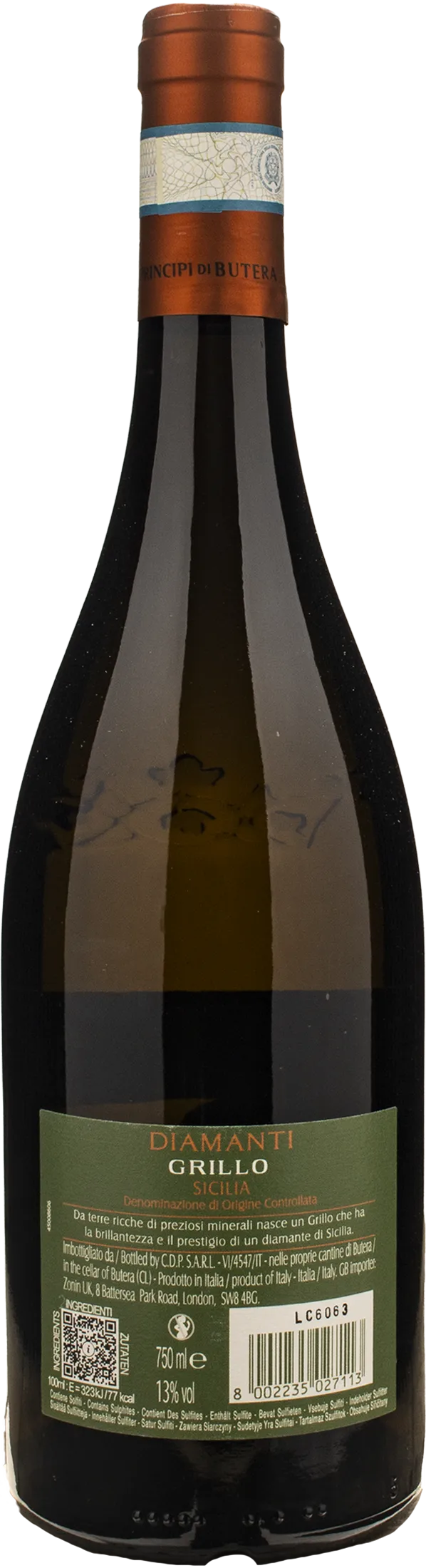
Diamanti Grillo 2025
| Denomination | DOC Sicilia Grillo |
|---|---|
| Size | 0,75 l |
| Alcohol content | 13.0% by volume |
| Area | Sicily (Italy) |
| Grape varieties | 100% Grillo |
| Aging | Aged on the lees for 4-6 months in stainless steel, followed by several months of bottle ageing. |
- Grape variety and designation: 100% Grillo, Sicilia DOC, elegant still white wine
- Aroma: notes of citrus fruits, pineapple and passion fruit, with a subtle hint of mint
- Taste: complex and harmonious structure, with citrus freshness, savouriness and minerality
- Vinification: gentle pressing, fermentation in stainless steel at 16–18 °C, matured without wood
- Pairings: ideal with lean fish, sushi and vegetarian dishes; serve at 10-12 °C
Description
What kind of wine it is
Diamanti Grillo by Principi di Butera is a still white wine with the Sicilia designation that enhances the elegance of the Grillo grape variety, vinified and matured in stainless steel. Its bright straw-yellow colour, enriched with greenish highlights, anticipates a fresh and inviting aromatic profile. On the nose, there are clear citrus notes, pineapple and passion fruit, accompanied by a delicate hint of mint. On the palate, it is harmonious, supported by a marked savouriness and a pronounced minerality that provide great balance. This vibrancy makes it the ideal companion for vegetarian dishes and recipes based on raw lean fish.
Where it comes from
The grapes grow in the Butera area, in central-southern Sicily, on coastal hills situated between 250 and 350 metres above sea level, between the Valley of the Temples and Piazza Armerina. The vineyards benefit from constant sea breezes that preserve the aromatic freshness of the grapes during ripening. The soul of the terroir lies in the distinctive "white earth" soils, which are extraordinarily rich in minerals, limestone and marine fossils. This natural synergy defines the wine's identity, giving it a distinctly savoury character and a vibrant structure that faithfully reflects the landscape of its origin.
How it is produced
Production begins with a gentle pressing of the ripe grapes, an essential step to preserve their aromatic integrity. The must undergoes fermentation in stainless steel at a controlled temperature, allowing the grape variety's characteristics to be expressed in their purest form. To refine the taste harmony, the wine rests on the fine lees for several months, avoiding any wood ageing to maintain its typical fragrance. A carefully timed maturation in the bottle completes the production cycle, blending the fruity notes with the deep mineral backbone.
History and Curiosities
The Diamanti Grillo 2025 from Feudo Principi di Butera originates on the hills of central-southern Sicily, refreshed by gentle sea breezes. Grown as a single varietal on pale soils rich in limestone and marine shells, this elegant Sicilia DOC acquires a vibrant mineral character. The name pays tribute to the clear brilliance and depth of a rare diamond, evoking the essence of an unspoilt terroir. A refined oenological narrative that encapsulates extraordinary biodiversity in a fresh, savoury and perfectly harmonious sip.
Tasting notes

Perfume

Color

Taste
Serve at:
10 - 12 °C
Longevity:
03 - 05 years
- Start up year: 1997
- Oenologist: Antonio Paolo Froio
- Bottles produced: 800.000
- Hectares: 180
The name Butera appears to have its origins in Re Bute, the first king of the Siculi, who along with the Sicani and Grek colonisers, inhabited the strategically important southern central region of Sicily which acted as the border between the three civilisations.
Saracen occupation of the island started in 854 AD and continued until their expulsion in 1089 at the hands of the Norman Roger of Altavilla. The history of the principality was then characterised by three great families in succession: the Santapau, the Bracinforte and the Lanza.
The Santapau held the Feudo Principi di Butera for two centuries before ceding it to the Bracinforte, a noble family originally from the Piacenza region. In 1543 King Philip of Spain then nominated Ambrogio Bracinforte as Lord of Feudo Principi di Butera, which remained the most important noble title in Sicily up until the 19th century. The Bracinforte dynasty became one of the most powerful in the history of Sicily and it is estimated that at the turn of the 18th century they owned what amounted to about ten percent of the entire island’s income.
The Bracinforte dynasty came to an end with marriage of Stefania Bracinforte to Guiseppe Lanza, whose union brought together into one family dozens of titles, hundreds of manor houses, thousands of hectares of land and unbound riches. In 1895 the Lanza heir was also awarded the title of Prince of Deliella.
In the previous century, the Italian Royal Family of Savoia had founded the Principality of Deliella, on the very lands which today represent the borders of the Feudo Principi di Butera
The ancient Baglio (fortified manor house) of the Feudo Principi di Butera, having been completely restored with great attention being paid to its ancient structures, has come back to life and the intense ochre colours of its walls are even more striking when they meet the incredible blues and greens of the surrounding Sicily.
The Zonin family has thus also taken on the role of custodian of the territory, convinced that they have a definite responsibility to care for and highlight the history, architecture and landscape of the island. Read more


| Name | Feudo Principi di Butera Diamanti Grillo 2025 |
|---|---|
| Type | White still |
| Denomination | Sicilia DOC |
| Vintage | 2025 |
| Size | 0,75 l |
| Alcohol content | 13.0% by volume |
| Grape varieties | 100% Grillo |
| Country | Italy |
| Region | Sicily |
| Vendor | Feudo Principi di Butera |
| Story | History and Curiosities The Diamanti Grillo 2025 from Feudo Principi di Butera originates on the hills of central-southern Sicily, refreshed by gentle sea breezes. Grown as a single varietal on pale soils rich in limestone and marine shells, this elegant Sicilia DOC acquires a vibrant mineral character. The name pays tribute to the clear brilliance and depth of a rare diamond, evoking the essence of an unspoilt terroir. A refined oenological narrative that encapsulates extraordinary biodiversity in a fresh, savoury and perfectly harmonious sip. |
| Origin | Butera, central-southern Sicily (province of Caltanissetta) |
| Climate | Mediterranean |
| Soil composition | Mineral-rich soils with limestone and seashells; white earth |
| Fermentation temperature | 16 8 °C |
| Production technique | Soft pressing; fermentation in stainless steel at controlled temperature (16 8 °C); ageing on the lees for 4-6 months; subsequent ageing in bottle (without the use of wood) |
| Wine making | Soft pressing; fermentation in stainless steel at a controlled temperature (16 8 °C); maturation/ageing on the lees for 4-6 months; subsequent bottle ageing (without the use of wood). |
| Aging | Aged on the lees for 4-6 months in stainless steel, followed by several months of bottle ageing. |
| Allergens | Contains sulphites |