


De Sousa
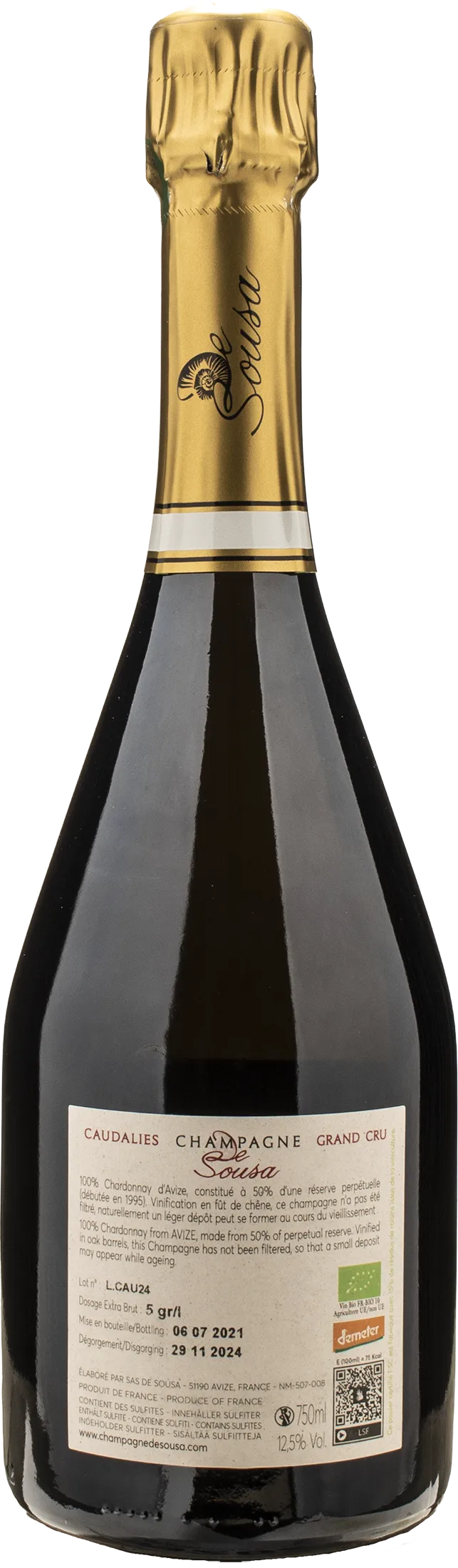
Champagne Grand Cru Blanc de Blancs Extra Brut Caudalies
| Denomination | AOC Champagne Grand Cru Blanc de Blancs Extra Brut |
|---|---|
| Size | 0,75 l |
| Alcohol content | 12.5% by volume |
| Area | Champagne region (France) |
| Grape varieties | 100% Chardonnay |
| Aging | 100% aged in oak barrels (15% new); 50% from a perpetual reserve started in 1995. |
- Grand Cru from Avize: Blanc de Blancs made exclusively from old vine Chardonnay
- Extra Brut style: very dry character, creaminess, maturity and elegance
- Mixed fermentation: use of steel and barrique, indigenous yeasts, unfiltered
- Aromas and colour: pale gold, refined notes with delicately integrated wood
- Serving and pairings: temperature 6-8 °C; ideal with caviar, turbot, shellfish and cheeses

Description
What kind of wine it is
Produced by De Sousa, the Champagne Grand Cru Blanc de Blancs Extra Brut reveals the purity of Chardonnay. Made according to the Traditional Method, it appears in the glass with a pale gold hue. On the nose, it expresses delicate scents and well-integrated woody aromas. The palate is mature and creamy, with a harmonious structure and a distinctly dry finish. Served chilled, this organic wine is ideal as an aperitif with caviar canapés, but also pairs perfectly with turbot steaks, shellfish and cheeses.
Where it comes from
This wine originates in Avize, from vineyards classified as Grand Cru. The estate covers eleven hectares divided into forty-two plots, with vines reaching up to fifty years of age. To preserve the soil, De Sousa follows the principles of organic farming, using horses for working the land instead of mechanical means. With a density of eight thousand vines per hectare, the old vines ensure low yields and a high concentration of aromas. This respectful approach is reflected in the glass, delivering the authentic essence of the terroir.
How it is produced
Vinification follows the precise rhythms of the Traditional Method. The first fermentation takes place partly in stainless steel and partly in oak barrels, thanks to the action of indigenous yeasts. Ageing is enriched by a blend from a perpetual reserve, a technique that gives the wine maturity and consistent quality. To maintain the original organoleptic properties, the wine is not filtered. The low sugar dosage ultimately defines its expressive rigour.
History and Curiosities
Born in Avize, in the heart of Champagne, the Caudalies cuvée embodies the excellence of old vines tended by the De Sousa estate. Entirely converted to organic farming, the estate works the soil with the help of horses to preserve the integrity of the terroir. The oenologist Erik De Sousa enriches this cuvée with a precious perpetual reserve started in 1995, ensuring an inimitable structure. The use of indigenous yeasts and the complete absence of filtration enhance the purity of this Grand Cru, awarded 95 points by James Suckling.
Awards
-
 93
93/100
Decanter is a wine and lifestyle magazine, published monthly in around 90 countries. The magazine includes industry news, classic guides and advice on wine and spirits.
-
 95
95/100
James Suckling is an influential American wine critic and journalist who worked at Wine Spectator for 30 years. He left the magazine in 2010 to start his own website and guidebook (JamesSuckling.com). He specialises in Italian and Bordeaux wines.
-
 93
93/100
The prestigious international wine guide from the renowned Robert Parker, the world's most experienced and trusted wine taster.
Tasting notes
Perfume

Color

Taste
Serve at:
06 - 08 °C
Longevity:
05 - 10 years
- Oenologist: Erik De Sousa
- Bottles produced: 75.000
- Hectares: 11
This is a fine and enlightened winemaker, but also a very talented winemaker, so today its about 75,000 bottles produced are currently literally fought over by enthusiasts. The De Sousa family owns 11 hectares subdivided into 42 parcels, planted with 8,000 plants / ha and with an average age of 45 years. Since 1989, Erick has started converting vines to AB (Agriculture Biologique), ending in 1999, and using the horse instead of tractors. It is, in short, a true "bio", but it is far from the slogans and, above all, it is with such skill that its champagne are neither rustic nor improbable.
In the cellar, the grapes are fermented partly in steel and partly in barrique, using only indigenous yeasts when possible. De Sousa produces an additional 30,000 bottles with the most accessible Zoémie De Sousa brand. Read more


| Name | De Sousa Champagne Grand Cru Blanc de Blancs Extra Brut Caudalies |
|---|---|
| Type | White organic classic method sparkling wine extra brut |
| Denomination | Champagne AOC |
| Size | 0,75 l |
| Alcohol content | 12.5% by volume |
| Grape varieties | 100% Chardonnay |
| Country | France |
| Region | Champagne region |
| Vendor | De Sousa |
| Story | History and Curiosities Born in Avize, in the heart of Champagne, the Caudalies cuvée embodies the excellence of old vines tended by the De Sousa estate. Entirely converted to organic farming, the estate works the soil with the help of horses to preserve the integrity of the terroir. The oenologist Erik De Sousa enriches this cuvée with a precious perpetual reserve started in 1995, ensuring an inimitable structure. The use of indigenous yeasts and the complete absence of filtration enhance the purity of this Grand Cru, awarded 95 points by James Suckling. |
| Origin | Avize (Champagne, France) |
| Plants per hectare | 8,000 plants/ha |
| Production technique | Traditional method |
| Wine making | Classic method; fermentation partly in stainless steel and partly in barriques/oak casks (about 15% new), with indigenous yeasts; no filtration. |
| Aging | 100% aged in oak barrels (15% new); 50% from a perpetual reserve started in 1995. |
| Residual sugar | 5.0 gr/L |
| Allergens | Contains sulphites |