


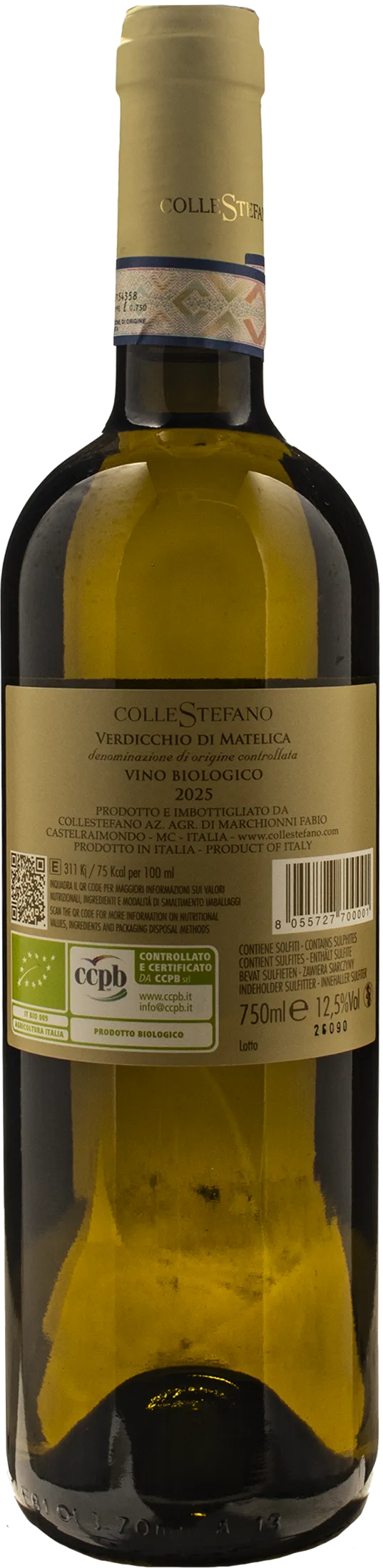
Collestefano
Verdicchio di Matelica 2025
| Denomination | DOC Verdicchio di Matelica |
|---|---|
| Size | 0,75 l |
| Alcohol content | 12.5% by volume |
| Area | Marche (Italy) |
| Grape varieties | 100% Verdicchio Bianco |
| Aging | Maturation in stainless steel on fine lees for at least 4 months (sur lie) followed by further ageing in bottle. |
- Name and variety: Verdicchio di Matelica DOC 2025, 100% Verdicchio, 12.5% vol
- Organic certification: Traced organic cultivation, grapes hand-selected in crates
- Origin: Camertina Valley 420–450 m, clay-limestone soils, temperature variation
- Vinification: Gentle pressing, low temperature fermentation, no malolactic
- Profile and pairings: 4 months on fine lees, persistent finish; excellent with sushi and seafood

Description
What kind of wine it is
Collestefano's Verdicchio di Matelica is an organic white wine with controlled designation of origin from the Marche region, matured in steel and produced from Verdicchio grapes. The bouquet harmonises aromas of white flowers, citrus fruits and green apple with subtle hints of ginger and cardamom. On the palate, it reveals a full body, balanced by a vibrant acidity and a pronounced mineral streak. The long, persistent finish evokes saline notes and hints of wild fennel, pairing perfectly with raw fish, pasta with pesto and blue cheeses.
Where it comes from
This wine originates in the Marche region, in the heart of the Camertina Valley, on the hills of Castelraimondo. The vineyards are situated at over four hundred metres above sea level and benefit from a temperate climate with a marked mountain influence. The significant temperature variation encourages slow ripening and precise aromatic definition. The medium-textured soils, characterised by a rich limestone component and a north-east exposure, are crucial in giving the wine its profound savouriness.
How it is produced
Collestefano employs viticulture based on strict organic methods. After the manual harvest, the grapes undergo gentle pressing. The free-run must ferments slowly at a controlled temperature, deliberately avoiding malolactic fermentation to preserve the fruit's integrity and energy. The winemaking process includes maturation in steel for four months on fine lees, followed by a period of bottle ageing which stabilises its purity and overall balance.
History and Curiosities
Since 1998, Fabio Marchionni has continued the winemaking tradition started by his family in the 1970s, creating a Verdicchio di Matelica DOC of undeniable elegance. This renowned label is the result of a meticulous selection of grapes, enhanced by certified traceable organic production by CCPB. Awarded 91 points by Decanter and two red glasses by Gambero Rosso, the wine offers a sip of pure dynamism that, with bottle ageing, evolves beautifully, developing greater minerality and complex tertiary notes.
Tasting notes
Perfume
Color
Taste
Serve at:
08 - 10 °C
Longevity:
03 - 05 years
- Start up year: 1998
- Bottles produced: 165.000
- Hectares: 16
The story of the Marchionni family, the owners of Collestefano, is a path of redemption. As a family of farmers, the Marchionnis arrived in the 1960s at Rustano di Castelraimondo (MC), in the valley of Verdicchio di Matelica. This hard-working family managed to acquire, in 1978, the small hillside village that has always been called "Collestefano". In 1998 Fabio Marchionni, son of the owners and fresh graduate from Oenology, bottled his first vintage of Verdicchio di Matelica. For Matelica that was the beginning of a new era.
In Collestefano we have always followed organic practices and we also gained the certification in 1995. Our vineyards are part of a broader self-sustainable, eco-friendly and balanced system. The soil is treated only with organic manure, thus minimizing the presence of copper. Read more


| Name | Collestefano Verdicchio di Matelica 2025 |
|---|---|
| Type | White organic still |
| Denomination | Verdicchio di Matelica DOC |
| Vintage | 2025 |
| Size | 0,75 l |
| Alcohol content | 12.5% by volume |
| Grape varieties | 100% Verdicchio Bianco |
| Country | Italy |
| Region | Marche |
| Vendor | Collestefano |
| Story | History and Curiosities Since 1998, Fabio Marchionni has continued the winemaking tradition started by his family in the 1970s, creating a Verdicchio di Matelica DOC of undeniable elegance. This renowned label is the result of a meticulous selection of grapes, enhanced by certified traceable organic production by CCPB. Awarded 91 points by Decanter and two red glasses by Gambero Rosso, the wine offers a sip of pure dynamism that, with bottle ageing, evolves beautifully, developing greater minerality and complex tertiary notes. |
| Origin | Valle Camertina, colline di Castelraimondo (Marche, Italia) |
| Climate | Temperate climate with mountain influence |
| Soil composition | Medium texture (sand-silt-clay) rich in limestone |
| Cultivation system | Traditional double arched cane/single and bilateral Guyot |
| Harvest | Second half of September |
| Fermentation temperature | Low temperature |
| Production technique | Organic and biodynamic farming; manual harvest in small crates with bunch selection; soft pressing; slow fermentation at low temperature in stainless steel without malolactic fermentation; maturation in stainless steel on fine lees for at least 4 months (sur lie) and bottle ageing |
| Wine making | Manual harvesting in small crates with selection of the grape bunches; gentle pressing; slow fermentation at low temperature in stainless steel without malolactic fermentation; maturation in stainless steel on fine lees for at least 4 months (sur lie); ageing in bottle. |
| Aging | Maturation in stainless steel on fine lees for at least 4 months (sur lie) followed by further ageing in bottle. |
| Total acidity | 7.5 gr/L |
| Residual sugar | 0.5 gr/L |
| Allergens | Contains sulphites |