


Kaltern Caldaro
Quintessenz Pinot Bianco 2023
| Denomination | DOC Alto Adige Pinot Bianco |
|---|---|
| Size | 0,75 l |
| Alcohol content | 13.5% by volume |
| Area | Trentino Alto Adige (Italy) |
| Grape varieties | 100% Pinot Bianco |
| Aging | In wood for 10 months, on fine lees with continuous bâtonnage; then 4 months in stainless steel on fine lees. |
- Name and variety: Alto Adige DOC, 100% Pinot Bianco, 2023 harvest
- Vinification: gentle pressing of whole bunches and spontaneous fermentation in oak barrels
- Ageing: 10–11 months on fine lees with bâtonnage, followed by 4 months in stainless steel tanks
- Aromatic profile: notes of yellow apple, melon, dried chamomile, fine herbs and graphite
- Taste characteristics: dry, creamy and savoury; pairs well with fish, poultry and fresh goat's cheese
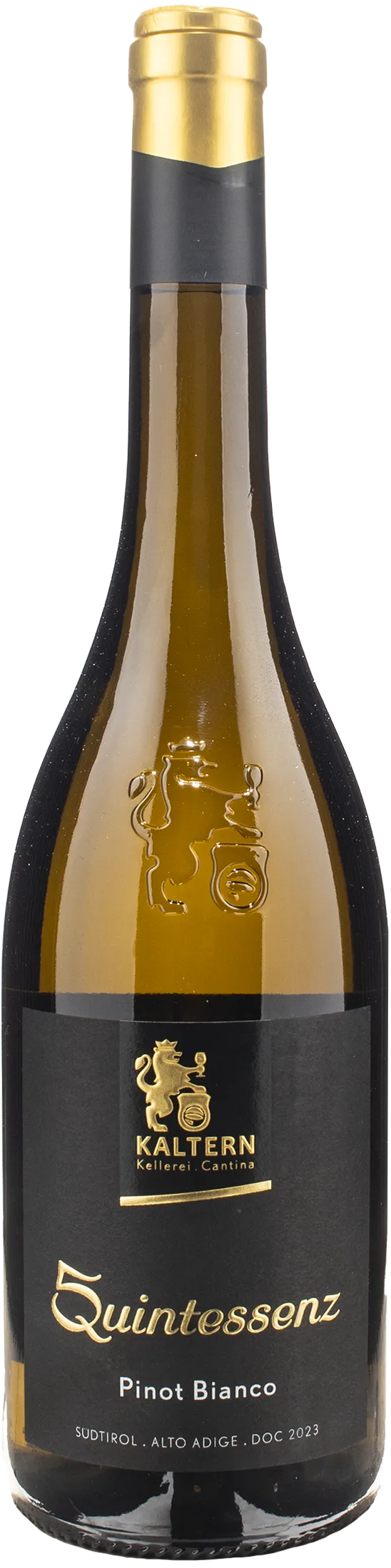
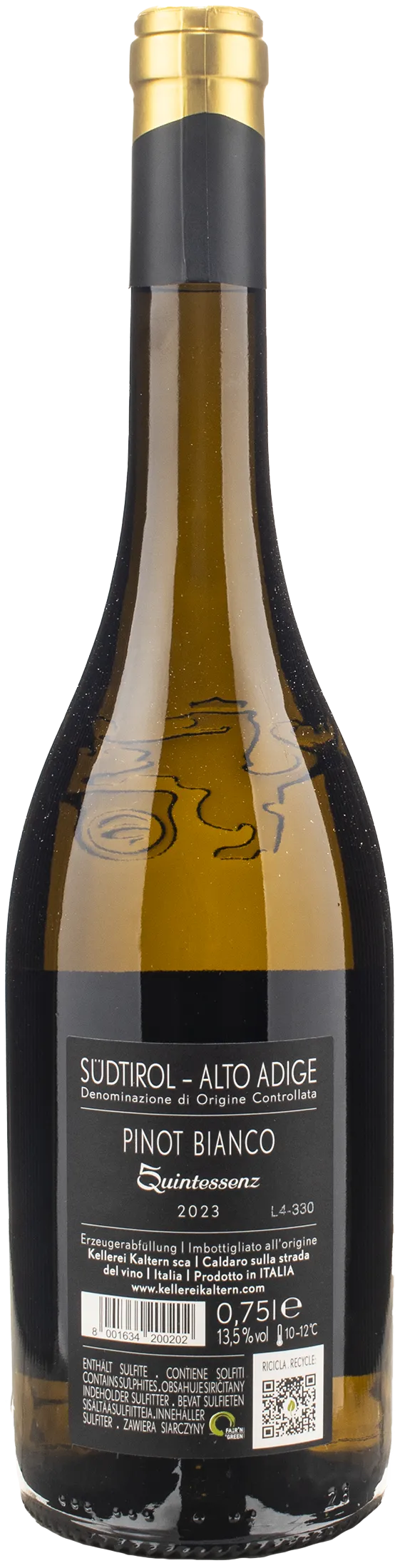
Description
What kind of wine it is
Quintessenz Pinot Bianco by Kaltern is a white wine with a Controlled Designation of Origin that fully expresses the elegance of Alto Adige, fermented and matured in wood. Made from Pinot Bianco grapes, it is dry and harmonious, with a creamy texture perfectly balanced by lively acidity. The palate finishes with a savoury and persistent aftertaste, while the nose develops a complex aromatic profile featuring notes of yellow apple, melon and dried chamomile. In the background, herbal nuances and a delicate hint of graphite emerge, lending the bouquet a deep personality.
Where it comes from
The vineyards are located on east-facing slopes in the San Nicolò area, at an altitude between 550 and 600 metres, where the mild climate and generous sunshine favour ideal ripening. The vines take root in loose limestone soils, enriched by glacial deposits and fragments of dolomitic rock. This particular, well-aerated soil composition gives the wine a distinct mineral character and natural freshness, clearly enhancing the authentic varietal expression.
How it is produced
The whole bunches undergo an extremely slow pressing, allowing for gentle extraction followed by natural settling. The unfiltered must ferments spontaneously thanks to indigenous yeasts inside oak barrels and large wooden casks. The wine then matures for a long time in contact with the fine lees, accompanied by continuous bâtonnage which enriches its structure and lends smoothness to the palate. A final stage of maturation in stainless steel, still on the fine lees, completes the process while preserving the purity of the aromas.
History and Curiosities
Born from the longstanding passion of Kellerei Kaltern, active since 1900, Quintessenz Pinot Bianco embodies the excellence of Alto Adige. Grown at an altitude of 600 metres on dolomitic soils, the grapes benefit from careful maturation in oak. From this dedication comes an award-winning wine, celebrated by renowned guides such as Falstaff and Gambero Rosso.
Awards
-
2023
 4
4Italian Sommelier Foundation (FIS) guide This has been one of the most prestigious wine guides in Italy for over 10 years.
-
2023
 95
95/100
One of the most prestigious wine guides in Italy.
-
2023
 3
3One of the most prestigious wine guides in Italy.
-
2023
 3
3Italian Sommelier Association (AIS) guide
Tasting notes

Perfume

Color

Taste
Serve at:
12 - 14 °C
Longevity:
03 - 05 years

- Start up year: 1900
- Oenologist: Thomas Scarizuola
- Bottles produced: 4.000.000
- Hectares: 440
Today, Kellerei Kaltern is one of the most relevant wineries in South Tyrol. The wine-growing municipality of Kaltern, the best known and best loved in South Tyrol, is proud of its reputation. But Kellerei Kaltern is more than just a special place for wine enthusiasts and connoisseurs. Wine is the great protagonist in the community's life: it has shaped it over the years by giving employment to local people. As a result, the wine fills the inhabitants and farmers with pride. For many, it is a full-time professional commitment pursued with great passion in many different spheres, whether in vineyards, cellars, gastronomy, or commerce.
For Kellerei Kaltern, wine is synonymous with taste and quality thanks to the terroir and the local community, making wines unique.
Kellerei Kaltern plays a vital role in this respect, perfectly reflecting the company philosophy: the unity of purpose and a constant search for quality to spread the spirit, the euphoria, the collective commitment, the wine and, of course, the natural beauty worldwide. Read more


| Name | Caldaro Quintessenz Pinot Bianco 2023 |
|---|---|
| Type | White green still |
| Denomination | Alto Adige DOC |
| Vintage | 2023 |
| Size | 0,75 l |
| Alcohol content | 13.5% by volume |
| Grape varieties | 100% Pinot Bianco |
| Country | Italy |
| Region | Trentino Alto Adige |
| Vendor | Kaltern Caldaro |
| Story | History and Curiosities Born from the longstanding passion of Kellerei Kaltern, active since 1900, Quintessenz Pinot Bianco embodies the excellence of Alto Adige. Grown at an altitude of 600 metres on dolomitic soils, the grapes benefit from careful maturation in oak. From this dedication comes an award-winning wine, celebrated by renowned guides such as Falstaff and Gambero Rosso. |
| Origin | St. Nikolaus (Alto Adige) |
| Climate | Mild climate with many hours of sunshine |
| Soil composition | Calcareous with glacial cone deposits and fragments of dolomitic rock; loose, well-aerated soil, neutral to basic |
| Cultivation system | Guyot |
| Yield per hectare | 45 hl/ha |
| Production technique | Extremely slow pressing of whole grapes; spontaneous fermentation of unfiltered must in oak barrels; ageing on fine lees with continuous bâtonnage |
| Wine making | Extremely slow pressing of whole grapes; spontaneous fermentation of the unfiltered must in 500-litre oak barrels and large wooden casks; maturation in wood for 10–11 months on fine lees with continuous bâtonnage, then 4 months in stainless steel on fine lees. |
| Aging | In wood for 10 months, on fine lees with continuous bâtonnage; then 4 months in stainless steel on fine lees. |
| Total acidity | 5.9 gr/L |
| Residual sugar | 1.5 gr/L |
| Allergens | Contains sulphites |