


Kaltern Caldaro
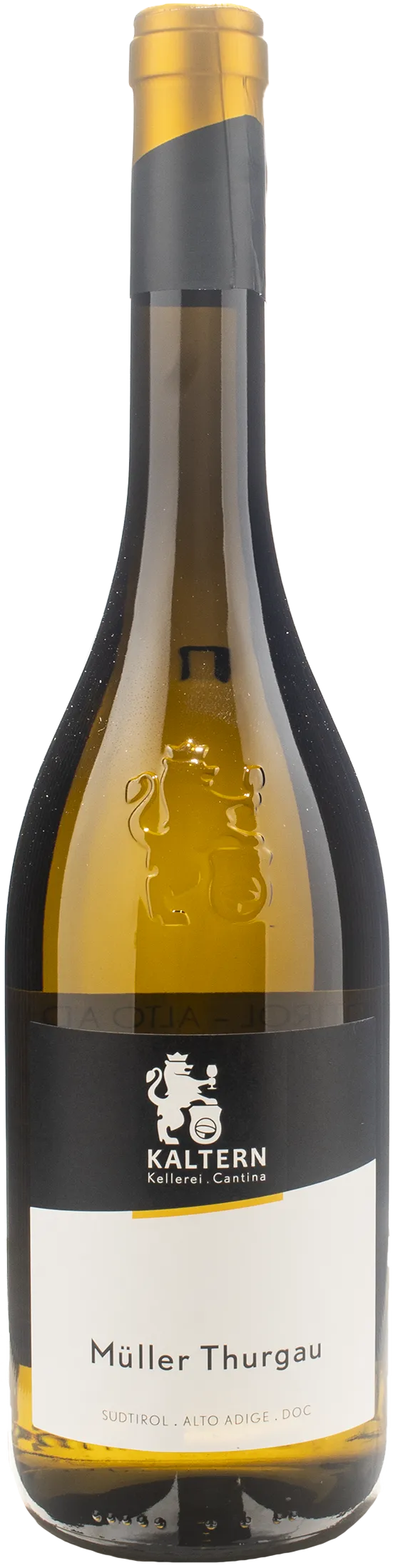
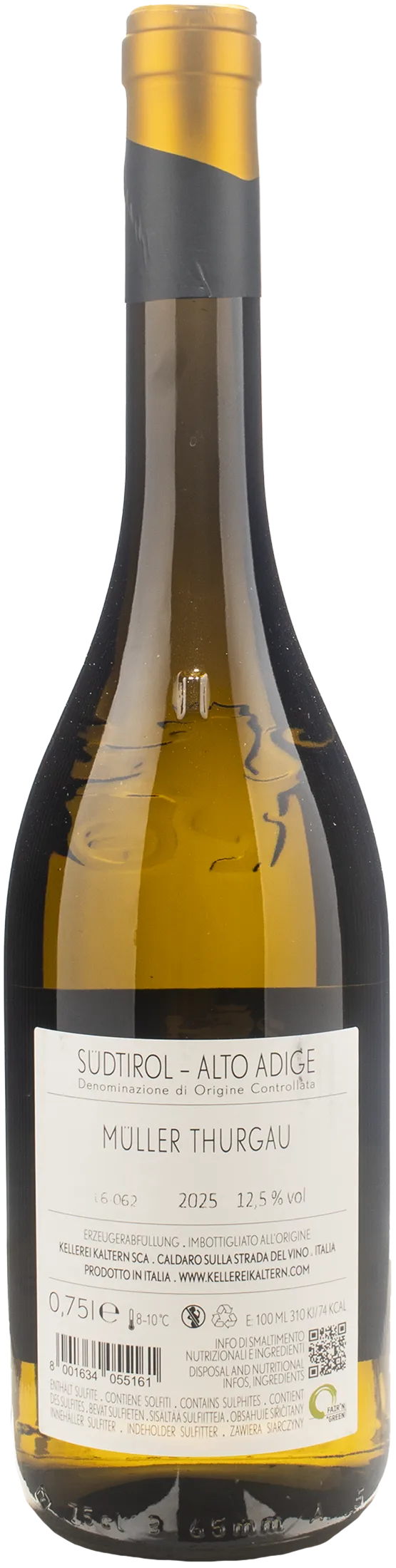
Muller Thurgau 2025
| Denomination | DOC Alto Adige Muller Thurgau |
|---|---|
| Size | 0,75 l |
| Alcohol content | 12.5% by volume |
| Area | Trentino Alto Adige (Italy) |
| Grape varieties | 100% Müller Thurgau |
| Aging | Maturation on the fine lees for 3 months in stainless steel tanks. |
- Grape variety and appellation: 100% Müller Thurgau, Alto Adige DOC, dry still white wine, 12.5% ABV
- Aroma: notes of peach, apricot, crisp apple, elderflower and a hint of nutmeg
- Palate: dry, savoury and balanced, lively acidity and a fruity finish with saline hints
- Winemaking: gentle pressing, fermentation at 16 °C, 3 months ageing on fine lees in stainless steel
- Serving and pairings: serve at 10–12 °C, ideal as an aperitif with starters, fish and shellfish
Description
What kind of wine it is
Kaltern's Müller Thurgau is a still white wine with a semi-aromatic profile, an expression of the Alto Adige appellation. Produced with Müller Thurgau grapes, it is distinguished by a fresh style and a light body, with a bouquet of peach, apricot, crisp apple, and nutmeg. On the palate, it reveals itself to be dry and balanced, supported by a well-defined acidity and a soft texture resulting from ageing in steel. The drink concludes with a fruity and saline finish, which pleasantly invites the next sip.
Where it comes from
The vineyards dedicated to this wine grow on the heights of Caldaro, in the heart of Alto Adige. The vineyards extend over selected hillsides with eastern exposure, at an altitude between 550 and 800 metres. This position benefits from an Alpine-Mediterranean climate, characterised by sunny days and nights cooled by descending breezes. Temperature fluctuations favour slow ripening of the grapes, preserving their primary aromas. The soils, composed of mineral-rich marls, limestone gravels, and a porphyry base, give the wine its typical savoury texture.
How it is produced
The harvest takes place between the end of August and September. After destemming, the grapes undergo soft pressing. The must is clarified through natural decantation, before starting temperature-controlled fermentation in stainless steel tanks. Subsequently, the wine undergoes ageing on the fine lees for three months, also in steel containers. This careful production process enriches the structure and ensures a round texture, enhancing the natural freshness and aromatic finesse of the Müller Thurgau grape variety without any interference.
History and interesting facts
The Müller Thurgau variety is a cross between Riesling and Madeleine Royale, created in 1882 by Professor Hermann Müller, originally from the Canton of Thurgau in Switzerland. This wine embodies the essence of the Caldaro area, with its history and its passion for viticulture.
Tasting notes
Perfume
Color
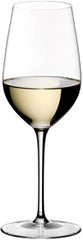
Taste
Serve at:
08 - 10 °C
Longevity:
03 - 05 years
- Start up year: 1900
- Oenologist: Thomas Scarizuola
- Bottles produced: 4.000.000
- Hectares: 440
Today, Kellerei Kaltern is one of the most relevant wineries in South Tyrol. The wine-growing municipality of Kaltern, the best known and best loved in South Tyrol, is proud of its reputation. But Kellerei Kaltern is more than just a special place for wine enthusiasts and connoisseurs. Wine is the great protagonist in the community's life: it has shaped it over the years by giving employment to local people. As a result, the wine fills the inhabitants and farmers with pride. For many, it is a full-time professional commitment pursued with great passion in many different spheres, whether in vineyards, cellars, gastronomy, or commerce.
For Kellerei Kaltern, wine is synonymous with taste and quality thanks to the terroir and the local community, making wines unique.
Kellerei Kaltern plays a vital role in this respect, perfectly reflecting the company philosophy: the unity of purpose and a constant search for quality to spread the spirit, the euphoria, the collective commitment, the wine and, of course, the natural beauty worldwide. Read more


| Name | Caldaro Muller Thurgau 2025 |
|---|---|
| Type | White green still semi-aromatic |
| Denomination | Alto Adige DOC |
| Vintage | 2025 |
| Size | 0,75 l |
| Alcohol content | 12.5% by volume |
| Grape varieties | 100% Müller Thurgau |
| Country | Italy |
| Region | Trentino Alto Adige |
| Vendor | Kaltern Caldaro |
| Story | History and interesting facts The Müller Thurgau variety is a cross between Riesling and Madeleine Royale, created in 1882 by Professor Hermann Müller, originally from the Canton of Thurgau in Switzerland. This wine embodies the essence of the Caldaro area, with its history and its passion for viticulture. |
| Origin | Caldaro (Kaltern), South Tyrol (Trentino-South Tyrol), North-eastern Italy |
| Climate | Alpine-Mediterranean influence |
| Soil composition | Medium-textured calcareous clay, highly mineral. |
| Cultivation system | Guyot and pergola |
| Yield per hectare | 80 hectolitres per hectare |
| Harvest | Late August - September |
| Fermentation temperature | 16 degrees Celsius |
| Production technique | Destemming, soft pressing, natural settling, temperature-controlled fermentation (16 °C) and ageing on the fine lees in stainless steel tanks. |
| Wine making | Destemming of ripe and healthy grapes, gentle pressing, natural settling; fermentation at a controlled temperature (16 °C); ageing for three months on the fine lees in stainless steel. |
| Aging | Maturation on the fine lees for 3 months in stainless steel tanks. |
| Total acidity | 6.0 gr/L |
| Residual sugar | 2.5 gr/L |
| Allergens | Contains sulphites |