


Pico Maccario
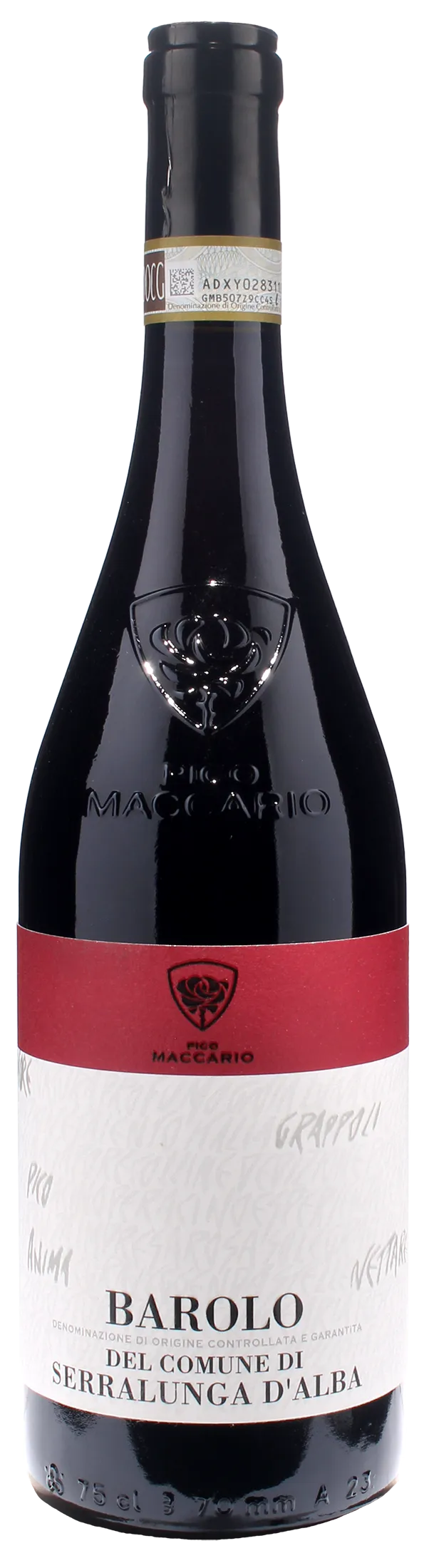
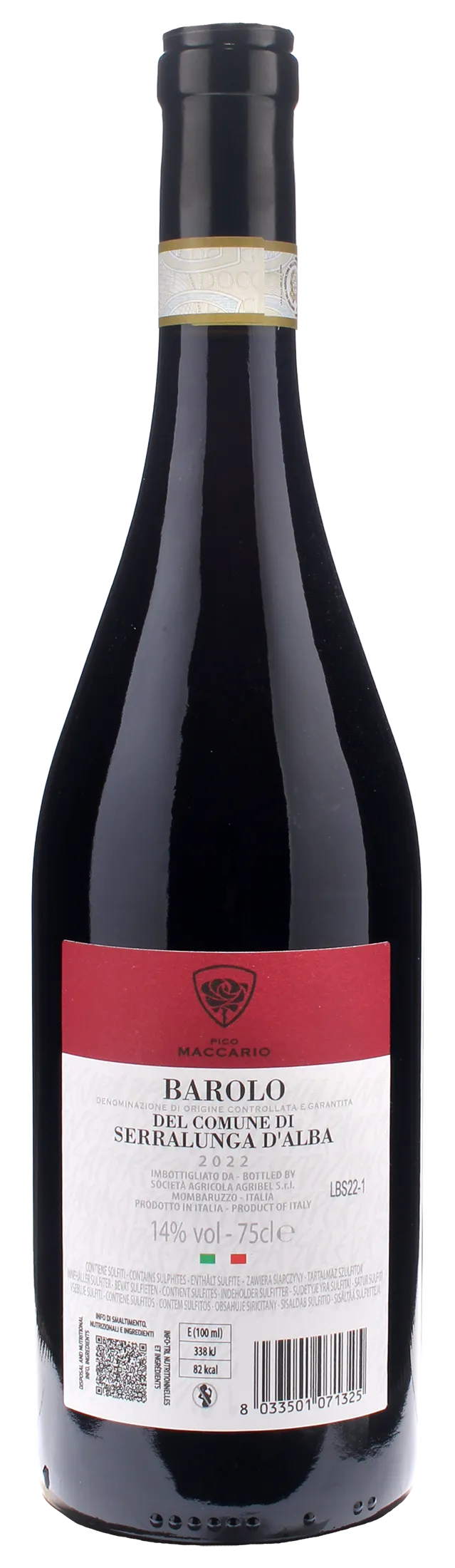
Barolo del Comune di Serralunga d'Alba 2022
| Denomination | DOCG Barolo |
|---|---|
| Size | 0,75 l |
| Alcohol content | 14.0% by volume |
| Area | Piedmont (Italy) |
| Grape varieties | 100% Nebbiolo |
| Aging | Ageing for 18–20 months in 25-hl casks, followed by further bottle ageing before release (minimum ageing: at least 3 years). |
- Appellation: Barolo DOCG 100% Nebbiolo from Serralunga d’Alba
- Aromas: Red fruits and flowers, spices, liquorice, sweet tobacco and leather
- Vinification: Manual harvest, fermentation in steel at 28–30°C, maceration for 15 days
- Maturation: 18-20 months in 25-hl barrels, then in bottle (minimum ageing 3 years)
- Service: Decant for 1 hour at 18°C; ageing potential over 8 years
Description
What kind of wine it is
Pico Maccario's Barolo del Comune di Serralunga d’Alba is a still red wine with a controlled and guaranteed designation of origin made from Nebbiolo grapes, vinified in steel and aged in barrels. To the eye, it presents a garnet red colour, introducing a fresh bouquet characterised by small red fruits and delicate floral hints. The olfactory profile is enriched by spicy notes, with hints of liquorice and sweet tobacco accompanied by slight notes of leather. On the palate, it is elegant and perfectly balanced, supported by robust tannins that guarantee remarkable longevity, and it is recommended to decant it for an hour before serving it at eighteen degrees.
Where it comes from
This wine originates in the municipality of Serralunga d’Alba, in the heart of Barolo, from vineyards located at an altitude of between two hundred and two hundred and twenty metres. The rows enjoy an eastern exposure and are trained using the Guyot system. The uniqueness of this area lies in the white calcareous-marly soil of Miocene-Helvetian origin, with sandy veins that give the wine a firm tannic texture and a profound territorial identity. The meticulous selection of the bunches, carried out manually in the vineyard and on sorting tables, ensures that only the best fruit reaches the Pico Maccario winery.
How it is produced
The harvest takes place in early October, followed by gentle de-stemming and crushing. Fermentation takes place in stainless steel tanks at a controlled temperature. During the maceration of approximately fifteen days, frequent punching down and gentle pumping over are performed to encourage a harmonious extraction of colour and structure. The wine then matures for a period of between eighteen and twenty months in barrels, developing balance and aromatic complexity. Further ageing in the bottle precedes commercialisation, completing a minimum ageing of at least three years to ensure a structured and deep sensory profile.
Tasting notes

Perfume

Color

Taste
Serve at:
18 - 20 °C
Longevity:
10 - 15 years
Decanting time:
1 hour

- Start up year: 1997
- Oenologist: Roberto Olivieri
- Bottles produced: 800.000
- Hectares: 100
Since 1997 it has been run by the two brothers Pico and Vitaliano Maccario who have been able to combine the main native vine also with international vines. Thus, most of the 85 hectares of vineyards are dedicated to Barbera, then subdivided into Merlot, Cabernet Sauvignon, Chardonnay, Sauvignon, Freisa and Favorita.
The company is in contemporary style both in the management of the vineyards and in the technological innovations in the cellar. Even the logo is very innovative with a stylized rose that wants to indicate its position instead of traditional and important next to each row.
We are pleased to officially inform you that the Barbera d'Asti Lavignone 2023 has been awarded the Tre Bicchieri® of the guide Vini d'Italia 2025. An achievement that also this year confirms the loyalty of our customers and our continuous commitment to guarantee, from the vineyard to the glass, the highest quality that distinguishes us. Read more


| Name | Pico Maccario Barolo del Comune di Serralunga d'Alba 2022 |
|---|---|
| Type | Red still |
| Denomination | Barolo DOCG |
| Vintage | 2022 |
| Size | 0,75 l |
| Alcohol content | 14.0% by volume |
| Grape varieties | 100% Nebbiolo |
| Country | Italy |
| Region | Piedmont |
| Vendor | Pico Maccario |
| Origin | Serralunga d'Alba (Piedmont, Italy) |
| Soil composition | White calcareous-marly soil of Miocene-Helvetian origin with sandy veins |
| Cultivation system | Guyot |
| Harvest | Early October (autumn) |
| Fermentation temperature | 28 to 30°C |
| Fermentation | About 15 days |
| Production technique | Manual harvesting; gentle crushing and destemming; fermentation in stainless steel at a controlled temperature (28–30°C); maceration for approximately 15 days with frequent punching down and gentle wetting of the cap; ageing for 18–20 months in 25 hl casks and further ageing in the bottle. |
| Wine making | Manual harvesting with selection of the bunches in the vineyard and on sorting tables; gentle crushing and destemming; fermentation in stainless steel at a controlled temperature (28–30°C); maceration for approximately 15 days with frequent punching down and gentle wetting of the cap; ageing for 18–20 months in 25 hl casks, followed by further bottle ageing before release. |
| Aging | Ageing for 18–20 months in 25-hl casks, followed by further bottle ageing before release (minimum ageing: at least 3 years). |
| Allergens | Contains sulphites |