


Pascal Machet
Champagne Extra Extra Brut
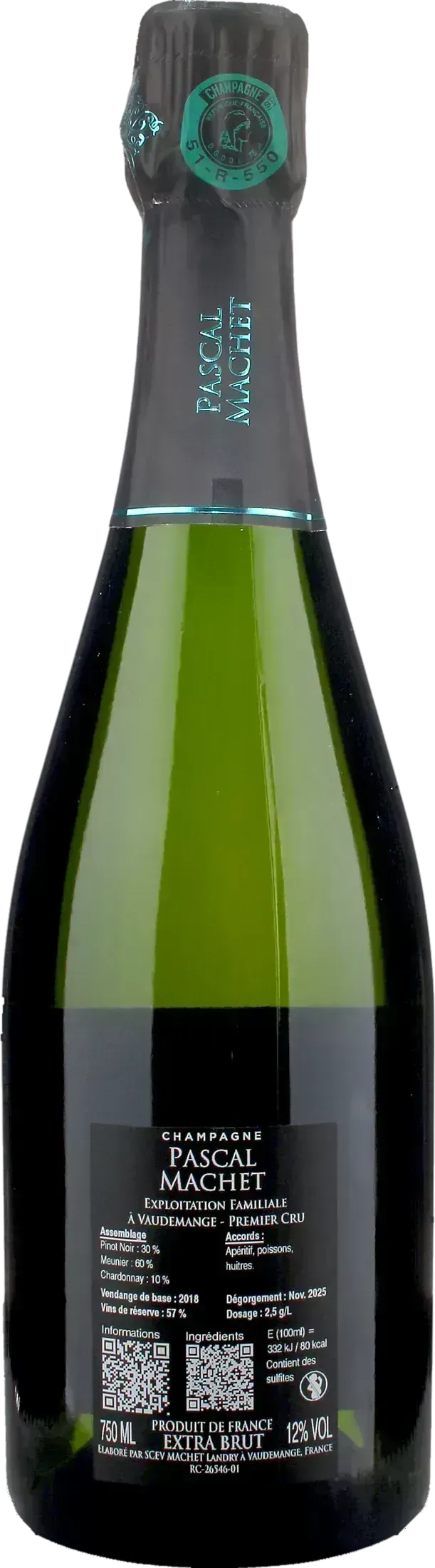
| Denomination | AOC Champagne Premier Cru Extra Brut |
|---|---|
| Size | 0,75 l |
| Alcohol content | 12.0% by volume |
| Area | Champagne region (France) |
| Grape varieties | 60% Pinot Meunier, 30% Pinot Nero, 10% Chardonnay |
| Aging | Extended ageing on the lees (bottle maturation using the Traditional Method). |
- Denomination and origin: Appellation d'Origine Contrôlée sparkling wine from Vaudemange, France
- Grape composition: 60% Pinot Meunier, 30% Pinot Noir, 10% Chardonnay
- Sugar-free dosage: Extra Extra Brut, 0 g/l for a dry and bold taste
- Production and ageing: Traditional Method, 57% reserve wines, aged on the lees
- Profile and pairings: Amber yellow, fine bubbles; perfect with oysters and shellfish

Description
The Essence of Premier Cru
Pascal Machet Champagne Premier Cru Extra Extra Brut, produced by Pascal Machet, is an elegant artisanal wine. This Premier Cru Champagne is masterfully crafted from a blend of Pinot Meunier, Pinot Noir, and Chardonnay grapes, grown in the renowned French region. In the glass, it presents a dry and expressive profile, characterised by an ample fruity flesh, a fine texture, and a marked vinosity on the finish. Its exquisite quality is the result of using the Traditional Method, which gives the cuvée a structured complexity, ideal for pairing with starters, fish, and fresh oysters.
Origins in Vaudemange
This wine originates from the esteemed territories of Vaudemange, a prestigious commune situated in the historic Champagne region of France. In this area, the Premier Cru classification certifies the high quality of the vineyards and the excellence of the plots managed by the family estate.
Artisanal Craftsmanship
Production follows the rigorous principles of the Traditional Method, based on a slow secondary fermentation in the bottle. A central element of the process is the inclusion of a high percentage of reserve wines, which enriches the blend by providing great depth and maturity. Subsequently, the cuvée undergoes prolonged ageing on the lees, a fundamental phase for developing the elegant perlage and complex aromatic expression. The process concludes with an Extra Extra Brut dosage, characterised by the total absence of residual sugars, to ensure a sharp, pure, and markedly vinous finish.
History and interesting facts
The Pascal Machet family estate in Vaudemange, France, stands out for its authentic artisanal production. The most fascinating detail of this Champagne Premier Cru lies in the use of fifty-seven per cent reserve wines, which enriches the cuvée after prolonged ageing. Another great feature is the total absence of residual sugars, a distinctive characteristic of Extra Extra Brut. This historic expression of the terroir is dominated by Pinot Meunier at sixty per cent, skilfully combined with Pinot Noir and Chardonnay grapes.
Tasting notes
Perlage
Color
Taste
Serve at:
06 - 08 °C
Longevity:
15 - 25 years
- Start up year: 1985
On the production side, the company pursues a reasoned and responsible viticulture, designed to respect natural cycles and follow the rules of the AOP Champagne. In the vineyard, work is marked by precision and the enhancement of parcel identity through three complementary terroirs: Vaudemange, in the Montagne de Reims, Premier Cru predominantly Chardonnay on chalky soils that bring freshness and minerality; Merlaut, in the Coteaux Vitryats, characterized by clay-limestone soils that give liveliness and fruity aromas; and Essoyes, in the Côte des Bar, where marls, limestone, and clay give structure to the wines. The harvesting of the grapes takes place via manual harvest to preserve the quality of the fruit, with the goal of obtaining authentic cuvées faithful to a vision of sustainable production. Read more


| Name | Pascal Machet Champagne Premier Cru Extra Extra Brut |
|---|---|
| Type | White green classic method sparkling wine extra brut |
| Denomination | Champagne AOC |
| Size | 0,75 l |
| Alcohol content | 12.0% by volume |
| Grape varieties | 60% Pinot Meunier, 30% Pinot Nero, 10% Chardonnay |
| Country | France |
| Region | Champagne region |
| Vendor | Pascal Machet |
| Story | History and interesting facts The Pascal Machet family estate in Vaudemange, France, stands out for its authentic artisanal production. The most fascinating detail of this Champagne Premier Cru lies in the use of fifty-seven per cent reserve wines, which enriches the cuvée after prolonged ageing. Another great feature is the total absence of residual sugars, a distinctive characteristic of Extra Extra Brut. This historic expression of the terroir is dominated by Pinot Meunier at sixty per cent, skilfully combined with Pinot Noir and Chardonnay grapes. |
| Origin | Vaudemange, Champagne, France |
| Production technique | Traditional Method (secondary fermentation in the bottle) |
| Wine making | Sparkling wine production using the Traditional Method (secondary fermentation in the bottle); use of 57% reserve wines and prolonged ageing on the lees; Extra Extra Brut dosage with zero residual sugars (0 g/l). |
| Aging | Extended ageing on the lees (bottle maturation using the Traditional Method). |
| Allergens | Contains sulphites |