


Marchesi di Barolo
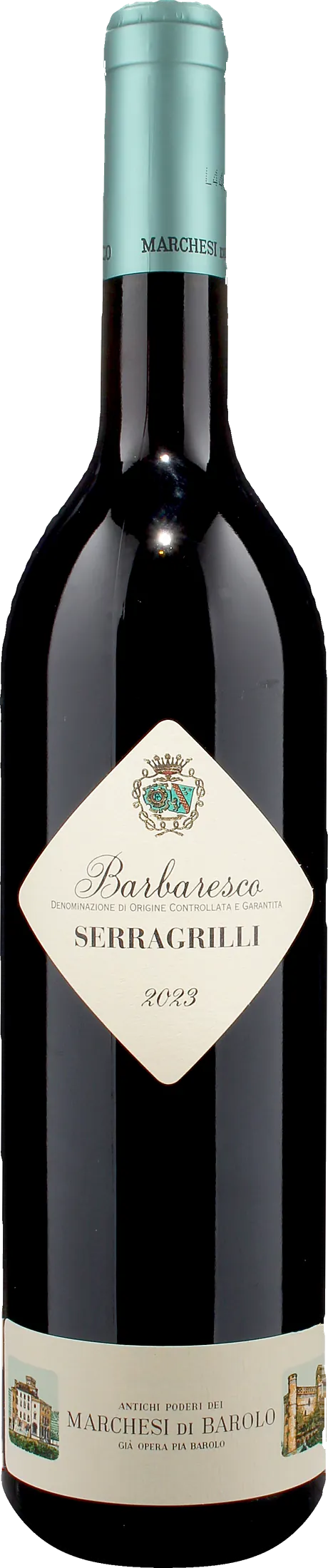
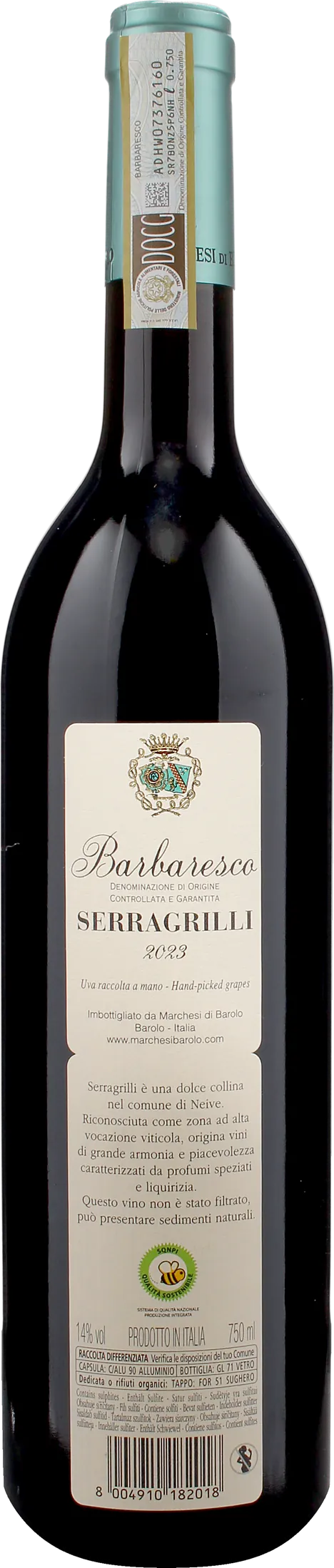
Barbaresco Serragrilli 2023
| Denomination | DOCG Barbaresco |
|---|---|
| Size | 0,75 l |
| Alcohol content | 14.0% by volume |
| Area | Piedmont (Italy) |
| Grape varieties | 100% Nebbiolo |
| Aging | Ageing: first year in Slavonian oak casks (30–35 hl) and in French oak barriques (225 l, medium toast); at least 9 months in wood (80% Slavonian casks, 20% barriques); blending in large traditional casks and subsequent bottle ageing (at least 6 months) before being released for sale. |
- Grape variety: 100% Nebbiolo, Piedmontese Barbaresco DOCG, 14% vol.
- Aroma: Hints of violet and wild rose, small red fruits and notes of sweet spices
- Flavour: Full and harmonious with soft tannins; matured in Slavonian oak and barrique.
- Territory: Vineyards in Neive (southwest); soils of marl, clay and quartz sands.
- Serving: 18°C (decant for 1 hour). Ideal with agnolotti, braised meats and medium-aged cheeses.
Description
Type of wine
Marchesi di Barolo's Barbaresco Serragrilli enhances the Nebbiolo grape variety through a full and enveloping sip. Characterised by a ruby red colour with garnet reflections, this Piedmontese red wine with a controlled and guaranteed designation of origin reveals a bouquet of wild violet, rose hip, small red fruits and sweet spices. On the palate, it expresses an elegant structure, supported by soft tannins, aged in oak barrels, which lead towards a persistent finish. Ideal for pairing with agnolotti, braised meats and medium-matured cheeses, it reveals a harmonious and very clean profile.
Origin
The vineyards are located on the Serragrilli hill in Neive, in the heart of the Barbaresco territory. The south-west exposure and altitude ensure constant sunlight until evening, which is fundamental for the correct ripening of the bunches. The terroir is distinguished by marine sedimentary soils, composed of Sant’Agata fossil marls, clay, silt and quartz sands. This particular composition, enriched by the presence of limestone, promotes a distinct aromatic definition and a solid structural balance.
How it is produced
After the manual harvest, the grapes undergo rapid de-stemming and gentle pressing. Fermentation takes place at a controlled temperature, with maceration on the skins for about eight days and frequent pump-overs. The wine rests in vitrified concrete vats to complete spontaneous malolactic fermentation. Ageing continues in wood, using Slavonian oak casks and medium-toasted French oak barrels, before concluding with the creation of the blend in large traditional casks. A subsequent period in the bottle completes the process, further refining the wine's texture.
History and facts
The prestigious Barbaresco DOCG Serragrilli by Marchesi di Barolo, a pearl of the Historic Crus line, is born on the sunny hills of Neive. The vines grow on an ancient soil of Sant’Agata fossil marls, dating back to the Tortonian age, which gives the Nebbiolo an incomparable structure. Celebrated by international critics with excellent accolades, including the prestigious 95 points from Decanter, this majestic Piedmontese red boasts an extraordinary longevity, capable of evolving with rare elegance for up to twenty years.
Awards
-
2023
 92
92/100
Decanter is a wine and lifestyle magazine, published monthly in around 90 countries. The magazine includes industry news, classic guides and advice on wine and spirits.
-
2023
 92
92/100
James Suckling is an influential American wine critic and journalist who worked at Wine Spectator for 30 years. He left the magazine in 2010 to start his own website and guidebook (JamesSuckling.com). He specialises in Italian and Bordeaux wines.
Tasting notes

Perfume

Color

Taste
Serve at:
18 - 20 °C
Longevity:
10 - 15 years
Decanting time:
1 hour
- Start up year: 1800
- Oenologist: Marco Marsili
- Bottles produced: 1.500.000
- Hectares: 105


| Name | Marchesi di Barolo Barbaresco Serragrilli 2023 |
|---|---|
| Type | Red still |
| Denomination | Barbaresco DOCG |
| Vintage | 2023 |
| Size | 0,75 l |
| Alcohol content | 14.0% by volume |
| Grape varieties | 100% Nebbiolo |
| Country | Italy |
| Region | Piedmont |
| Vendor | Marchesi di Barolo |
| Story | History and facts The prestigious Barbaresco DOCG Serragrilli by Marchesi di Barolo, a pearl of the Historic Crus line, is born on the sunny hills of Neive. The vines grow on an ancient soil of Sant’Agata fossil marls, dating back to the Tortonian age, which gives the Nebbiolo an incomparable structure. Celebrated by international critics with excellent accolades, including the prestigious 95 points from Decanter, this majestic Piedmontese red boasts an extraordinary longevity, capable of evolving with rare elegance for up to twenty years. |
| Origin | Serragrilli, municipality of Neive, Piedmont, Italy |
| Soil composition | Uniform and compact soil composed of clay and limestone, covered with quartz sands and very fine silt (approximately 25% sand, 53% silt, 22% clay). |
| Cultivation system | Vertical trellis with Guyot pruning |
| Fermentation temperature | Around 22 °C |
| Fermentation | Approximately 8 days |
| Production technique | Manual harvest; destemming and gentle crushing; temperature-controlled fermentation in temperature-controlled vats with maceration on the skins (approx. 8 days) and frequent pump-overs; spontaneous malolactic fermentation in glass-lined concrete vats; ageing in Slavonian oak casks and medium-toast French oak barriques, then blending in large casks and ageing in the bottle. |
| Wine making | The grapes, freshly harvested, arrive at the winery intact and are quickly crushed and gently destemmed. Fermentation takes place at a controlled temperature in temperature-conditioned tanks; maceration on the skins lasts for approximately 8 days with frequent pump-overs. Racking is carried out only once the sugars have been completely converted into alcohol. The wine is then transferred into vitrified concrete vats insulated with cork to maintain a post-fermentation temperature of around 22°C and encourage the spontaneous onset of malolactic fermentation, which is generally completed by December. This is followed by ageing in wood (Slavonian oak casks and medium-toasted French oak barriques), blending in large traditional casks, and further ageing in the bottle. |
| Aging | Ageing: first year in Slavonian oak casks (30–35 hl) and in French oak barriques (225 l, medium toast); at least 9 months in wood (80% Slavonian casks, 20% barriques); blending in large traditional casks and subsequent bottle ageing (at least 6 months) before being released for sale. |
| Total acidity | 5.17 gr/L |
| Residual sugar | 0.7 gr/L |
| Allergens | Contains sulphites |