


Grosjean
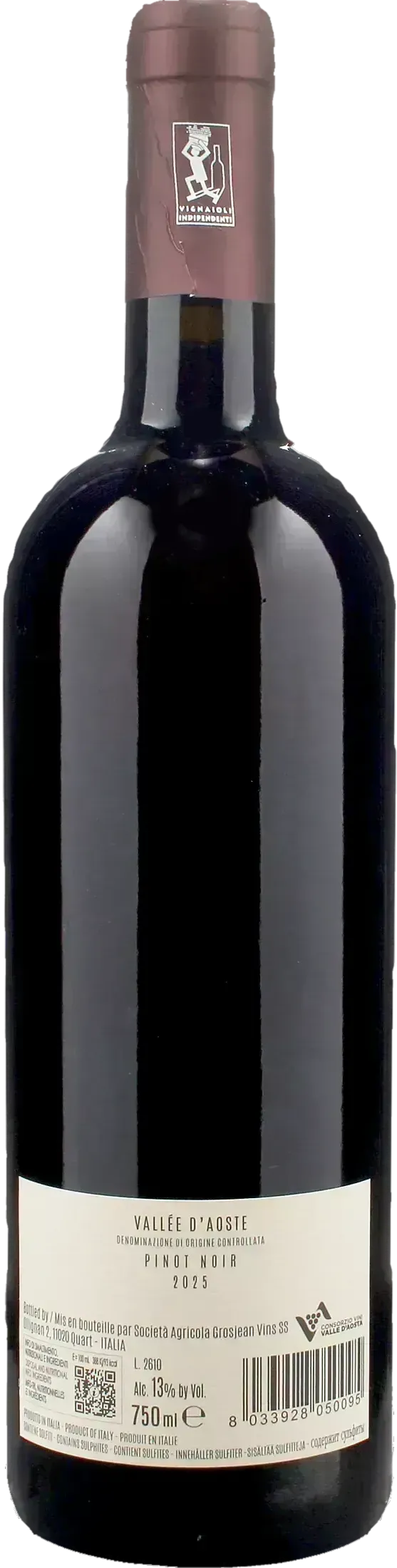
Pinot Noir 2025
| Denomination | DOC Valle d'Aosta Pinot Nero (pinot noir)(vin. Rosso) |
|---|---|
| Size | 0,75 l |
| Alcohol content | 13.0% by volume |
| Area | Aosta Valley (Italy) |
| Grape varieties | 100% Pinot Nero |
| Aging | Ageing: 50% in wooden barrels and 50% in stainless steel; aged in oak for 8 months; rested in the bottle for 2–3 months. |
- Type: Single-variety still red wine DOC
- Aromas: Scents of strawberry and raspberry, with toasted, balsamic and smoky notes
- Palate: Dry, balanced and smooth, with velvety tannins and good persistence
- Origin: Aosta Valley, vineyards between 600 and 850 metres in the municipalities of Quart and Saint-Christophe
- Vinification: 70% destemmed grapes and 30% whole bunch. Ideal with pork and cheeses

Description
What type of wine it is
Grosjean's Grosjean Pinot Noir is a still red wine that expresses the authentic character of the Valle d'Aosta denomination. Made from Pinot Noir grapes, it is distinguished by a balanced and smooth sensory profile, characterised by a dry mouthfeel and velvety tannins. On the nose, it reveals intense aromas of strawberry, raspberry, and forest fruits, finely enriched by toasted and balsamic notes. Its structure and lasting finish make it ideal for pairing with grilled meats, cheeses, and hearty first courses.
Where it comes from
The grapes come from the municipalities of Quart and Saint-Christophe, a territory that represents a true example of heroic viticulture in the Aosta Valley. The vineyards grow on extreme slopes at an altitude between 600 and 850 metres, influenced by a harsh alpine mountain climate. The sandy-loam soils, which are shallow and rich in mineral skeleton, give the wine precision and a well-defined character. Agricultural management adopts eco-sustainable practices to preserve the biodiversity of the alpine environment.
How it is produced
The production process begins in mid-September with a manual harvest. Vinification involves a base of 70% de-stemmed grapes combined with 30% whole clusters, with maceration on the skins for 8-10 days at a controlled temperature and frequent punching down. Fermentation takes place inside large oak barrels. The ageing phase lasts eight months and is divided equally between wooden barrels and stainless steel tanks, before finishing with a few months of rest in the bottle to complete its gustatory harmony.
History and trivia
This Pinot Noir represents the dedication of the Grosjean family, passionate winegrowers since 1781. It is the result of true heroic viticulture, with grapes grown on steep slopes between six hundred and eight hundred and fifty metres in the municipalities of Quart and Saint-Christophe. Each bottle expresses the connection with the mountain environment, protected by eco-sustainable practices that have excluded insecticides since 1975. A masterpiece created by an independent winegrower, capable of transforming Alpine challenges into extraordinary elegance.
Tasting notes

Perfume

Color

Taste
Serve at:
14 -16 °C
Longevity:
05 - 10 years
Decanting time:
1 hour
- Start up year: 1969
- Oenologist: Hervè Grosjean
- Bottles produced: 14.000
- Hectares: 14
The company is located on the border of the towns of Quart and Saint Christophe, where lie the vineyards of Tzeriat, Rovetta, Creton, Touren in Quart, Tzantè de Wet, lace and Castle Pleod Saint Christophe. The first cultivated vines, in addition to traditional Petit Rouge, were Gamay, Pinot Noir and Petite Arvine, and currently are growing even as the native Fumin, carnelian, pressed and Vuillermin. Cultivation techniques are rooted in respect for the environment since 1975 so it is not handled insecticides and acaricides treatments are carried out rigorously and fertilizing with manure of organic origin.
Read more


| Name | Grosjean Pinot Noir 2025 |
|---|---|
| Type | Red green still |
| Denomination | Valle d'Aosta DOC |
| Vintage | 2025 |
| Size | 0,75 l |
| Alcohol content | 13.0% by volume |
| Grape varieties | 100% Pinot Nero |
| Country | Italy |
| Region | Aosta Valley |
| Vendor | Grosjean |
| Story | History and trivia This Pinot Noir represents the dedication of the Grosjean family, passionate winegrowers since 1781. It is the result of true heroic viticulture, with grapes grown on steep slopes between six hundred and eight hundred and fifty metres in the municipalities of Quart and Saint-Christophe. Each bottle expresses the connection with the mountain environment, protected by eco-sustainable practices that have excluded insecticides since 1975. A masterpiece created by an independent winegrower, capable of transforming Alpine challenges into extraordinary elegance. |
| Origin | Municipalities of Quart and Saint-Christophe, Aosta Valley |
| Climate | Alpine mountain climate |
| Soil composition | Sandy loam and partly loamy sand, with shallow depth (<50 cm) and abundant coarse fragment content. |
| Cultivation system | Tablemount |
| Harvest | Mid-September |
| Fermentation temperature | 28–30 °C |
| Fermentation | 8–10 days |
| Production technique | 70% de-stemmed grapes and 30% whole bunches; maceration on the skins for 8–10 days with three punch-downs per day at a controlled temperature (28–30 °C); fermentation of the must in large oak casks; ageing 50% in wooden barrels and 50% in stainless steel; resting in bottle for 2–3 months. |
| Wine making | 70% de-stemmed grapes and 30% whole bunches; maceration on the skins for 8–10 days with three punch-downs per day at a controlled temperature (28–30 °C); fermentation of the must in large oak casks; ageing 50% in wooden barrels and 50% in stainless steel; resting in the bottle for 2–3 months. |
| Aging | Ageing: 50% in wooden barrels and 50% in stainless steel; aged in oak for 8 months; rested in the bottle for 2–3 months. |
| Allergens | Contains sulphites |