


Giacomo Borgogno e Figli
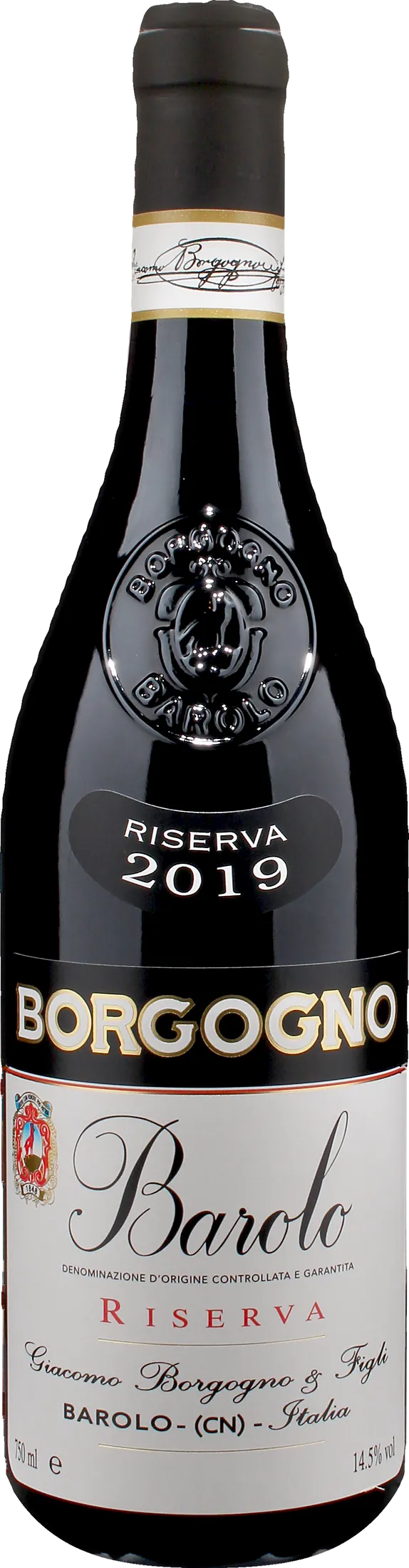
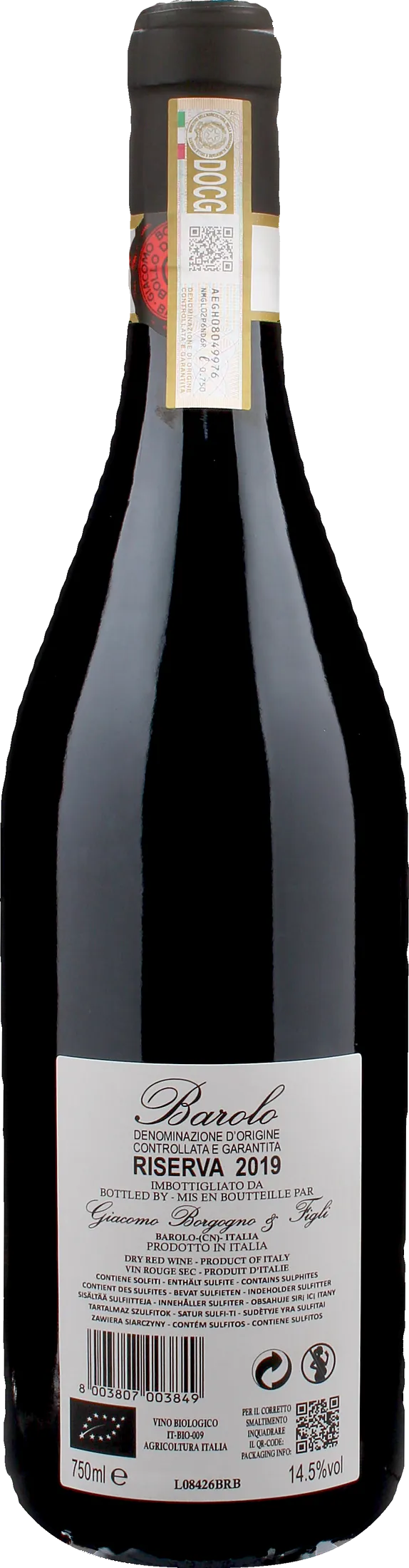
Barolo Riserva 2019
Other years:
2018| Denomination | DOCG Barolo Riserva |
|---|---|
| Size | 0,75 l |
| Alcohol content | 14.5% by volume |
| Area | Piedmont (Italy) |
| Grape varieties | 100% Nebbiolo |
| Aging | 6 years in large Slavonian oak casks, with further bottle ageing for 12 months |
| Other years | 2018 |
- Type: Organic still red wine Nebbiolo, Barolo DOCG Riserva 2019
- Aromatic profile: Briny hints, tar, cocoa, rose and cypress with balsamic nuances
- Palate: Velvety texture, silky tannins, long and persistent finish
- Winemaking: 2 weeks fermentation, 30 days maceration, 6 years in oak
- Origin and pairings: Barolo; ideal with red meats, game and cheeses
Description
What kind of wine it is
Giacomo Borgogno's Barolo Riserva is an organic red wine that fully expresses the authenticity of Nebbiolo. The bouquet opens with mineral nuances, tar, cocoa beans and cypress wood, softened by notes of rose petals, lilac and delicate balsamic touches. On the palate, it is distinguished by its solid and velvety structure, supported by silky and round tannins that lead towards a very persistent finish. This precise flavour architecture pairs beautifully with red meat dishes, game and mature cheeses.
Where it comes from
This red originates in Piedmont, in the heart of the commune of Barolo, from historic and famous vineyards such as Cannubi, Fossati and Liste. The vines are rooted in calcareous and clayey soils, capable of bestowing vigour and longevity on the clusters. The south and south-east exposure mitigates the impact of frequent fogs and frosts, ensuring steady phenolic development. Row management involves the arched Guyot system, an agronomic technique aimed at supporting the plant's physiology and preserving its productive balance.
How it is produced
Vinification follows classical processes, starting with temperature-controlled fermentation accompanied by manual punching down and pumping over. This is followed by a slow submerged-cap maceration, fundamental for extracting the complex richness of the must. The evolution is completed through long ageing for six years in large Slavonian oak barrels, before concluding with twelve months of rest in the bottle, ensuring a perfect flavour balance at the time of tasting.
History and interesting facts
Famous as the “Wine of Kings”, Giacomo Borgogno e Figli’s Barolo Riserva was chosen by Cavour to celebrate the Unification of Italy in 1861. The winery preserves its legacy by following strict traditional procedures, including the complex submerged cap maceration. Ageing for six years in large Slavonian oak barrels, followed by twelve months of rest in the bottle, establishes a masterpiece awarded the 4 Vines by the Vitae AIS guide.
Awards
-
2019
 4
4Italian Sommelier Foundation (FIS) guide This has been one of the most prestigious wine guides in Italy for over 10 years.
-
2019
 4
4Italian Sommelier Association (AIS) guide
Tasting notes

Perfume

Color

Taste
Serve at:
18 - 20 °C
Longevity:
10 - 15 years
Decanting time:
1 hour
- Start up year: 1761
- Oenologist: Simone Borsari
- Bottles produced: 250.000
- Hectares: 40
The winery has some interesting records: in 1861, Barolo Borgogno sealed the pact for the birth of Italian unity, and in 1908, it was served to the Tsar of all Russia during a visit to Racconigi.
The turning point came in 1920, when Cesare Borgogno began exporting abroad. However his greatest insight came when he decided to "forget" half of the production of Barolo Riserva in order to sell it 20 years later, realising the great versatility and power of Nebbiolo.
Borgogno is synonymous with slowness: the winery chooses to take its time understanding things and doing them correctly. The vineyards are cared for and attended to with only organic products.
This has resulted in the winery to gain their first Biological harvest.
The decision to plant forest on eight of their 39 hectars is to protect the biodiversity of the Langa fauna from being decimated by the cultivation of vineyards.
Borgogno has a sense of history, tradition, and roots that blend with the innovation of the changing times. Read more


| Name | Giacomo Borgogno Barolo Riserva 2019 |
|---|---|
| Type | Red organic still |
| Denomination | Barolo DOCG |
| Vintage | 2019 |
| Size | 0,75 l |
| Alcohol content | 14.5% by volume |
| Grape varieties | 100% Nebbiolo |
| Country | Italy |
| Region | Piedmont |
| Vendor | Giacomo Borgogno e Figli |
| Story | History and interesting facts Famous as the "Wine of Kings", Giacomo Borgogno e Figli’s Barolo Riserva was chosen by Cavour to celebrate the Unification of Italy in 1861. The winery preserves its legacy by following strict traditional procedures, including the complex submerged cap maceration. Ageing for six years in large Slavonian oak barrels, followed by twelve months of rest in the bottle, establishes a masterpiece awarded the 4 Vines by the Vitae AIS guide. |
| Origin | Municipality of Barolo (Cuneo), Piedmont, Italy |
| Soil composition | Calcareous and clayey |
| Cultivation system | Arched variant of the Guyot system |
| Plants per hectare | 4000 plants/ha |
| Harvest | 29 September - 7 October |
| Fermentation temperature | Initially 22–25 °C, at the end of fermentation 29–30 °C. |
| Fermentation | About 2 weeks |
| Production technique | Traditional procedures using ancient tools; long fermentation at a controlled temperature with manual punching down and pumping over; submerged cap maceration; slow ageing in large Slavonian oak casks. |
| Wine making | Fermentation for approximately 2 weeks at a controlled temperature (initially 22–25 °C, reaching 29–30 °C by the end of fermentation) with manual punching down and pumping over, followed by submerged-cap maceration for 30 days; ageing in large Slavonian oak casks for 6 years and further ageing in the bottle for 12 months. |
| Aging | 6 years in large Slavonian oak casks, with further bottle ageing for 12 months |
| Allergens | Contains sulphites |