


Donnhoff
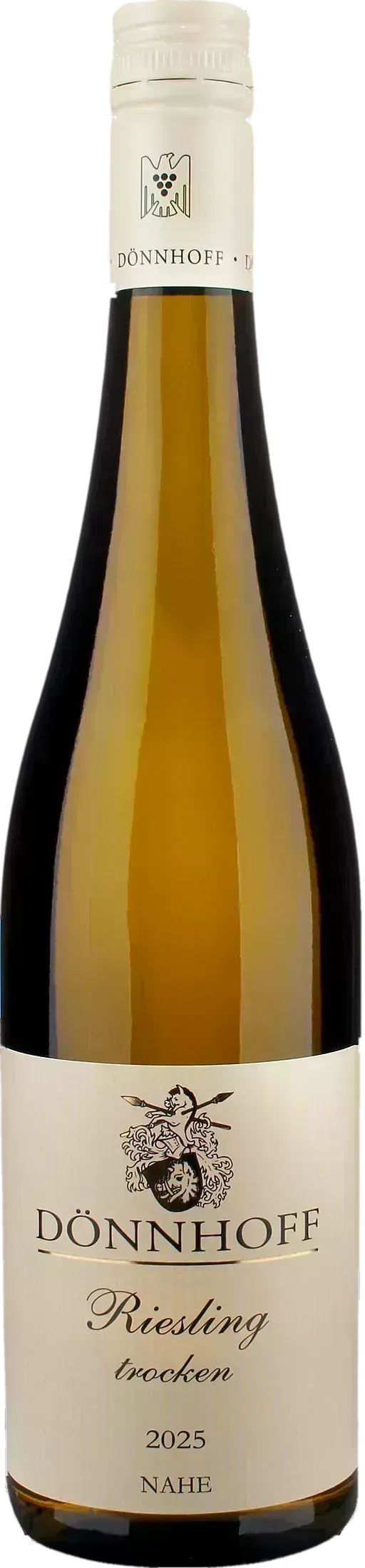
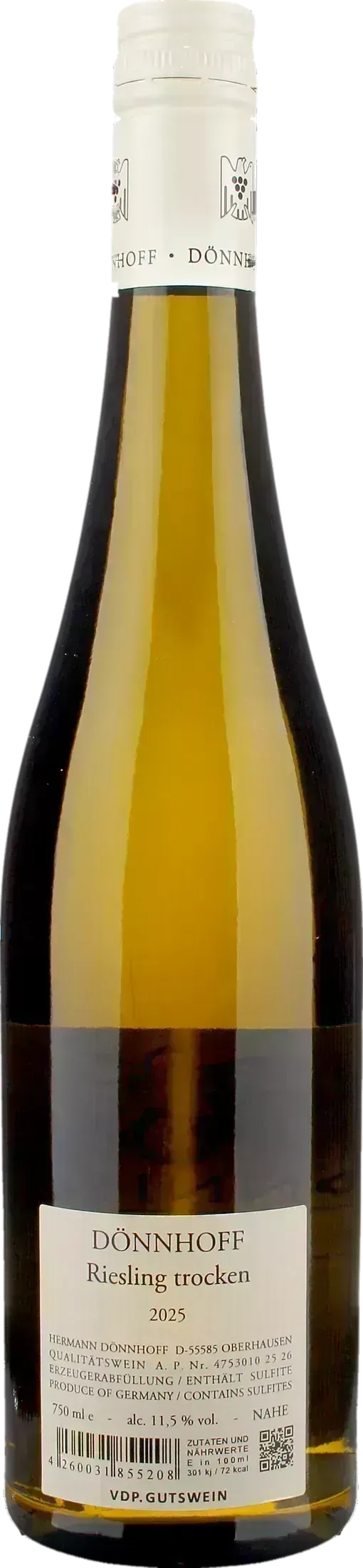
Riesling Qba Nahe Trocken 2025
| Denomination | QbA Mosel-Saar-Ruwer |
|---|---|
| Size | 0,75 l |
| Alcohol content | 11.5% by volume |
| Area | Mosel-Saar-Ruwer (Germany) |
| Grape varieties | 100% Riesling |
| Aging | Matured partly in stainless steel tanks and partly in large old oak casks. |
- Type: Dry still white wine from Riesling grapes from the Nahe Valley (Germany), 2025 vintage
- Aromas: Hints of citrus, white peach and flowers; accents of ginger, chives and mineral stone
- Vineyards and soils: Sourced from the Leistenberg and Kieselberg crus, on porphyry, slate and quartz soils
- Winemaking: Manual harvesting; spontaneous fermentation with indigenous yeasts; ageing in steel and oak
- Data/Pairings: 11.5% ABV; 3.8 g/l residual sugar; ideal with fish and goat's cheeses
Description
What type of wine it is
Donnhoff Riesling Nahe Trocken is a still white wine produced by the Dönnhoff winery. Made exclusively from Riesling grapes, it originates in the prestigious German region of the Nahe and is classified as a quality wine. It is distinguished by a dry, taut style driven by a vibrant acidity, accompanied by a clear mineral footprint. The aromatic profile offers notes of citrus, peach and fresh white flowers, enriched by nuances of ginger and deep stony hints. Vinification in stainless steel and large oak barrels preserves varietal purity, giving the palate a straightforward sip and an elegant persistent finish.
Where it comes from
The grapes come from the steep hillside vineyards of Leistenberg and Kieselberg, located in the municipality of Oberhausen an der Nahe, Germany. In this specific area of the region, the vines range in age from fifteen to thirty years, ensuring modest yields that favour a marked aromatic concentration. The volcanic soils are characterised by a complex composition of porphyry, slate and quartz, fundamental elements that infuse the wine with its unmistakable rocky character and typical minerality. The layout of the land is reflected in a demanding and meticulous viticulture, long linked to the estate's historical dedication and care for its most suitable plots.
How it is produced
The production process begins with a manual harvest, performed through a rigorous selective picking in several stages to isolate only the best bunches. Once in the cellar, a particularly slow spontaneous fermentation takes place, triggered largely by indigenous yeasts. Subsequently, the wine undergoes a maturation period balanced between stainless steel tanks and large old oak barrels. This targeted technical choice allows for the balancing of the grape's natural gustatory tension and enhances the structure of the sip, while keeping the vibrant expression of the varietal fruit intact.
History and curiosities
Born from the steep slopes of Leistenberg and Kieselberg in Oberhausen, this wine proudly bears witness to the dedication of the legendary Helmut Dönnhoff. The result of vines ranging in age from fifteen to thirty years, it fully expresses the most authentic soul of the picturesque Nahe region. Despite its essential nature, this precious dry Riesling receives the same meticulous care traditionally reserved for the most renowned plots. Every single bottle passes on an important historical heritage, offering a pure varietal expression of the highest calibre.
Tasting notes
Perfume
Color
Taste
Serve at:
10 - 12 °C
Longevity:
05 - 10 years
- Hectares: 25
Read more


| Name | Donnhoff Riesling Nahe Trocken 2025 |
|---|---|
| Type | White still dry |
| Denomination | Mosel-Saar-Ruwer QbA |
| Vintage | 2025 |
| Size | 0,75 l |
| Alcohol content | 11.5% by volume |
| Grape varieties | 100% Riesling |
| Country | Germany |
| Region | Mosel-Saar-Ruwer |
| Vendor | Donnhoff |
| Story | History and curiosities Born from the steep slopes of Leistenberg and Kieselberg in Oberhausen, this wine proudly bears witness to the dedication of the legendary Helmut Dönnhoff. The result of vines ranging in age from fifteen to thirty years, it fully expresses the most authentic soul of the picturesque Nahe region. Despite its essential nature, this precious dry Riesling receives the same meticulous care traditionally reserved for the most renowned plots. Every single bottle passes on an important historical heritage, offering a pure varietal expression of the highest calibre. |
| Origin | Oberhausen an der Nahe (Germany) |
| Soil composition | Volcanic porphyry soils with slate and quartz |
| Yield per hectare | Approximately 40 hl/ha |
| Production technique | Manual harvesting with selective picking in several passes; mostly spontaneous and slow fermentation with indigenous yeasts; ageing partly in stainless steel tanks and partly in large old oak casks. |
| Wine making | Manual harvest with selective picking in multiple passes; mostly spontaneous and slow fermentation with indigenous yeasts (limited use of selected yeasts); ageing partly in stainless steel tanks and partly in large old oak casks. |
| Aging | Matured partly in stainless steel tanks and partly in large old oak casks. |
| Total acidity | 7.5 gr/L |
| Residual sugar | 3.8 gr/L |
| Allergens | Contains sulphites |