


Marchesi Frescobaldi
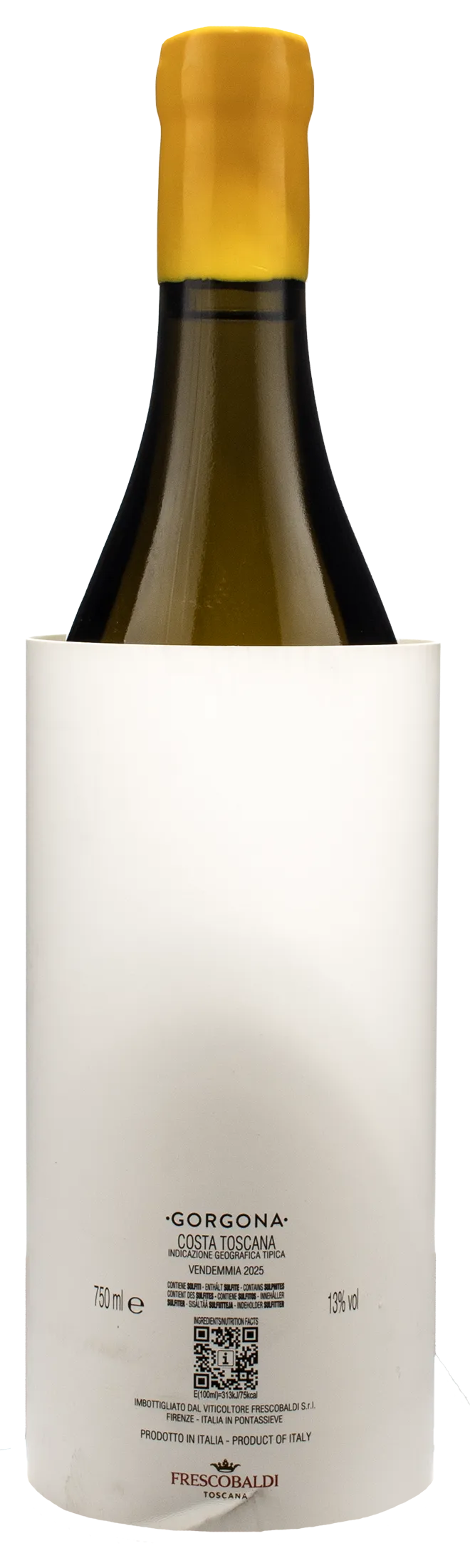
Gorgona Bianco 2025
| Denomination | IGT Costa Toscana |
|---|---|
| Size | 0,75 l |
| Alcohol content | 13.0% by volume |
| Area | Tuscany (Italy) |
| Grape varieties | Ansonica/Inzolia, Vermentino |
- Grape varieties and type: Costa Toscana IGT White from Vermentino and Ansonica grapes
- Mediterranean aromas: Broom, citrus fruits, aromatic herbs and flowers on a briny base
- Savoury flavour: Marked freshness, long persistence and a clean finish with saline notes
- Island origin: Eastern vineyards on iron-rich soils of Gorgona Island
- Social project: Viticultural work with inmates using organic methods; 96 pts James Suckling

Description
What type of wine it is
Gorgona Bianco is a still white wine from Frescobaldi, born from an organic blend of Vermentino and Ansonica in the Costa Toscana region. It presents with a straw-yellow hue, opening with an olfactory bouquet of citrus, broom and Mediterranean scrub. On the palate, a clear savoury freshness stands out, ensuring great taste-olfactory coherence. The tasting concludes with a persistent and clean iodised finish, a perfect reflection of its marine character.
Where it comes from
This wine comes to life on the island of Gorgona, in the heart of the Tuscan Archipelago, where the vineyards take root in iron-rich soils. The eastern exposure protects the rows from the strong prevailing winds, while the Mediterranean climate, mitigated by the action of the sea, gives the grapes a marked saline imprint. The agricultural management is part of a socio-environmental project in collaboration with the local prison, where inmates work in contact with nature, acquiring valuable viticultural skills for their future reintegration into society.
How it is produced
The entire estate operates according to the principles of organic farming, using the green manure technique to nourish the soil and protect biodiversity. To ensure maximum expressive potential, a staggered harvest is carried out: the Vermentino is harvested in September, followed by the Ansonica in October. This management of ripening allows the natural gustatory tension of the grapes to be preserved intact, resulting in a white wine capable of fully enhancing the marine salinity of its territory of origin.
History and Curiosities
Established in 2012 from the virtuous collaboration between Marchesi Frescobaldi and Europe's only prison island, this noble socio-environmental project guides inmates in acquiring valuable viticultural skills to facilitate their reintegration. The two hectares of vineyards, planted between 1999 and 2018, stand as a symbol of hope and freedom. Each vintage features a special edition label that tells the story of the territory's uniqueness, skilfully combining ethics and excellence: an achievement celebrated by an exceptional 96 James Suckling points.
Awards
-
2025
 96
96/100
James Suckling is an influential American wine critic and journalist who worked at Wine Spectator for 30 years. He left the magazine in 2010 to start his own website and guidebook (JamesSuckling.com). He specialises in Italian and Bordeaux wines.
Tasting notes
Perfume

Color

Taste
Serve at:
08 - 10 °C
Longevity:
05 - 10 years
- Start up year: 1300
- Oenologist: Nicolò D'Afflitto
- Hectares: 923
One thousand years of family history are a unique and incomparable treasure of knowledge and tradition. It is our duty to share this passion with future generations, passing on our love for these eternal places, these eternal hills. Read more


| Name | Frescobaldi Gorgona Bianco 2025 |
|---|---|
| Type | White still |
| Denomination | Costa Toscana IGT |
| Vintage | 2025 |
| Size | 0,75 l |
| Alcohol content | 13.0% by volume |
| Grape varieties | Ansonica/Inzolia, Vermentino |
| Country | Italy |
| Region | Tuscany |
| Vendor | Marchesi Frescobaldi |
| Story | History and Curiosities Established in 2012 from the virtuous collaboration between Marchesi Frescobaldi and Europe's only prison island, this noble socio-environmental project guides inmates in acquiring valuable viticultural skills to facilitate their reintegration. The two hectares of vineyards, planted between 1999 and 2018, stand as a symbol of hope and freedom. Each vintage features a special edition label that tells the story of the territory's uniqueness, skilfully combining ethics and excellence: an achievement celebrated by an exceptional 96 James Suckling points. |
| Origin | Gorgona Island, Tuscan Archipelago (Tyrrhenian Sea), Italy |
| Climate | Mediterranean island climate mitigated by the sea |
| Soil composition | Iron-rich soil |
| Harvest | Vermentino: second week of September; Ansonica: from the second week of October |
| Production technique | Managed according to organic farming methods |
| Wine making | Estate managed using rigorous organic farming methods, employing green manure to enrich the soil and promote biodiversity; harvesting at staggered intervals (Vermentino in September, Ansonica in October) to preserve salinity and palate tension. |
| Allergens | Contains sulphites |