
Under the law of Hong Kong, intoxicating liquor must not be sold or supplied to a minor in the course of business. | 根據香港法律,不得在業務過程中,向未成年人售賣或供應令人醺醉的酒類。


San Michele Appiano
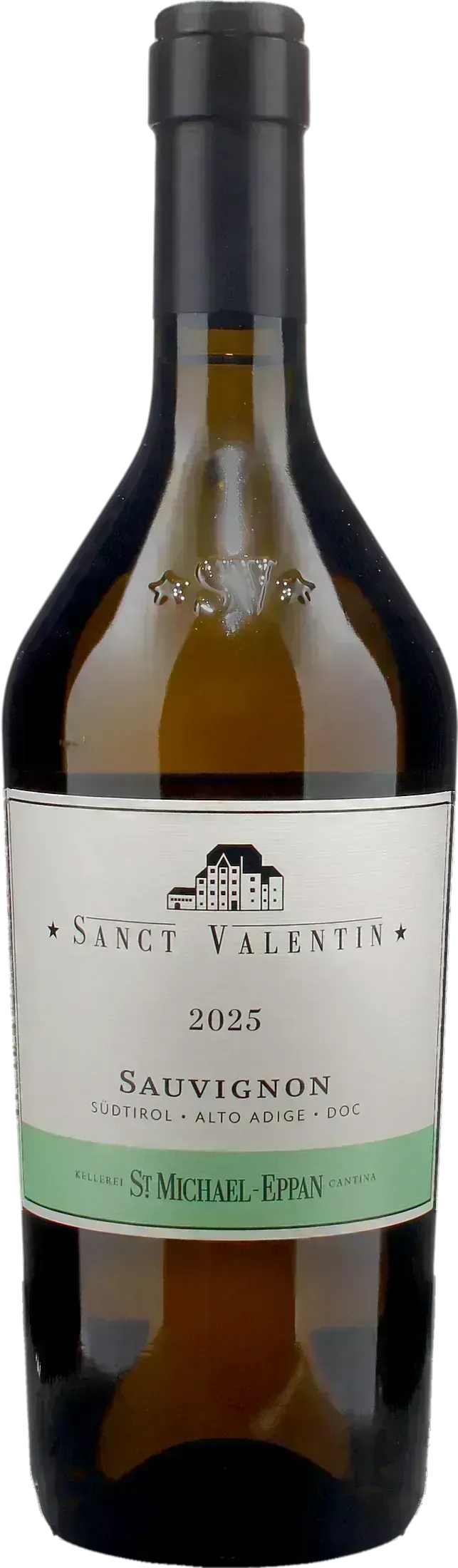
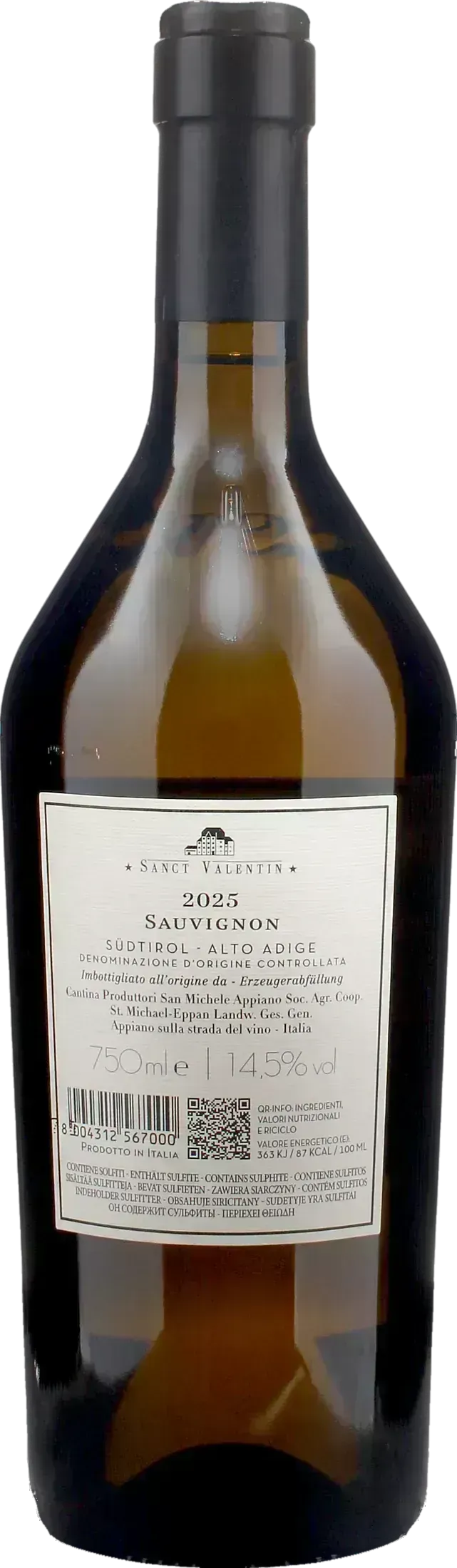
Sanct Valentin Sauvignon 2025
| Denomination | DOC Alto Adige Sauvignon |
|---|---|
| Size | 0,75 l |
| Alcohol content | 14.5% by volume |
| Area | Trentino Alto Adige (Italy) |
| Grape varieties | 100% Sauvignon |
| Aging | Approximately 80% ferments in steel tanks and rests on the fine lees until late April; the remaining 20% is fermented and aged in wood (10% in large casks and 10% in tonneaux). |
- Origin and variety: Alto Adige DOC, 100% Sauvignon from San Michele Appiano
- Vinification method: 80% in stainless steel on the fine lees until April, 20% in wood and tonneaux
- Aromas: notes of yellow fruit, gooseberry, elderflower and ripe currants
- Taste profile: lively acidity, soft and full structure with a persistent mineral finish
- Awards: 4 Bibenda grapes, 96 pts Maroni, 94 pts Suckling, 93 pts Decanter
Description
What type of wine it is
Sanct Valentin Sauvignon by San Michele Appiano is a still white wine produced with Sauvignon grapes within the Alto Adige appellation. This wine stands out for its elegant profile and complex aromaticity, offering a crisp acidity and a soft body that fills the palate with fullness. On the nose, it expresses an intense and layered bouquet, dominated by notes of gooseberry, elderflower, yellow fruit and ripe currants. The vinification, which combines the use of steel and wood, gives the structure remarkable longevity and a persistent finish, outlining a structured style that is reflected in a brilliant chromatic hue.
Where it comes from
This Sauvignon comes from vineyards located between San Michele and Appiano Monte, within the Trentino Alto Adige wine region. The vines, cultivated with the Guyot system and exposed to the south-east, grow at an altitude between 450 and 650 metres above sea level. The gravelly soil with a significant limestone component plays a fundamental role in the development of the wine's aromatic profile. These specific pedoclimatic conditions, combined with the age of the plants, favour optimal yields and contribute to defining the pronounced minerality typical of mountain vineyards.
How it is produced
The production process begins in mid-September with the manual harvest, during which the bunches are carefully selected in the vineyard to ensure the highest quality of the raw material. The vinification is divided into different stages to enhance the complexity of the grape variety. Most of the must ferments in steel vats, where the wine rests on the fine lees until the end of April, preserving freshness and fruity aromas. The remaining part is fermented and refined in wooden barrels and tonneaux, an essential technical step that gives the wine further breadth and an enveloping structure.
History and curiosities
The San Michele Appiano Sanct Valentin Sauvignon 2025 is a masterpiece of South Tyrolean viticulture, the flagship of the Sanct Valentin range. Produced in Trentino Alto Adige, it is made from selected grapes from the finest vineyards between San Michele and Appiano Monte, at an altitude of 450-650 metres. The vines, aged between 10 and 33 years and Guyot-trained, have earned numerous accolades from critics such as Luca Maroni, James Suckling and Robert Parker.
Awards
-
2025
 94
/100
James Suckling is an influential American wine critic and journalist who worked at Wine Spectator for 30 years. He left the magazine in 2010 to start his own website and guidebook (JamesSuckling.com). He specialises in Italian and Bordeaux wines.
Tasting notes
Perfume

Color
Taste
Serve at:
12 - 14 °C
Longevity:
05 - 10 years
- Start up year: 1907
- Oenologist: Hans Terzer
- Bottles produced: 2.800.000
- Hectares: 390
The surrounding soils offer exceptional characteristics for the cultivation of unique wines. Harvest after harvest, passion has become culture. Read more


| Name | San Michele Appiano Sanct Valentin Sauvignon 2025 |
|---|---|
| Type | White still |
| Denomination | Alto Adige DOC |
| Vintage | 2025 |
| Size | 0,75 l |
| Alcohol content | 14.5% by volume |
| Grape varieties | 100% Sauvignon |
| Country | Italy |
| Region | Trentino Alto Adige |
| Vendor | San Michele Appiano |
| Story | History and curiosities The San Michele Appiano Sanct Valentin Sauvignon 2025 is a masterpiece of South Tyrolean viticulture, the flagship of the Sanct Valentin range. Produced in Trentino Alto Adige, it is made from selected grapes from the finest vineyards between San Michele and Appiano Monte, at an altitude of 450-650 metres. The vines, aged between 10 and 33 years and Guyot-trained, have earned numerous accolades from critics such as Luca Maroni, James Suckling and Robert Parker. |
| Origin | St Michael and Appiano Monte (Appiano on the Wine Road, Bolzano, South Tyrol, Italy) |
| Soil composition | Gravelly with a limestone component |
| Yield per hectare | 45 hectolitres per hectare |
| Harvest | Mid-September |
| Fermentation | Until the end of April |
| Production technique | Fermentation in stainless steel tanks with maturation on the fine lees until the end of April; partial fermentation and ageing in wood (large casks) and in tonneaux. |
| Wine making | Approximately 80% ferments in stainless steel tanks and remains on the fine lees until the end of April; the remaining 20% is vinified in wood, of which 10% is in large casks and 10% in tonneaux (fermentation and ageing in wood and tonneaux for one part, and in stainless steel for the remainder). |
| Aging | Approximately 80% ferments in steel tanks and rests on the fine lees until late April; the remaining 20% is fermented and aged in wood (10% in large casks and 10% in tonneaux). |
| Total acidity | 6.3 gr/L |
| Residual sugar | 3.8 gr/L |
| Allergens | Contains sulphites |