


Villa Russiz
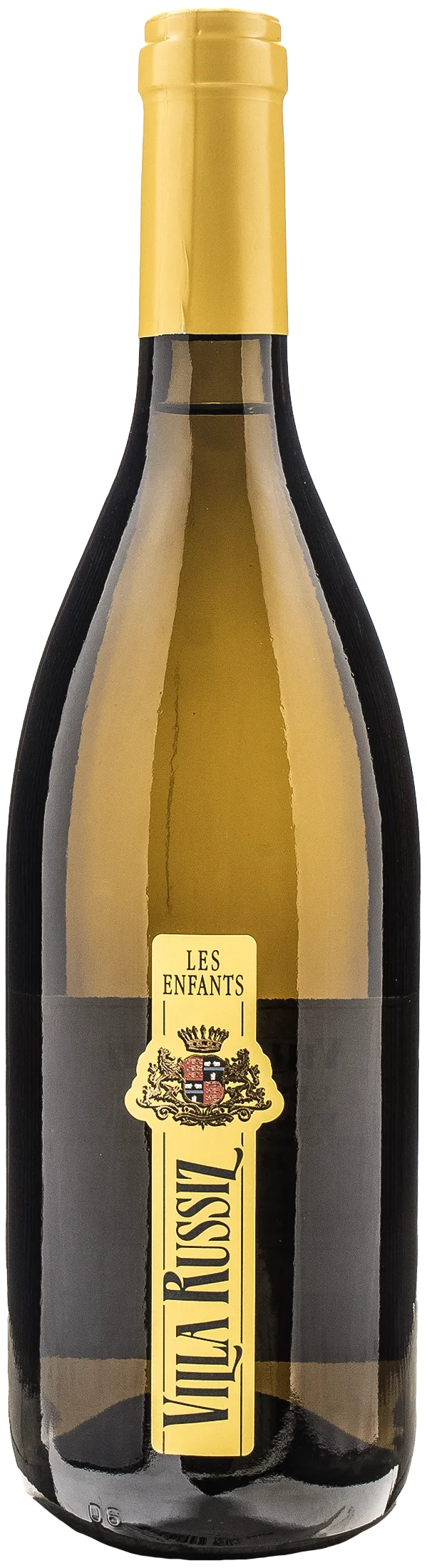
Les Enfants Bianco
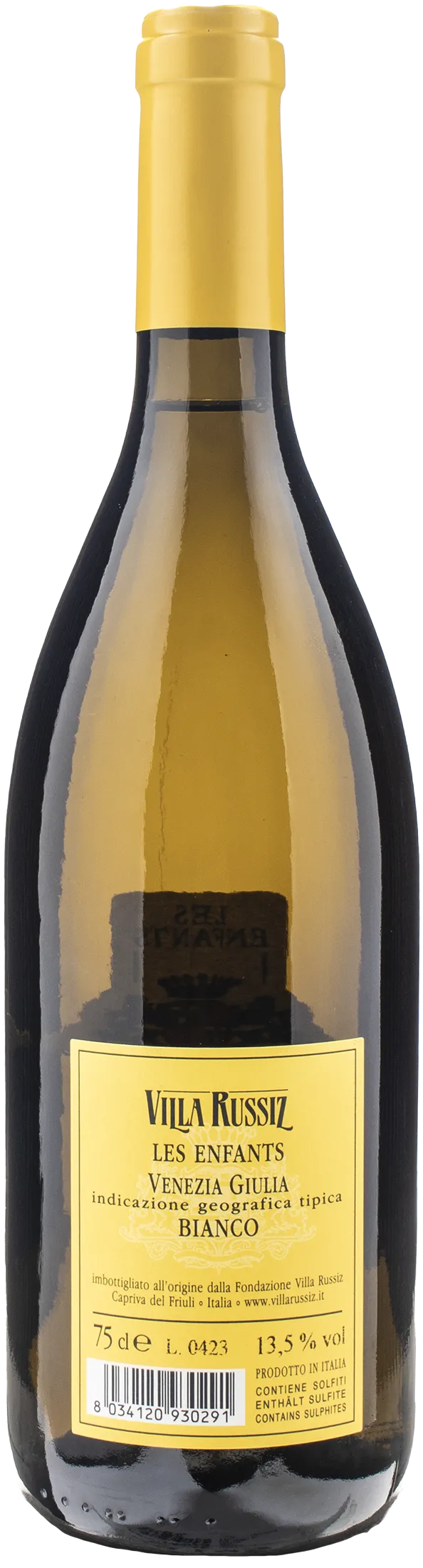
| Denomination | IGT Venezia Giulia |
|---|---|
| Size | 0,75 l |
| Alcohol content | 13.5% by volume |
| Area | Friuli-Venezia Giulia (Italy) |
| Grape varieties | 33% Pinot Bianco, 33% Pinot Grigio, 17% Ribolla Gialla, 16% Sauvignon |
| Aging | The wines are blended at the end of fermentation and remain on the fine lees for at least 7 months; they are bottled 8-9 months after the harvest. |
- Blend of white grapes: Pinot Bianco, Pinot Grigio, Ribolla Gialla, Sauvignon Blanc
- Delicate aroma: notes of Golden apple and ripe fruit in a refined bouquet
- Velvety taste: balanced and enveloping sip, with prolonged persistence
- Aged on fine lees: minimum 7 months for superior structure and smoothness
- Data and serving: 13.5% vol, 0.75 l; serving temperature 12-14 °C; storage 5-10 years
Description
What kind of wine it is
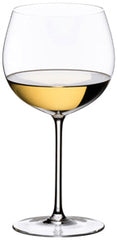
Villa Russiz Les Enfants Bianco is a still white wine that expresses the soul of the Venezia Giulia region. It is born from a harmonious blend of white grape varieties, where Pinot Bianco, Pinot Grigio, Ribolla Gialla and Sauvignon Blanc come together to create a balanced and enveloping organoleptic profile. To the eye, it presents a bright straw yellow hue, anticipating a delicate bouquet characterised by distinct notes of Golden apple and nuances of ripe fruit. On the palate, it reveals a pleasant velvety texture, accompanying an elegant drink and a finish of excellent persistence.
Where it comes from
The grapes dedicated to this label come from the lush hillside vineyards surrounding the Villa Russiz estate, a historic establishment founded in 1868. The vines grow on a distinctive entirely marl soil, which gives the wine remarkable aromatic finesse. The south-facing rows, together with the Guyot training system, ensure optimal ripening of the bunches. The winery, renowned for its crus in the Collio area, manages its vineyards by maintaining an appropriate planting density, essential for achieving balanced yields and fruit with great expressive concentration.
How it is produced
Vinification begins with the separate harvesting of the different varieties at full ripeness. In the winery, the whole grapes undergo a gentle pneumatic pressing, followed by the first racking of the must. Fermentation takes place in temperature-controlled tanks, thus preserving the integrity of the varietal aromas. Subsequently, the base wines are combined in the final blend, which undergoes a period of ageing on fine lees for at least seven months; this technical choice is fundamental for enriching the wine with structure and smoothness. The process concludes about nine months after the harvest, offering a white wine capable of evolving elegantly over time.
History and Curiosities
Founded in 1868 in Friuli-Venezia Giulia, the Villa Russiz estate boasts a long tradition of oenological excellence. Around the heart of the estate stretch thirty hectares of lush hillside vineyards, rooted in a distinctive entirely marl soil that gives the grapes a unique character. Thanks to the expert guidance of oenologists Fabijan Muzic and Giorgio Bertossi, meticulous agronomic care and constant technical research combine to create a production of the highest quality, capable of offering elegant internationally renowned wines with timeless appeal.
Tasting notes

Perfume

Color

Taste
Serve at:
12 - 14 °C
Longevity:
05 - 10 years
- Start up year: 1868
- Oenologist: Fabijan Muzic, Giorgio Bertossi
- Bottles produced: 250.000
- Hectares: 45
Théodore de La Tour was the first to understand the essence that made Collio wines great worldwide. Here, the extraordinary microclimate can offer the maximum benefits in the encounter between the cool winds of the Julian Alps and the sea breezes of the nearby Adriatic, and both softened in the perfectly exposed hills of Capriva del Friuli.
Therefore, this gave rise to what is still today the fundamental basis of Villa Russiz: new varieties best suited to the territory and capable of developing quality at the highest levels, a marvellous cellar with large vaults that is entirely underground, and a passion and constant commitment to attention to detail from the vineyard, to the wine factory, to the bottle.
Villa Russiz was and still is a symbol of generosity and sentiment. The sentiment of Elvine Ritter who, after the death of her husband in 1894, continued the count's commitment until she was overwhelmed by the events of the First World War and decided to leave the estate. Later, the generosity of the noblewoman Adele Cerruti took the form of vital help and support for children, which continues to this day, with the configuration of Villa Russiz into a non-profit organisation. The meticulous passion for viticulture is more alive today than ever at Villa Russiz, in the 94 hectares that make up the estate, 30 of which are given over to vineyards, with particular attention to keeping the number of vines per hectare between 4,500 and 7,000, thus guaranteeing grapes of great concentration. The wines of Villa Russiz are all part of the Collio DOCG, as are the three crus: Sauvignon de La Tour, Graf de La Tour and Grafin de La Tour. These three crus are the company's flagship for a modern quest for maximum quality, a coherent path of development and for creating great wines of international standing. Read more


| Name | Villa Russiz Les Enfants Bianco |
|---|---|
| Type | White still |
| Denomination | Venezia Giulia IGT |
| Size | 0,75 l |
| Alcohol content | 13.5% by volume |
| Grape varieties | 33% Pinot Bianco, 33% Pinot Grigio, 17% Ribolla Gialla, 16% Sauvignon |
| Country | Italy |
| Region | Friuli-Venezia Giulia |
| Vendor | Villa Russiz |
| Story | History and Curiosities Founded in 1868 in Friuli-Venezia Giulia, the Villa Russiz estate boasts a long tradition of oenological excellence. Around the heart of the estate stretch thirty hectares of lush hillside vineyards, rooted in a distinctive entirely marl soil that gives the grapes a unique character. Thanks to the expert guidance of oenologists Fabijan Muzic and Giorgio Bertossi, meticulous agronomic care and constant technical research combine to create a production of the highest quality, capable of offering elegant internationally renowned wines with timeless appeal. |
| Origin | Vineyards located on the hills surrounding the company headquarters |
| Soil composition | Entirely marly soil |
| Cultivation system | Guyot |
| Plants per hectare | 4500 |
| Production technique | Pneumatic pressing; fermentation in temperature-controlled tanks; blending at the end of fermentation; ageing on fine lees for at least 7 months; bottling 8-9 months after harvest |
| Wine making | The whole grapes are placed in the pneumatic press; after an initial racking, the must is transferred to fermentation tanks at a controlled temperature. The wines are blended at the end of fermentation and remain on the fine lees for at least 7 months; bottling takes place 8-9 months after the harvest. |
| Aging | The wines are blended at the end of fermentation and remain on the fine lees for at least 7 months; they are bottled 8-9 months after the harvest. |
| Total acidity | 5.2 gr/L |
| Year production | 250000 bottles |
| Allergens | Contains sulphites |