


Podere Conca
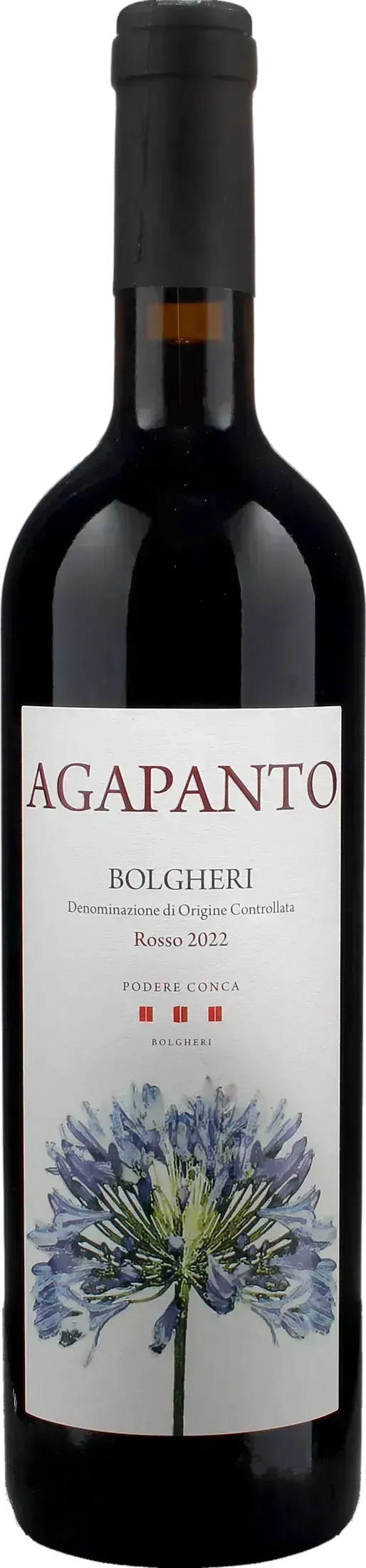
Bolgheri Agapanto 2022
| Denomination | DOC Bolgheri Rosso |
|---|---|
| Size | 0,75 l |
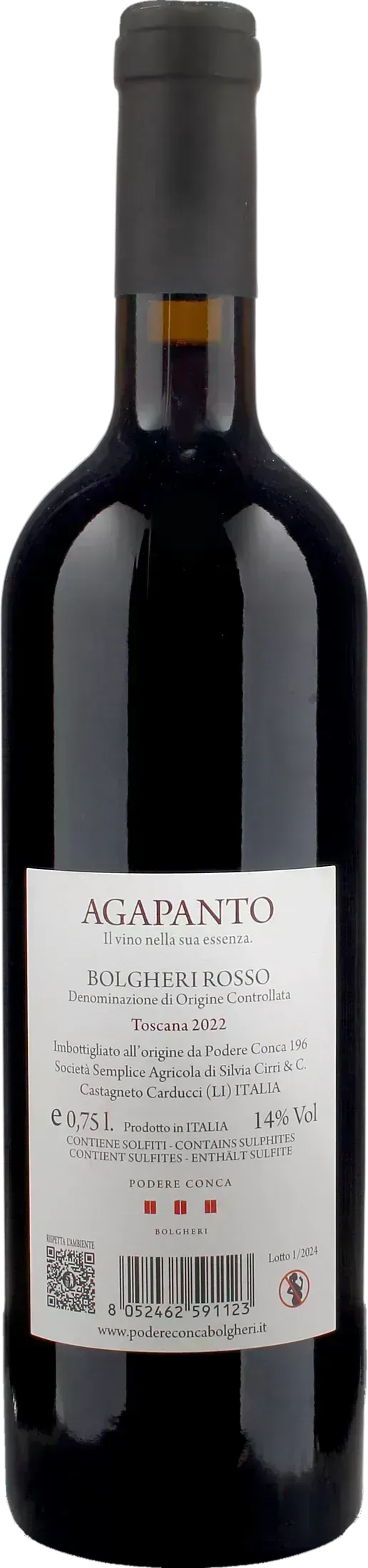
| Alcohol content | 14.0% by volume |
| Area | Tuscany (Italy) |
| Grape varieties | Cabernet Franc, Cabernet Sauvignon, Ciliegiolo |
| Aging | Ageing in second and third-passage barriques and tonneaux for 12 months. |
- Origin: Bolgheri DOC, Tuscany; still red wine from Podere Conca
- Grape varieties: Blend of Cabernet Franc, Cabernet Sauvignon and Ciliegiolo
- Winemaking: Fermented for 20 days in concrete; aged for 12 months in wooden barrels
- Sensory profile: Notes of red fruits; dry, full-bodied taste with a persistent finish
- Pairings: 14% vol, decant for one hour. Ideal for accompanying meats and cured meats
Description
What type of wine is it
Podere Conca's Bolgheri Agapanto is a red wine made from a careful blend of Cabernet Franc, Cabernet Sauvignon, and Ciliegiolo, produced in Tuscany in the renowned Bolgheri appellation. In the glass, it presents an intense and vibrant red colour, revealing distinct notes of red fruits on the nose. On the palate, it is dry and vibrant, supported by a full yet fresh body, which develops into a harmonious and persistent finish. Its structured profile is the result of fermentation in concrete followed by a calibrated ageing in wooden barrels.
Where it comes from
This wine originates from the famous Bolgheri area, in the heart of Tuscany. Production is entrusted to the Podere Conca agricultural estate, which is set around a historic 19th-century farmhouse surrounded by organically grown olive trees. The wine's name is a tribute to the Agapanthus, a flower of African origin that symbolises selfless love.
How it is produced
The winemaking process begins with a manual harvest of the bunches, which are promptly de-stemmed and crushed once they reach the cellar. Fermentation takes place inside concrete tanks and lasts about twenty days, a step designed to enhance aromatic extraction while keeping the primary characteristics of the grapes intact. The subsequent phase involves ageing for twelve months in second and third-passage barrels. This targeted period in wood enriches the wine's structure, ensuring balance while at the same time preserving a pleasant drinking freshness.
History and facts
Bolgheri Rosso Agapanto takes its name from the African flower on the label, a symbol of selfless love. Produced at Podere Conca, in a 19th-century farmhouse set amongst organic olive trees, it is overseen by the oenologist Linda Franceschi. With the introduction of Cabernet Franc in 2015, it has achieved prestigious accolades, including 91 James Suckling points, 90 Decanter points, and 4 AIS vines.
Awards
-
2022
 3
One of the most prestigious wine guides in Italy.
-
2022
 4
Italian Sommelier Association (AIS) guide
Tasting notes

Perfume

Color

Taste
Serve at:
16 - 18 °C
Longevity:
10 - 15 years
Decanting time:
1 hour

- Start up year: 2015
- Oenologist: Linda Franceschi
- Bottles produced: 30.000
- Hectares: 5
The Podere, at 196 of the Strada Provinciale Bolgherese, a few kilometers from the famous Viale dei Cipressi and Castagneto Carducci in the province of Livorno, Tuscany, has been the vacation home of the family of Silvia Cirri, the majority shareholder and CEO of the company, since the 1980s. It is located in the center of a 3.8-hectare basin with 800 olive trees, some of which are centuries-old, of the typically Tuscan varieties Leccino, Frantoio and Moraiolo, among whose rows in 2015 0.2 hectares of Cabernet Franc were planted.
The production of the oil, started by Silvia's mother, has been conducted since the very beginning using organic farming and the Extra Virgin Olive Oil Organic IGP Toscano now also boasts the new territorial denomination Bolgheri. Read more


| Name | Podere Conca Bolgheri Agapanto 2022 |
|---|---|
| Type | Red green still |
| Denomination | Bolgheri DOC |
| Vintage | 2022 |
| Size | 0,75 l |
| Alcohol content | 14.0% by volume |
| Grape varieties | Cabernet Franc, Cabernet Sauvignon, Ciliegiolo |
| Country | Italy |
| Region | Tuscany |
| Vendor | Podere Conca |
| Story | History and facts Bolgheri Rosso Agapanto takes its name from the African flower on the label, a symbol of selfless love. Produced at Podere Conca, in a 19th-century farmhouse set amongst organic olive trees, it is overseen by the oenologist Linda Franceschi. With the introduction of Cabernet Franc in 2015, it has achieved prestigious accolades, including 91 James Suckling points, 90 Decanter points, and 4 AIS vines. |
| Origin | Bolgheri, Tuscany, Italy |
| Fermentation | 20 days |
| Production technique | Manual harvesting of the grapes; destemming and crushing; fermentation in concrete tanks for 20 days; ageing in second- and third-fill barriques and tonneaux for 12 months |
| Wine making | The grapes are harvested by hand, destemmed, crushed and fermented in concrete tanks for 20 days; ageing in second and third-use barriques and tonneaux for 12 months. |
| Aging | Ageing in second and third-passage barriques and tonneaux for 12 months. |
| Allergens | Contains sulphites |