


Capovilla
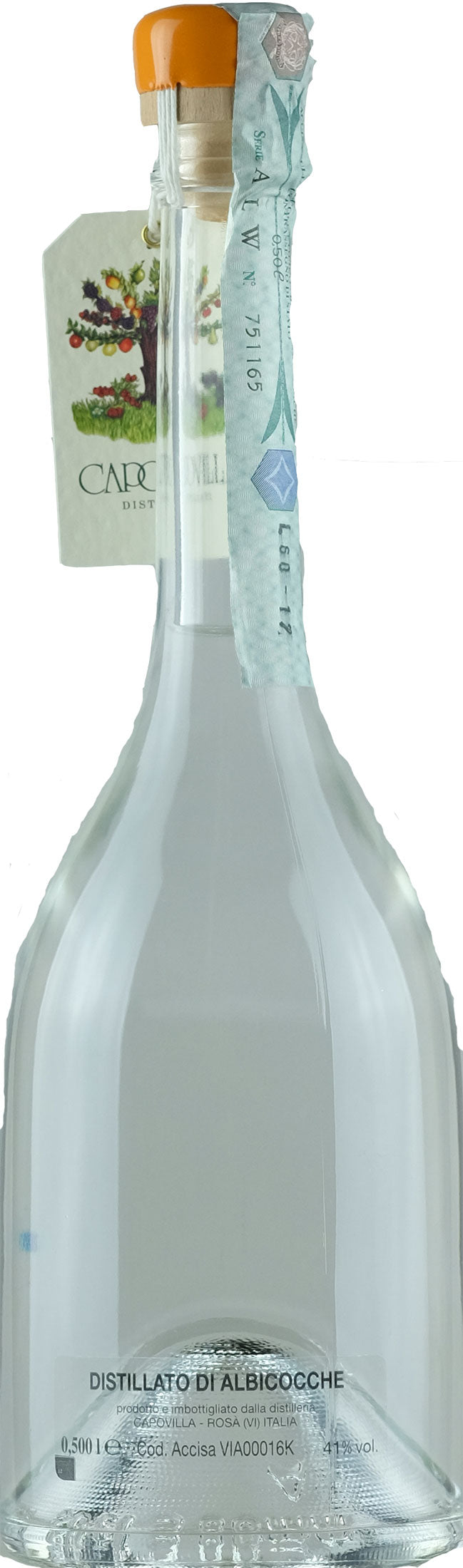
Distillato di Albicocche 0.5L
| Size | 0,50 l |
|---|---|
| Alcohol content | 41.0% by volume |
| Area | Veneto (Italy) |
| Aging | Ageing for a few years in stainless steel tanks before bottling. |
- Origin and format: Apricot distillate, 0.5L, 41% vol, produced in Veneto
- Organic apricots: Harvested at ideal ripeness, without pesticides or treatments
- Spontaneous fermentation: Initiated by the natural yeasts present on the fruit skin
- Double distillation: In a bain-marie at 103°C, without the stone to prevent bitter notes
- Maturation and aromas: Aged for years in stainless steel; hints of ripe apricot and sweet spices

Description
What type of spirit it is
Capovilla Apricot Brandy is a fruit spirit produced in Veneto, Italy, with an alcohol content of 41% vol. It appears clear and transparent, while the nose offers aromas of ripe and jammy apricot, combined with sweet spices and mineral notes. On the palate, it is fresh, delicate and persistent, characterised by floral and fruity apricot notes that allow it to be tasted without complex accompaniments. The production process involves spontaneous fermentation and a double distillation in a bain-marie, followed by a period of ageing in stainless steel.
Where it comes from
The spirit comes from the municipality of Rosà, located in the province of Vicenza, in the Veneto region of Italy. Gianni Capovilla's dedication to distillation has its roots in 1974, the year he began to take an active interest in this field. Previously, his work was as a mechanic employed in the wine sector, a previous technical experience that preceded his focus on processing spirits.
How it is produced
The organic apricots used are harvested at the moment of their optimal ripeness and undergo no treatment with pesticides or antifungal agents. The harvested fruit is transformed into a purée, carefully removing the stone, as this component could give a bitter taste to the final liquid. Subsequently, spontaneous fermentation begins, favoured by the indigenous yeasts found naturally on the fruit skins. The following phase consists of a double distillation in a bain-marie at a temperature of 103 °C; the prolonged duration of this technical process allows the fruit's aromas to be preserved. At the end of processing, the spirit undergoes an ageing period for a few years in stainless steel containers.
History and interesting facts
The Apricot Spirit stems from the passion of Gianni Capovilla, which blossomed in 1974. Starting out as an oenological mechanic, he became a pioneer of distillation in Italy and today enjoys worldwide fame as a master distiller. A curious detail of the production process is the use of special machinery to remove the stones during crushing, as these could impart a bitter taste. This is followed by spontaneous fermentation and double distillation in a bain-marie: the extended duration of the latter allows for the preservation of the fruit's aromas and scents.
Tasting notes

Perfume

Color

Taste
Serve at:
10 - 12 °C

Numerous trips abroad, particularly Switzerland,
Germany and Austria, allowed me to discover the world of distillation which, unlike what was happening in Italy, laid the foundation for a completely different culture.
At that time in our country all had the ambition to distill "something" in the house without having the compenses to do so.
The passion for the world of distillates was born by accident in '74, the year I started to deal with machinery for oenology.
Many trips abroad, particularly Switzerland, Germany and Austria, allowed me to discover the world of distillation which, unlike what was happening in Italy, laid the foundations
on a completely different culture.
At that time in our country all had the ambition to distill "something" in the house without having the compenses to do so. Read more


| Name | Capovilla Distillato di Albicocche 0.5L |
|---|---|
| Type | Fruit |
| Size | 0,50 l |
| Alcohol content | 41.0% by volume |
| Country | Italy |
| Region | Veneto |
| Vendor | Capovilla |
| Story | History and interesting facts The Apricot Spirit stems from the passion of Gianni Capovilla, which blossomed in 1974. Starting out as an oenological mechanic, he became a pioneer of distillation in Italy and today enjoys worldwide fame as a master distiller. A curious detail of the production process is the use of special machinery to remove the stones during crushing, as these could impart a bitter taste. This is followed by spontaneous fermentation and double distillation in a bain-marie: the extended duration of the latter allows for the preservation of the fruit's aromas and scents. |
| Origin | Rosà (Vicenza) |
| Production technique | Spontaneous fermentation with indigenous yeasts and double distillation in a bain-marie (103°C) |
| Aging | Ageing for a few years in stainless steel tanks before bottling. |
| Allergens | Contains sulphites |