
Under the law of Hong Kong, intoxicating liquor must not be sold or supplied to a minor in the course of business. | 根據香港法律,不得在業務過程中,向未成年人售賣或供應令人醺醉的酒類。


Passopisciaro (Vini Franchetti)
Etna Rosso Passorosso 2024
| Denomination | DOC Etna Rosso |
|---|---|
| Size | 0,75 l |
| Alcohol content | 14.5% by volume |
| Area | Sicily (Italy) |
| Grape varieties | 100% Nerello Mascalese |
| Aging | Overall maturation of about 18 months: 10 months in large oak and cement casks, followed by 6 months in bottle |
- Etna DOC Territory: Nerello Mascalese from the northern slope on volcanic ash soils
- Historic vineyards: 80-110 year old vines restored by Andrea Franchetti in Passopisciaro
- Aged for 18 months: in large oak barrels, cement and then in bottle
- Tasting profile: bright ruby colour, mineral notes and a smoky finish
- Pairings: decant for 1 hour; ideal to accompany meats and cheeses

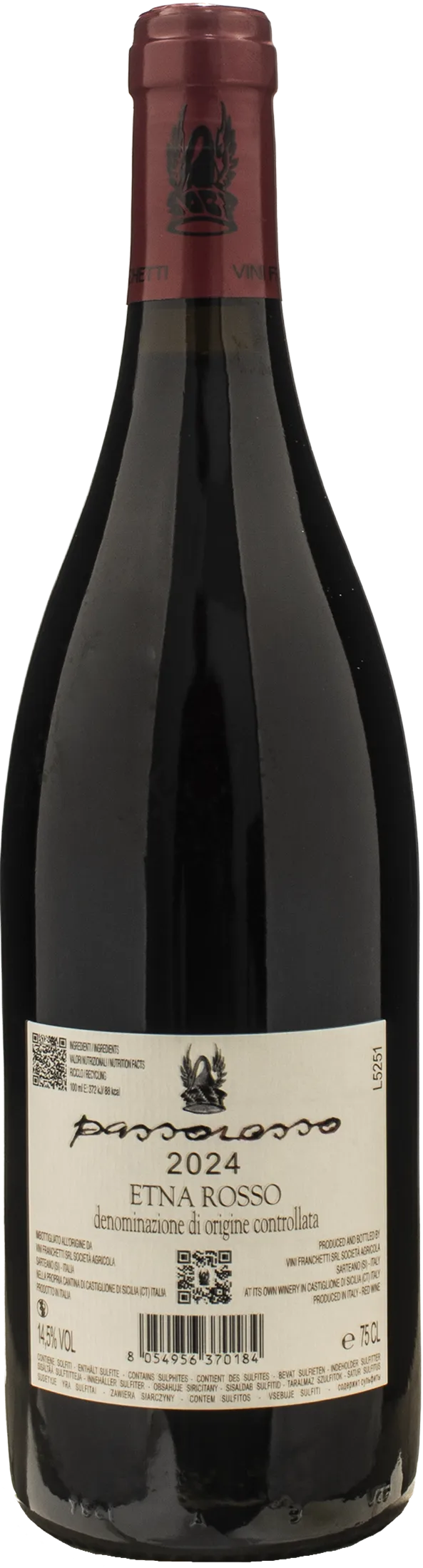
Description
What kind of wine it is
This still red wine expresses the elegance of Nerello Mascalese. Produced by Passopisciaro on Mount Etna, it presents a brilliant ruby colour. The aromatic profile reveals a distinct mineral note, enriched with hints of citrus, wild berries, peppercorns, fern and camphor. On the palate, it is structured and balanced, supported by a noble tannic texture. The pronounced smoky persistence makes it ideal for pairing with pork, roast meats and mature cheeses.
Where it comes from
The grapes grow on the northern slopes of Mount Etna, at an altitude between five hundred and one thousand one hundred metres. The historic vineyards are located in the districts of Spirito, Moganazzi, Favazza, Feudo di Mezzo and Malpasso, where cool nights preserve the integrity of the aromas. The roots delve into soils composed of volcanic ash and coarse gravel, which impart a vibrant gustatory tension and an authentic territorial character to the wine.
How it is produced
The process begins with alcoholic fermentation in steel vats for about fifteen days. During vinification, natural elements such as clay and propolis, grapefruit and sulphur extracts are used. Malolactic fermentation takes place in large oak barrels, followed by eighteen months of ageing. The wine matures for ten months between the wood of the barrels and cement, then completes its journey with a rest in the bottle that defines its final harmony.
History and Curiosities
In 2000, Andrea Franchetti restored ancient, centuries-old vineyards abandoned on the northern slope of Mount Etna, founding the Passopisciaro estate. From prized Nerello Mascalese grapes, rooted at high altitude among volcanic ash and gravel from ancient lava flows, an extraordinary red wine is born. This elegant Etna DOC harmonises the characteristics of different districts in a fascinating synthesis of the territory.
Tasting notes

Perfume

Color

Taste
Serve at:
14 -16 °C
Longevity:
10 - 15 years
Decanting time:
1 hour

- Start up year: 2000
- Oenologist: Andrea Franchetti
- Bottles produced: 90.000
- Hectares: 27
At the top of the steep Passopisciaro property looms a hump of black gravel. It’s where the lava spill from a big eruption in 1947 had stopped, caking up just before it could submerge whole terraces below it, vines, walls, and buildings: on Etna you can lose it all.
Here, it’s always very cold at night, even in August. During the day in the vineyards the lava powder penetrates in the skin and you get intoxicated, tired. The first wine I made was pale and meager, and I was discouraged. I planted other grapes; whatever is planted there the wine always tastes of citrus and camphor, without that generous body that you like earth to lend right away to a wine.
There’s no mold, no moss; the ground sparkles black like the night; the wine slowly becomes very elegant and strange. During the day a soft light penetrates everything and then there are starry nights; Etna has enormous poetry. Making wine, you have access to it. There isn’t Mother Nature here. You are conducting your viticulture on stuff that comes out of the terrible below." (Andrea Franchetti) Read more


| Name | Passopisciaro Etna Rosso Passorosso 2024 |
|---|---|
| Type | Red green still |
| Denomination | Etna DOC |
| Vintage | 2024 |
| Size | 0,75 l |
| Alcohol content | 14.5% by volume |
| Grape varieties | 100% Nerello Mascalese |
| Country | Italy |
| Region | Sicily |
| Vendor | Passopisciaro (Vini Franchetti) |
| Story | History and Curiosities In 2000, Andrea Franchetti restored ancient, centuries-old vineyards abandoned on the northern slope of Mount Etna, founding the Passopisciaro estate. From prized Nerello Mascalese grapes, rooted at high altitude among volcanic ash and gravel from ancient lava flows, an extraordinary red wine is born. This elegant Etna DOC harmonises the characteristics of different districts in a fascinating synthesis of the territory. |
| Origin | Northern slope of Mount Etna (districts of Spirito, Moganazzi, Favazza, Feudo di Mezzo, Malpasso), Castiglione di Sicilia, Sicily, Italy |
| Climate | Cool nights even in summer thanks to the high altitude |
| Soil composition | Volcanic ash (from ancient lava flows) and coarse gravel |
| Plants per hectare | 8000 plants per hectare |
| Yield per hectare | 40 hl/ha |
| Harvest | 20, 21, 22 and 29 October |
| Fermentation | 15 days |
| Production technique | Alcoholic fermentation for 15 days in stainless steel tanks; malolactic fermentation in large oak barrels; use of natural additives (clay, propolis, grapefruit and sulphur extracts); maturation for about 18 months (10 months in large oak and cement barrels, then 6 months in bottle) |
| Wine making | Alcoholic fermentation for 15 days in stainless steel tanks; malolactic fermentation in large oak barrels; use of natural additives including clay, propolis, grapefruit extracts and sulphur; total maturation of about 18 months (10 months in large oak and cement barrels, then 6 months in bottle). |
| Aging | Overall maturation of about 18 months: 10 months in large oak and cement casks, followed by 6 months in bottle |
| Allergens | Contains sulphites |