


Vajra
Dolcetto d'Alba Coste&Fossati 2025
| Denomination | DOC Dolcetto d'Alba |
|---|---|
| Size | 0,75 l |
| Alcohol content | 13.5% by volume |
| Area | Piedmont (Italy) |
| Grape varieties | 100% Dolcetto |
| Aging | Ageing exclusively in stainless steel for 5 months, with two rackings, then bottled in spring. |
- Origin and grapes: 100% Dolcetto from the hills of Vergne and Fossati, Piedmont
- Steel vinification: 15-20 days fermentation below 31°C, 5 months in steel
- Aromatic profile: black cherry, wild berries, violet, white pepper and balsamic hints
- Taste characteristics: juicy and savoury palate, lively acidity and a typical almond-like finish
- Organic and service: certified organic, serve at 16-17°C, decant for 1 hour, excellent with meats

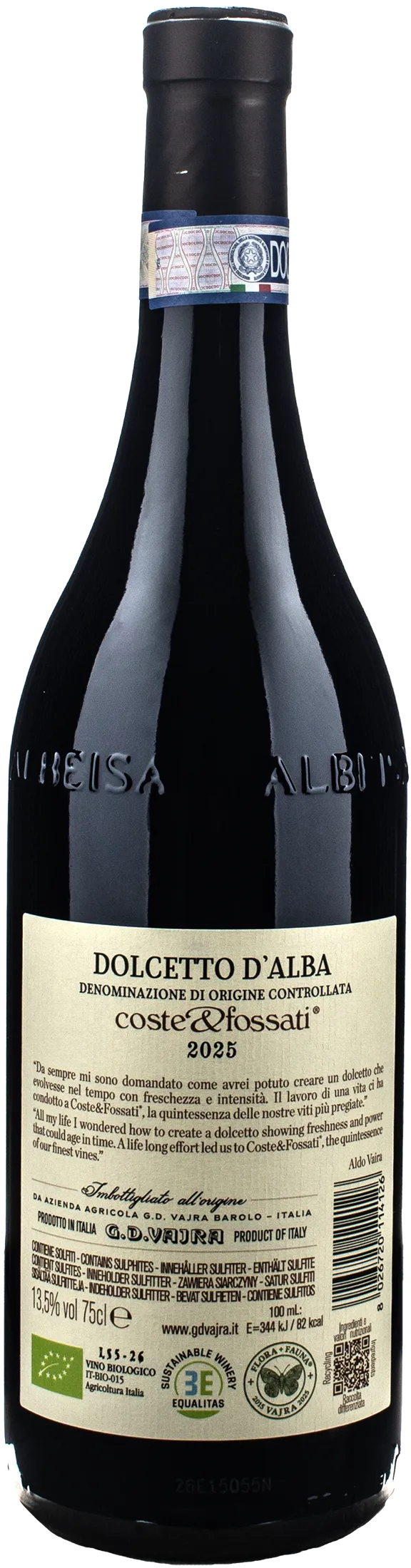
Description
What type of wine is it
The Dolcetto d’Alba Coste & Fossati by G.D. Vajra is a still red wine aged in steel that expresses the authentic essence of Dolcetto, grown with dedication in Piedmont. Produced in the Dolcetto d’Alba region, it stands out for its fresh and elegant style, supported by a structure capable of evolving pleasantly over time. On the palate, it offers a juicy and savoury sip, characterised by soft yet well-defined tannins, leading towards a finish enhanced by a distinctive almond note.
Where it comes from
The grapes come from the renowned Coste di Vergne and Fossati vineyards, historic G.D. Vajra parcels immersed in the Piedmontese wine-growing landscape. These plots are home to ancient Dolcetto biotypes, which guarantee low yields and fruit of the highest quality. The ideal exposures favour optimal phenolic ripening, ensuring an intense and balanced profile. The entire agricultural management follows the principles of organic farming, using spontaneous grassing to protect and enrich the biodiversity of the area.
How it is produced
Production begins with a late harvest, carried out to collect healthy and loose bunches. In the cellar, vinification takes place delicately for fifteen to twenty days in vertical vats, maintaining controlled temperatures and performing regular punching down. All stages of fermentation and the subsequent resting period focus on ageing in steel, which lasts for about five months with careful racking. This precise technical choice allows the aromatic purity and lively freshness of the fruit to be preserved intact until the moment of bottling.
History and interesting facts
Produced from historic vines planted in 1979 and 1985, Dolcetto d’Alba Coste & Fossati embodies Aldo Vaira’s vision: to create a wine capable of evolving over time while maintaining a vibrant freshness. The vineyards have been cultivated according to the principles of certified organic farming since 1971, protecting biodiversity through natural cover cropping. To enhance the purity of the fruit from ancient biotypes, ageing takes place for five months in stainless steel before spring bottling.
Tasting notes

Perfume

Color

Taste
Serve at:
14 -16 °C
Longevity:
05 - 10 years
Decanting time:
1 hour
- Start up year: 1972
- Oenologist: Aldo e Giuseppe Vaira
- Bottles produced: 500.000
- Hectares: 80
A true family estate, G.D. Vajra blends tradition and innovation with heartfelt authenticity. Today, alongside founders Aldo and Milena Vaira, the new generation — Giovanni, Francesca, and Isidoro — carries the vision forward, also overseeing the historic Luigi Baudana estate in Serralunga d’Alba since 2009.
Every bottle reflects the family’s artisanal spirit and deep-rooted connection to the land, offering wines with soul, identity, and a timeless elegance. Read more


| Name | Vajra G.D. Dolcetto d'Alba Coste&Fossati 2025 |
|---|---|
| Type | Red organic still |
| Denomination | Dolcetto d'Alba DOC |
| Vintage | 2025 |
| Size | 0,75 l |
| Alcohol content | 13.5% by volume |
| Grape varieties | 100% Dolcetto |
| Country | Italy |
| Region | Piedmont |
| Vendor | Vajra |
| Story | History and interesting facts Produced from historic vines planted in 1979 and 1985, Dolcetto d’Alba Coste & Fossati embodies Aldo Vaira’s vision: to create a wine capable of evolving over time while maintaining a vibrant freshness. The vineyards have been cultivated according to the principles of certified organic farming since 1971, protecting biodiversity through natural cover cropping. To enhance the purity of the fruit from ancient biotypes, ageing takes place for five months in stainless steel before spring bottling. |
| Origin | Barolo (Cuneo), Piedmont, Italy |
| Harvest | Late harvest (usually in mid-September) |
| Fermentation temperature | Below 31 °C |
| Fermentation | 15–20 days |
| Production technique | Gentle fermentation in vertical stainless steel tanks (with punch-downs) and ageing exclusively in stainless steel for 5 months, with two rackings. |
| Wine making | Late harvest (usually in mid-September); gentle fermentation for 15–20 days in vertical vats below 31°C with a couple of punch-downs per day, without submerged cap maceration; two rackings before malolactic fermentation; fermentation and malolactic conversion in stainless steel; ageing exclusively in stainless steel for 5 months with two rackings to preserve freshness and fruit, then bottling in spring. |
| Aging | Ageing exclusively in stainless steel for 5 months, with two rackings, then bottled in spring. |
| Allergens | Contains sulphites |