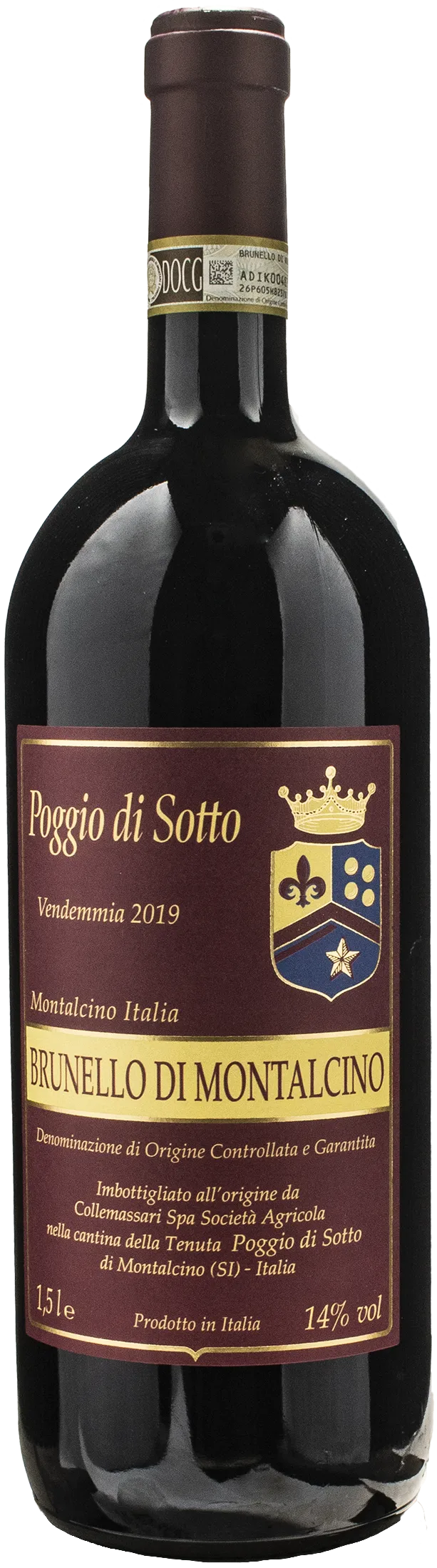
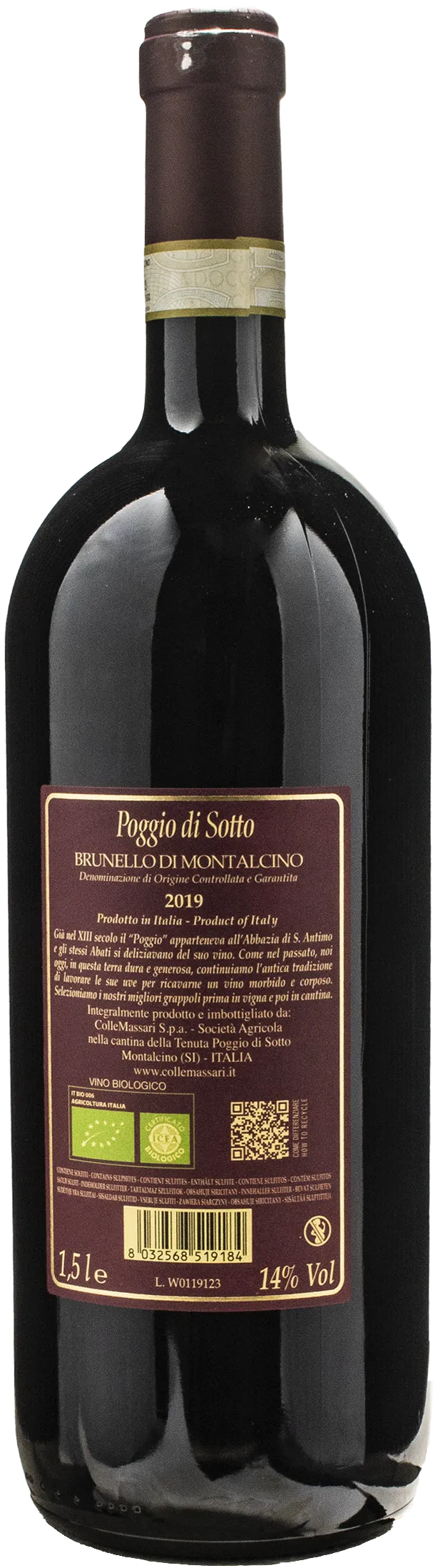
Poggio di Sotto
Brunello di Montalcino 2019
Other years:
2020| Denomination | Brunello di Montalcino DOCG |
|---|---|
| Size | 1,50 l |
| Alcohol content | 14.0% by volume |
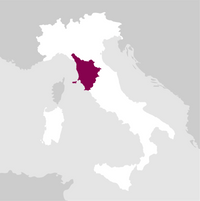
| Area | Tuscany (Italy) |
| Grape varieties | 100% Sangiovese |
| Aging | After racking, the wine matures in stainless steel and oak vats in a temperature-controlled environment until December/January. Afther that, it undergoes the malolactic fermentation. Afterwards, the wine is transferred to oak barrels from 25 to 30 hl for about four years. During this period, the Brunello will be given all the necessary attention such as racking, topping off, and analytical and sensory controls. At the end of the ageing, the wine is judged by a special public commission, and if deemed suitable it is bottled without filtration and without any treatment or addition. Ageing in the bottle lasts for at least one year. |
| Year | 2019 |
| Biologic | Sì |
| Product name | Brunello di Montalcino 2019 |
| Color | Deep ruby red with garnet reflections. |
| Perfume | Intense, rich and pronounced with ethereal and spicy notes. |
| Taste | Vigorous, harmonious, good tannins, robust structure. |
| Pairings | It perfectly matches with game. |
| Region | Tuscany |
| Country | Italy |
| Other years | 2020 |
Description
Still organic red Brunello di Montalcino DOCG, 14% ABV, produced by Poggio di Sotto. 100% Sangiovese. 1.50L magnum format, 2019 vintage. A Brunello di Montalcino that embodies the excellence of a unique terroir, with limited production and obsessive attention to quality. Harvest, determined through periodic grape sampling to measure sugar and acidity, pH, and polyphenolic content, takes place in September/October. The grapes are hand-picked and placed in perforated crates, sorted directly in the field. Fermentation begins spontaneously with indigenous yeasts. Fermentation and maceration take place in steel vats and, since 2001, also in oak vats. Maceration lasts approximately 20 days, with periodic pumping over. Delestages are sometimes performed for better color extraction. After racking, the wine ages in stainless steel and oak vats in temperature-controlled environments until December/January. During this period, the wine undergoes a second fermentation: malolactic fermentation. The wine is then transferred to oak barrels ranging in capacity from 25 to 30 hl for approximately four years. Intense and complex, with an ethereal and spicy undertone. Deep ruby red with slightly garnet hues. Robust, tannic, harmonious, balanced, and well-structured.
Awards
-
2019
 5
5Italian Sommelier Foundation (FIS) guide This has been one of the most prestigious wine guides in Italy for over 10 years.
-
2019
 95
95/100
Decanter is a wine and lifestyle magazine, published monthly in around 90 countries. The magazine includes industry news, classic guides and advice on wine and spirits.
-
2019
 3
3This guide is highly respected and offers the most comprehensive review of Italian wines. It has a long tradition and is based on blind tastings carried out by over 100 experts.
-
2019
 96
96/100
James Suckling is an influential American wine critic and journalist who worked at Wine Spectator for 30 years. He left the magazine in 2010 to start his own website and guidebook (JamesSuckling.com). He specialises in Italian and Bordeaux wines.
-
2019
 98
98/100
The prestigious international wine guide from the renowned Robert Parker, the world's most experienced and trusted wine taster.
-
2019
 3
3One of the most prestigious wine guides in Italy.
-
2019
 96
96/100
Vinous is the online guide from Antonio Galloni, one of the world's leading wine connoisseurs.
-
2019
 4
4Italian Sommelier Association (AIS) guide
-
2019
 94
94/100
Wine spectator is the most influential wine guide on the internet.
Details

Perfume

Color

Taste
Serve at:
18 - 20 °C.
Longevity:
15 - 25 years
Decanting time:
1 hour

Pairings
- Start up year: 1989
- Oenologist: Federico Staderini, Luca Marrone
- Bottles produced: 45.000
- Hectares: 20

| Name | Poggio di Sotto Brunello di Montalcino Magnum 2019 |
|---|---|
| Type | Red organic still |
| Denomination | Brunello di Montalcino DOCG |
| Vintage | 2019 |
| Size | 1,50 l |
| Alcohol content | 14.0% by volume |
| Grape varieties | 100% Sangiovese |
| Country | Italy |
| Region | Tuscany |
| Vendor | Poggio di Sotto |
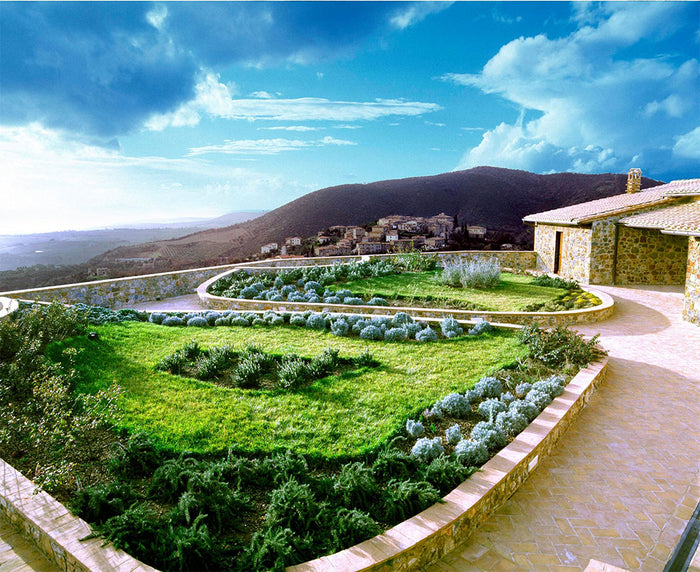
| Origin | Village of Castelnuovo dell’Abate (Siena) |
| Soil composition | Poor soil mainly composed of Marl. This kind of rock soil avoids on the one hand the stagnation of water and on the other allows water to emerge very easily from the deep layers of the soil. The big fragments of rock absorb heat during the day and give it back when it becomes cool in the evening. |
| Cultivation system | Guyot |
| Plants per hectare | About 3,000- 4,200. |
| Harvest | Usually between September and October. The grapes are picked by hand and are selected directly in the vineyards. When the grapes arrive in the wine factory in small boxes, they are once more accurately selected, destemmed and softly pressed. |
| Wine making | Fermentation starts spontaneously with indigenous yeasts. Fermentation and maceration occur in steel vats and since 2001 also in oak vats. Fermentation is followed scrupulously through chemical and sensory analyses. Maceration lasts about 20 days, during which periodic pump-overs are carried out. Delestages are also carried out for better colour extraction. |
| Aging | After racking, the wine matures in stainless steel and oak vats in a temperature-controlled environment until December/January. Afther that, it undergoes the malolactic fermentation. Afterwards, the wine is transferred to oak barrels from 25 to 30 hl for about four years. During this period, the Brunello will be given all the necessary attention such as racking, topping off, and analytical and sensory controls. At the end of the ageing, the wine is judged by a special public commission, and if deemed suitable it is bottled without filtration and without any treatment or addition. Ageing in the bottle lasts for at least one year. |
| Allergens | Contains sulphites |