


La Crotta di Vegneron
Chambave Muscat 2025
| Denomination | DOC Valle d'Aosta Chambave Moscato |
|---|---|
| Size | 0,75 l |
| Alcohol content | 13.5% by volume |
| Area | Aosta Valley (Italy) |
| Grape varieties | 100% Moscato Bianco/Moscato Reale |
| Aging | Ageing for 5 months in stainless steel on the fine lees with frequent bâtonnage |
- Style and variety: Dry still white wine made from 100% Moscato Bianco
- Aromas and flavour: Apricot, peach, sage and thyme; savoury, fresh and persistent finish
- Origin: Aosta Valley, vineyards between 450 and 750 metres on sandy morainic soils
- Vinification: 36–48h maceration, fermentation at 12–16 °C, 5 months on the fine lees
- Suitable for vegans: Equalitas sustainable certification, 13.5% vol, 750 ml bottle
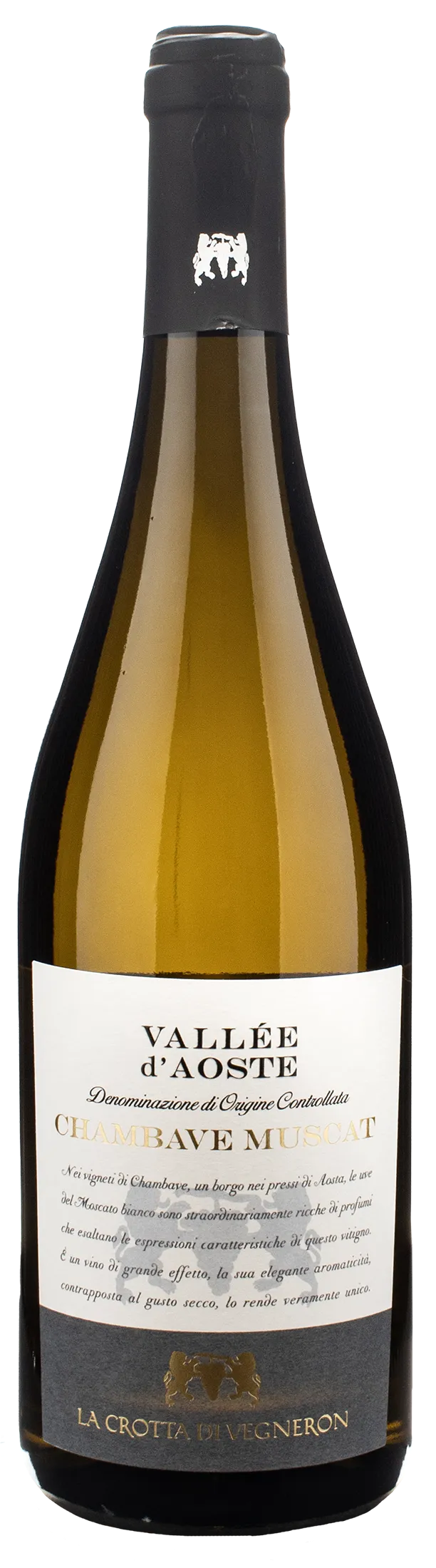
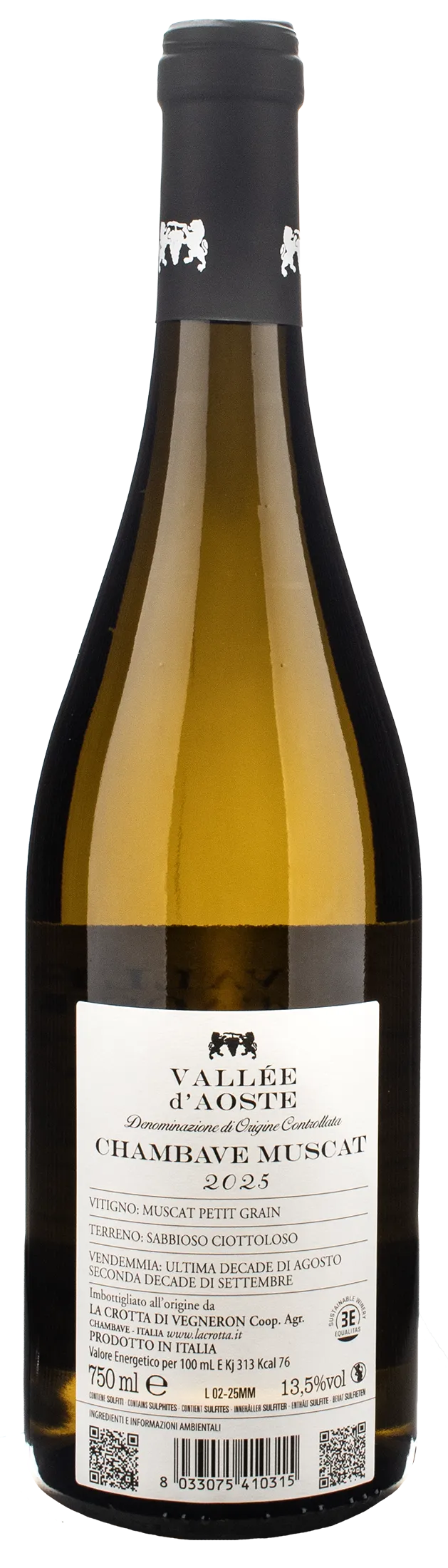
Description
Type of wine
Chambave Muscat from La Crotta di Vegneron is a still white wine with a strictly dry profile. This expression of Muscat Blanc faithfully represents the Aosta Valley Chambave territory. Through cold skin contact maceration in stainless steel, the aromatic essence of the skins is delicately extracted, preserving its natural freshness. On the palate, it is full and lively, with clear notes of apricot and peach accompanied by hints of sage and thyme, finishing with long persistence.
Origin
This wine originates in the Aosta Valley, in the municipalities of Chambave, Saint-Denis and surrounding areas, within a context of mountain viticulture with steep slopes reaching 750 metres in altitude. The Alpine climate, characterised by low rainfall and marked temperature variations, promotes excellent aromatic precision. The vines take root in morainic soils, which are shallow and stony, with a sandy texture low in clay. This geological matrix gives the wine a distinct mineral sapidity, enhancing the clarity of flavour typical of the Aosta Valley.
How it is produced
The harvest is carried out by hand, with a careful selection of Muscat Blanc bunches collected between September and October from vines grown using bush-vines, Guyot and spurred cordon systems. Fermentation takes place in temperature-controlled stainless steel tanks to keep the integrity of the fruit intact. The process is completed with ageing in stainless steel for five months on the fine lees, enhanced by frequent bâtonnage. This meticulous care in the cellar elevates the texture and olfactory clarity, ensuring a result of great purity that fully meets the requirements of a vegan diet.
History and facts
Founded in Chambave in 1980, La Crotta di Vegneron celebrates heroic viticulture with this fine and rare dry interpretation of Moscato Bianco. The grapes, grown on steep Alpine slopes at altitudes of up to 750 metres, give life to a vegan and certified sustainable wine, which has already been awarded the prestigious Gambero Rosso Tre Bicchieri.
Tasting notes

Perfume

Color

Taste
Serve at:
12 - 14 °C
Longevity:
03 - 05 years

- Start up year: 1987
- Oenologist: Andrea Costa
- Bottles produced: 200.000
- Hectares: 30
The Cooperative collects the grapes from two important production areas that give their name to the Chambave Appellation of Origin, including the villages of Chambave, Châtillon, Pontey, Saint Vincent, Saint Denis Verrayes and Nus.
The company's history is essentially based on people with solid roots in this glorious Alpine region and generations of skilled vinegrowers who are determined to achieve the highest quality from the vines. La Crotta di Vegneron continues the ancestral tradition of the farmers drawing its strength from the ancient relationship between indigenous vines and the terroir.
The Wines and Grappa spirits of La Crotta di Vegneron powerfully express the spirit of the Aosta Valley mountains through native or traditional vines, skilfully cultivated with pride. The winemaking processes are respectful of a unique terroir marked by various variants. Read more


| Name | La Crotta di Vegneron Chambave Muscat 2025 |
|---|---|
| Type | White green still dry aromatic |
| Denomination | Valle d'Aosta DOC |
| Vintage | 2025 |
| Size | 0,75 l |
| Alcohol content | 13.5% by volume |
| Grape varieties | 100% Moscato Bianco/Moscato Reale |
| Country | Italy |
| Region | Aosta Valley |
| Vendor | La Crotta di Vegneron |
| Story | History and facts Founded in Chambave in 1980, La Crotta di Vegneron celebrates heroic viticulture with this fine and rare dry interpretation of Moscato Bianco. The grapes, grown on steep Alpine slopes at altitudes of up to 750 metres, give life to a vegan and certified sustainable wine, which has already been awarded the prestigious Gambero Rosso Tre Bicchieri. |
| Origin | Vineyards in the municipalities of Chambave, Saint-Denis, Châtillon, Verrayes, Nus, Fénis and Pontey, in the Aosta Valley, Italy. |
| Climate | Alpine |
| Soil composition | Soil of glacial moraine origin, with a loose and sandy texture; shallow, stony/rich in rock fragments, slightly alkaline, with minimal clay content (up to 10%). |
| Cultivation system | Guyot, bush-vine, spurred cordon |
| Plants per hectare | 6,500–8,000 plants per hectare |
| Yield per hectare | 7,600 kg per hectare |
| Harvest | From 20 September to 5 October (depending on the altitude) |
| Fermentation temperature | 12 to 16 °C |
| Fermentation | 18–21 days |
| Production technique | Cold pre-fermentative skin maceration (36–48 hours) in stainless steel; temperature-controlled fermentation at 12–16 °C; ageing for 5 months in stainless steel on the fine lees with frequent bâtonnage |
| Wine making | In stainless steel, with cold pre-fermentative skin maceration for 36–48 hours; temperature-controlled fermentation at 12–16 °C; ageing for 5 months in stainless steel on the fine lees with frequent bâtonnage. |
| Aging | Ageing for 5 months in stainless steel on the fine lees with frequent bâtonnage |
| Year production | 55000 bottles |
| Allergens | Contains sulphites |