


La Crotta di Vegneron
Chambave Moscato Passito Prieure 0.375L 2021
| Denomination | DOC Valle d'Aosta Chambave Moscato Passito |
|---|---|
| Size | 0,50 l |
| Alcohol content | 13.5% by volume |
| Area | Aosta Valley (Italy) |
| Grape varieties | 100% Moscato Bianco/Moscato Reale |
| Aging | Aged for 12 months in stainless steel on fine fermentation lees with frequent bâtonnage |
- Grape variety and designation: 100% Moscato Bianco, DOC Valle d’Aosta Chambave Passito
- Production: grape drying, cold maceration for 36–48 hours and fermentation in stainless steel
- Ageing: 12 months in stainless steel on fine lees with frequent bâtonnage
- Tasting notes: golden yellow colour; hints of acacia, yellow peach, honey and sweet almond
- Serving and pairings: 10–12 °C; ideal with desserts, liver, cheeses and spicy dishes

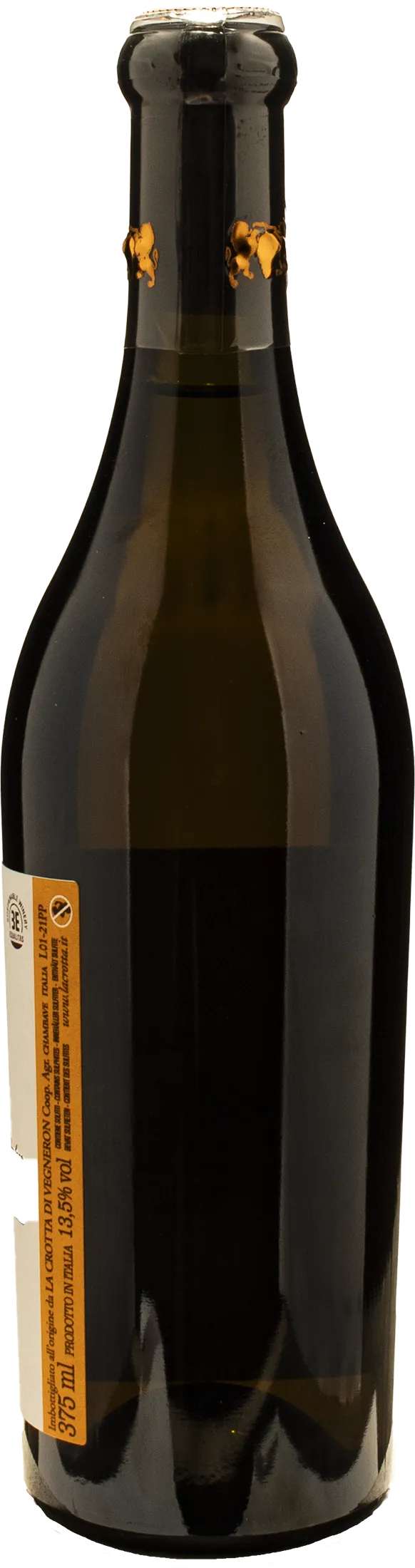
Description
What kind of wine it is
La Crotta di Vegneron Chambave Moscato Passito Prieuré is a sweet wine of great intensity, an expression of Valle d’Aosta Chambave Moscato Passito. Made from Moscato Bianco grapes, it presents a crystalline golden yellow colour. The aromatic profile is enveloping, enhanced by intense notes of acacia, wilted violet, yellow peach and honey. On the palate, it is warm and structured, with a soft sip and a long persistence of sweet almond. This roundness makes it perfect paired with blue cheeses, liver-based dishes and delicate desserts at the end of a meal.
Where it comes from
This wine originates from Chambave, an ancient Alpine village in the Aosta Valley. The vineyards are located on steep morainic slopes, situated between 450 and 680 metres above sea level, characterised by loose, sandy soils. The mountain climate encourages slow ripening, maintaining an impeccable balance between freshness and aromatic richness. Production has deep historical roots, dating back to 1494, when this nectar was offered to Charles VIII, King of France. Today, La Crotta di Vegneron preserves and enhances this extraordinary heritage.
How it is produced
The harvest carefully selects the bunches trained using the Guyot system, choosing only the ripest and healthiest fruit. Drying in well-ventilated rooms allows for the natural concentration of sugars. Vinification includes a cold skin maceration to extract the maximum aromatic charge, followed by fermentation. The wine matures in steel tanks with frequent bâtonnage on the fine lees; this process encourages yeast autolysis, enriching the structure and giving a pleasant fullness to the sip.
History and Curiosities
The origins of this nectar date back to 1494, when it was gifted to the King of France. Made from Moscato Bianco grapes dried on the steep slopes of Chambave, this wine embodies the true vocation of the Aosta Valley. The La Crotta di Vegneron winery enhances the Alpine environment, enriching the structure of the passito with expert bâtonnage in steel that imparts warmth and smoothness. Awarded the 3 Bicchieri Gambero Rosso, it releases persistent notes of sweet almond and honey, ideal for accompanying spicy cheeses and refined desserts at the end of a meal.
Awards
-
2021
 3
3This guide is highly respected and offers the most comprehensive review of Italian wines. It has a long tradition and is based on blind tastings carried out by over 100 experts.
Tasting notes

Perfume

Color

Taste
Serve at:
10 - 12 °C
Longevity:
10 - 15 years

- Start up year: 1987
- Oenologist: Andrea Costa
- Bottles produced: 200.000
- Hectares: 30
The Cooperative collects the grapes from two important production areas that give their name to the Chambave Appellation of Origin, including the villages of Chambave, Châtillon, Pontey, Saint Vincent, Saint Denis Verrayes and Nus.
The company's history is essentially based on people with solid roots in this glorious Alpine region and generations of skilled vinegrowers who are determined to achieve the highest quality from the vines. La Crotta di Vegneron continues the ancestral tradition of the farmers drawing its strength from the ancient relationship between indigenous vines and the terroir.
The Wines and Grappa spirits of La Crotta di Vegneron powerfully express the spirit of the Aosta Valley mountains through native or traditional vines, skilfully cultivated with pride. The winemaking processes are respectful of a unique terroir marked by various variants. Read more


| Name | La Crotta di Vegneron Chambave Moscato Passito Prieure 0.375L 2021 |
|---|---|
| Type | White dessert wine from grapes with noble rot dessert wine aromatic |
| Denomination | Valle d'Aosta DOC |
| Vintage | 2021 |
| Size | 0,50 l |
| Alcohol content | 13.5% by volume |
| Grape varieties | 100% Moscato Bianco/Moscato Reale |
| Country | Italy |
| Region | Aosta Valley |
| Vendor | La Crotta di Vegneron |
| Story | History and Curiosities The origins of this nectar date back to 1494, when it was gifted to the King of France. Made from Moscato Bianco grapes dried on the steep slopes of Chambave, this wine embodies the true vocation of the Aosta Valley. The La Crotta di Vegneron winery enhances the Alpine environment, enriching the structure of the passito with expert bâtonnage in steel that imparts warmth and smoothness. Awarded the 3 Bicchieri Gambero Rosso, it releases persistent notes of sweet almond and honey, ideal for accompanying spicy cheeses and refined desserts at the end of a meal. |
| Origin | Chambave (Aosta) |
| Climate | Alpine (mountain) climate |
| Soil composition | Morainic soil, loose and sandy, on a steep slope |
| Cultivation system | Guyot |
| Plants per hectare | 6,500-8,000 vines/ha |
| Yield per hectare | 7,600 kg/ha |
| Harvest | From 20 September to 5 October |
| Fermentation | 36–48 hours |
| Production technique | Appassimento of the grapes (passito) in well-ventilated environments; vinification in steel with cold pre-fermentation skin maceration (36–48 hours); ageing in steel on fine lees with frequent bâtonnage |
| Wine making | In steel, with cold pre-fermentation skin maceration for 36/48 hours. |
| Aging | Aged for 12 months in stainless steel on fine fermentation lees with frequent bâtonnage |
| Allergens | Contains sulphites |