


Frecciarossa
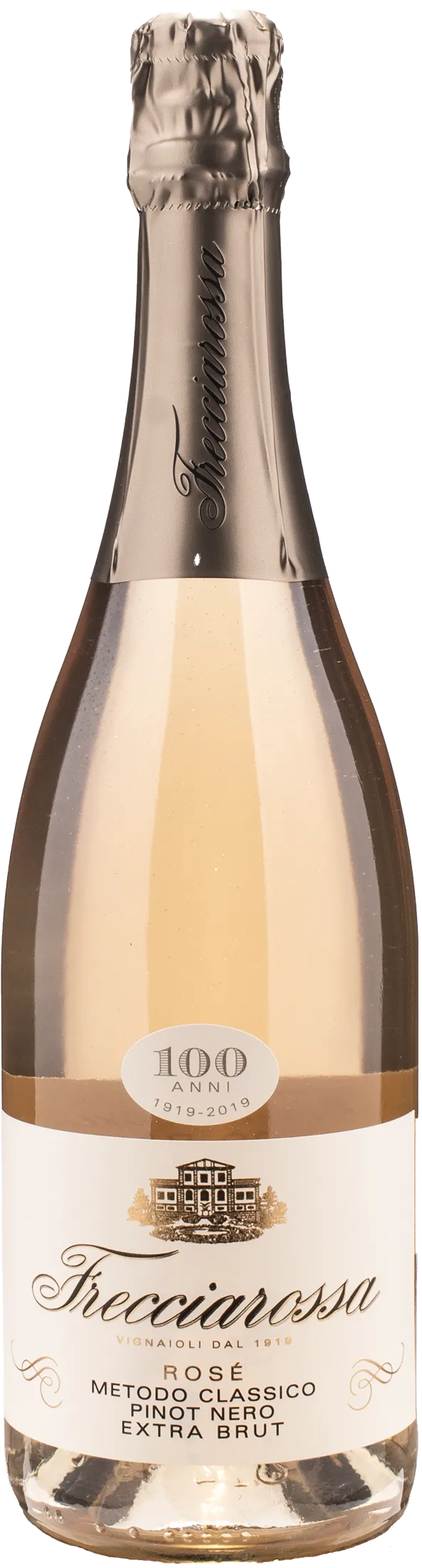
Metodo Classico Rosato Pinot Nero Extra Brut
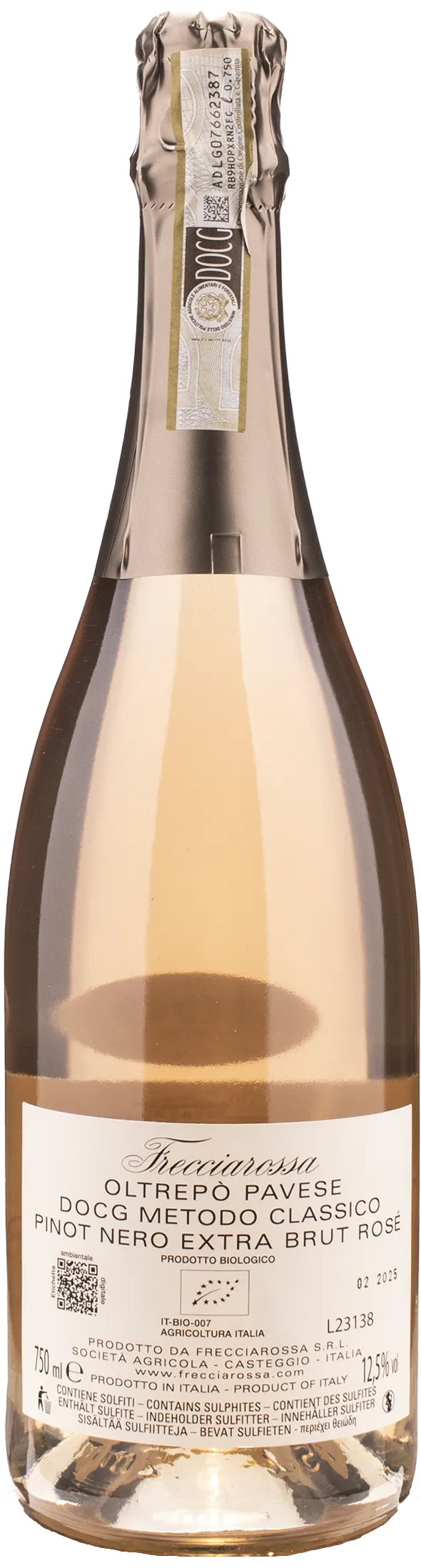
| Denomination | DOCG Oltrepo' Pavese Metodo Classico Pinot Nero Rose' |
|---|---|
| Size | 0,75 l |
| Alcohol content | 12.5% by volume |
| Area | Lombardy (Italy) |
| Grape varieties | 100% Pinot Nero |
| Aging | Racking in the spring following the harvest; secondary fermentation at 16°C and ageing on the lees for over 18 months, followed by disgorgement. |
- Identity: Organic rosé sparkling wine, Classic Method Extra Brut made from 100% Pinot Noir
- Ageing: Over 18 months on the lees for a fine and persistent perlage
- Aromas: Wild strawberries and red flowers, hints of white pepper and bitter orange
- Taste: Harmonious and vinous profile, lively acidity providing freshness and a mineral finish
- Origin: Oltrepò Pavese DOCG, hills of Casteggio, Lombardy; alcohol 12.5%
Description
What kind of wine it is
Frecciarossa Metodo Classico Rosato Pinot Nero Extra Brut is an organic sparkling wine from Lombardy, an authentic expression of the Oltrepò Pavese. Made from Pinot Noir grapes and crafted using the Traditional Method, it reveals a fine and persistent perlage. On the nose, fragrances of wild strawberries and red flowers emerge. On the palate, it shows excellent harmony and lively acidity, accompanied by a pronounced vinosity at the centre of the mouth. The finish is characterised by refined notes of white pepper, bitter orange peel and precise mineral accents.
Where it comes from
The grapes are grown on the hills of Casteggio, in the heart of the Oltrepò Pavese, an area historically suited to the cultivation of Pinot Noir. The vineyards are situated between 140 and 200 metres above sea level and are trained using the Guyot system to ensure low yields and a high concentration of aromas. The north-east and north-west exposure favours gradual ripening, preserving the freshness of the fruit. The clay-limestone soil composition gives the wine a solid structure and a distinct minerality, defining its taut and elegant character. Frecciarossa thus precisely interprets the identity of the territory.
How it is produced
Production begins with manual harvesting carried out at first light to preserve the integrity of the grapes. After gentle pressing to extract the free-run must, the wine undergoes spontaneous clarification and the first fermentation. Following winter settling, the prise de mousse, a crucial stage of the Traditional Method, begins. The sparkling wine then matures on the lees for over eighteen months, gaining depth and complexity before disgorgement. The low residual sugar enhances the clean and essential profile typical of the Extra Brut dosage.
History and Curiosities
This sparkling rosé from Frecciarossa is a vibrant tribute to Oltrepò Pavese, a renowned homeland of Pinot Noir, and to the history of the winery founded in 1919. Acclaimed by prestigious guides such as Bibenda and Gambero Rosso, the wine is a true expression of excellence. Aged for over eighteen months on the lees, this refined organic Traditional Method reveals an elegant bouquet of wild strawberries and red flowers. The palate develops with a pleasant vinosity, finishing with fresh mineral notes that perfectly cleanse the palate.
Awards
-
 3
3Italian Sommelier Association (AIS) guide
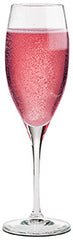
Tasting notes

Perlage

Perfume

Color

Taste
Serve at:
06 - 08 °C
Longevity:
05 - 10 years
- Start up year: 1919
- Oenologist: Gianluca Scaglione, Cristiano Garella
- Bottles produced: 90.000
- Hectares: 21
He bought a beautiful 19th century mansion on top of a hill, exotically named «Frecciarossa,» which means «red arrow» in Italian. He wasn’t to know that the fancy moniker was actually the result of a bureaucratic blunder… The original name in the local dialect of the area was «fraccia rossa,» or «red landslide,» thus named because of the color and nature of the soil. The terrain here is mostly clay with veins of iron ore and retains great amounts of water underground. These, in turn, cause frequent landslides. The expression was mistakenly translated as «Frecciarossa» at the local registry, at the turn of the last century, and has remained the name of our hill ever since.
Enter Giorgio Odero, Mario’s son, my grandfather. I remember him from my childhood as a sort of modern day renaissance man. He seemed to know everything about everything and when he didn’t, he’d go rummaging through his vast library to find the answer. He was also a gourmet and a fine wine connoisseur with a taste for opera and literature. However, to get back to the early days of Frecciarossa, Giorgio, like his father, fell in love with the land and decided to study agriculture in order to take an active part in the wine making. After graduating, he developed an interest for Pinot Noir and went to France to get some first hand experience, because when it comes to Pinot Noir, the French were, and still are ahead of the game.
He learned a lot, both in Burgundy and Champagne, and returned to Italy with new ideas and very high standards of quality. Frecciarossa started to sell wine in bottles, a rarity at the time. As a matter of fact, film director, Alfred Hitchcock drank a few at Villa D’Este and had the good grace to tell Giorgio, how much he enjoyed them. By the 1920s, Frecciarossa was already a well established name, far beyond the confines of Oltrepò Pavese. When Prohibition ended in the States, in 1933, Frecciarossa was among the first Italian wines to appear on the American market and was issued Export Permit n. 19, i.e., the nineteenth Italian product to be granted the right to sell in the U.S.
My mother, Margherita, started working with my grandfather in the late ’70s, with equal passion and determination. In the ’90s, she renovated the cellars and hired the help of oenologist, Franco Bernabei. He was replaced in 2000 by Gianluca Scaglione, who is still with us today and has become an integral part of our team, along with Cristiano Garella. I came back to this land a few years ago. It felt like home to me, and I love it just like the generations who bestowed it on me. (Valeria Radici Odero) Read more


| Name | Frecciarossa Metodo Classico Rosato Pinot Nero Extra Brut |
|---|---|
| Type | Rosé organic classic method sparkling wine extra brut |
| Denomination | Oltrepò Pavese Metodo Classico DOCG |
| Size | 0,75 l |
| Alcohol content | 12.5% by volume |
| Grape varieties | 100% Pinot Nero |
| Country | Italy |
| Region | Lombardy |
| Vendor | Frecciarossa |
| Story | History and Curiosities This sparkling rosé from Frecciarossa is a vibrant tribute to Oltrepò Pavese, a renowned homeland of Pinot Noir, and to the history of the winery founded in 1919. Acclaimed by prestigious guides such as Bibenda and Gambero Rosso, the wine is a true expression of excellence. Aged for over eighteen months on the lees, this refined organic Traditional Method reveals an elegant bouquet of wild strawberries and red flowers. The palate develops with a pleasant vinosity, finishing with fresh mineral notes that perfectly cleanse the palate. |
| Origin | Lower hills of Casteggio |
| Climate | Altitudine 140–200 m s.l.m.; esposizione nord-est e nord-ovest |
| Soil composition | Clay-limestone |
| Cultivation system | Single Guyot |
| Plants per hectare | 5000 |
| Yield per hectare | 5.000–6.000 kg/ha |
| Fermentation temperature | 13–15 °C; second fermentation at 16 °C |
| Fermentation | Secondary fermentation and ageing on the lees for over 18 months |
| Production technique | Traditional method |
| Wine making | Gentle pressing of the grapes, obtaining the free-run must and spontaneous clarification. Alcoholic fermentation between 13 and 15 °C, spontaneous decantation and cold stabilisation during the winter. Bottling in the spring following the harvest, secondary fermentation at 16 °C and ageing on the lees for over 18 months with subsequent disgorgement. |
| Aging | Racking in the spring following the harvest; secondary fermentation at 16°C and ageing on the lees for over 18 months, followed by disgorgement. |
| Total acidity | 7.1 gr/L |
| Residual sugar | 5.8 gr/L |
| Year production | 90000 bottles |
| Allergens | Contains sulphites |