


Domaine de la Janasse
Cotes du Rhone Village Terre d'Argile 2024
| Denomination | AOC Côtes du Rhône Villages |
|---|---|
| Size | 0,75 l |
| Alcohol content | 14.5% by volume |
| Area | Rhone Valley (France) |
| Grape varieties | 25% Carignano, 25% Grenache, 25% Mourvedre, 25% Syrah |
| Aging | 75% in barrels (1/3 new) for Syrah and Mourvèdre and 25% in large casks (foudre) for Grenache for 12 months |
- Name and style: Still red wine AOC Côtes-du-Rhône Villages, 2024 vintage
- Rhône blend: Grenache, Syrah, Mourvèdre and Carignan for a rich flavour profile
- Aromatic notes: Blackcurrant, dark fruits and olive paste, intense and concentrated aromas
- Taste and finish: Dense and fleshy palate, ripe fruit, long and persistent finish
- Vineyard and ageing: Grown without pesticides; 12 months ageing in barriques and large casks
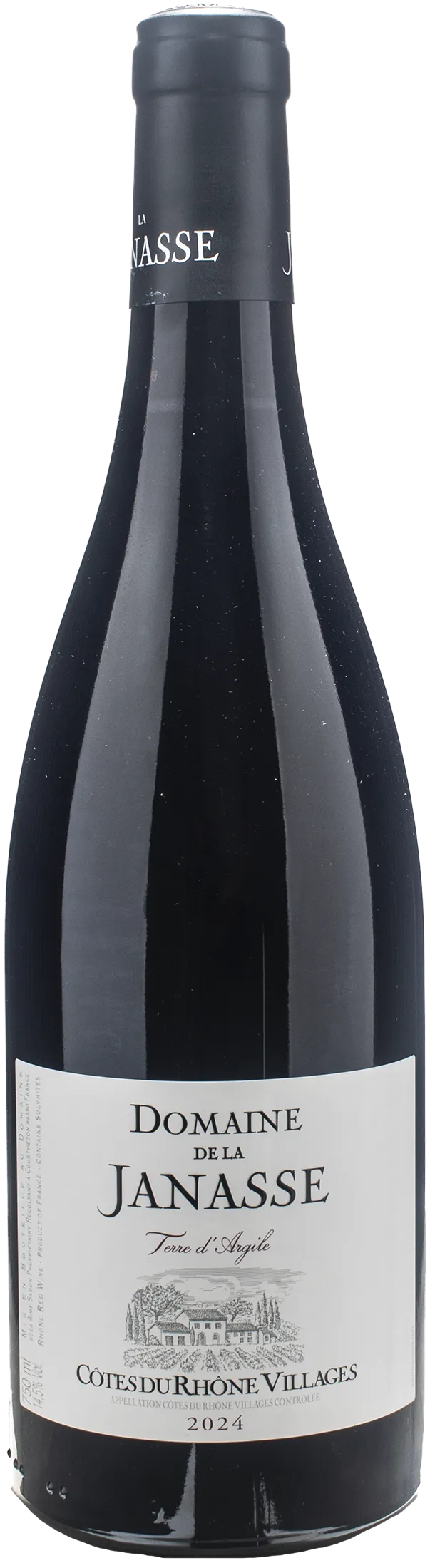
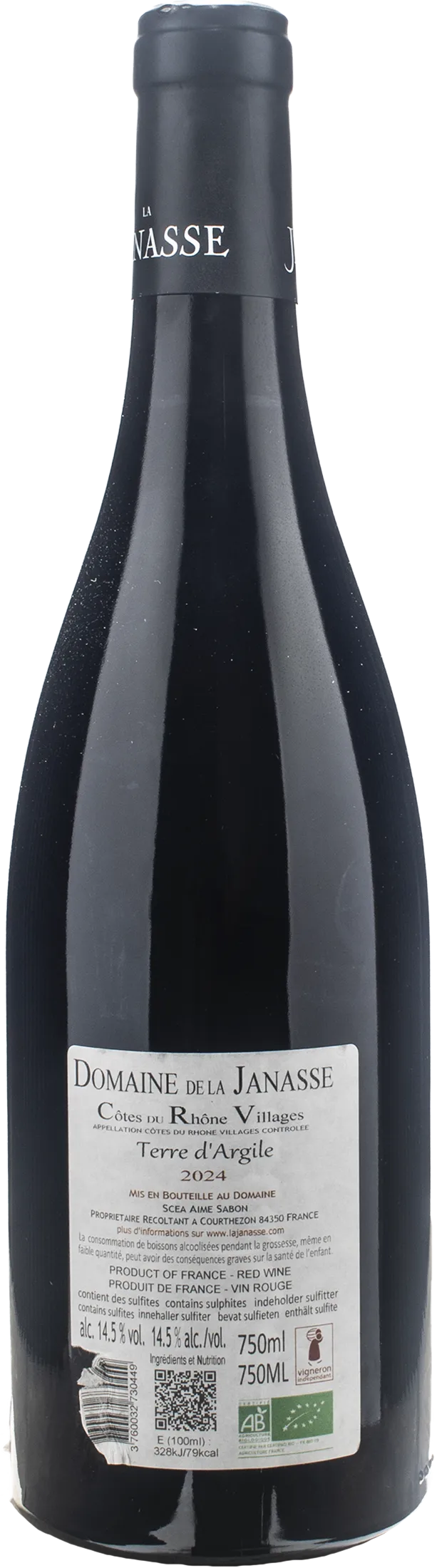
Description
What kind of wine it is
Terre d’Argile by Domaine de la Janasse is a still red wine from Côtes du Rhône Villages. This structured blend of Grenache, Syrah, Mourvèdre and Carignan offers a full and enveloping sensory profile. The bouquet opens with clear notes of blackcurrant, followed by refined hints of olive paste and dark fruits. On the palate, it is dense and fleshy, delivering a long and persistent sip reminiscent of ripe fruit. At the table, it proves ideal for enhancing rich meat dishes, pairing excellently with lamb cutlets.
Where it comes from
The vineyards are located in the Rhône, north of the commune of Courthézon, in close proximity to the borders of Châteauneuf-du-Pape. The vines grow on a typical terroir composed of rounded pebbles and red clay, features that provide excellent concentration and a compact flavour profile. The estate practises strict soil-friendly agriculture, forgoing insecticides and chemical pesticides in favour of organic fertilisers. The soil is worked mechanically and without herbicides to preserve maximum aeration, allowing the plants to express themselves at their best.
How it is produced
The production cycle begins with a rigorous manual harvest and careful selection in the field, preceded by targeted green harvesting for the Syrah and Mourvèdre grapes. In the winery, partial destemming takes place before fermentation, which benefits from a prolonged maceration of around twenty days, enhanced by daily pressing to extract intensity and aromas. Maturation continues for twelve months in wooden barrels: partly new barrels are dedicated to Syrah, Mourvèdre and Carignan, while large barrels are used for Grenache.
History and Curiosities
Terre d’Argile originates in the Rhône, near Châteauneuf-du-Pape, on a terroir of rounded pebbles and red clay. Produced by Domaine de la Janasse since 1973, this Côtes du Rhône Villages AOC comes from vines cultivated without pesticides. After a rigorous manual harvest, destemming and maceration, the wine is aged in both barriques and large wooden casks, resulting in a dense, structured, intense and enveloping red profile.
Tasting notes

Perlage

Perfume

Color

Taste
Serve at:
14 -16 °C
Longevity:
05 - 10 years
Decanting time:
1 hour

- Start up year: 1973
- Oenologist: Isabelle Sabon and Christophe Sabon
- Hectares: 90
Due to its fragmented structure -more than sixty plots- the area of La Janasse covers a mosaic of terroirs. Thorough research on soil, exposure and microclimates helped to ideally organize the vineyard. White varieties and syrahs were preferably planted on sandy limestones, exposed eastward of the appellation in order to preserve freshness, acidity and fineness. Mourvedres were planted on clay-limestone soils covered with river rocks so as to reach perfect maturity. Read more


| Name | Domaine de La Janasse Cotes du Rhone Village Terre d'Argile 2024 |
|---|---|
| Type | Red organic still |
| Denomination | Côtes du Rhône AOC |
| Vintage | 2024 |
| Size | 0,75 l |
| Alcohol content | 14.5% by volume |
| Grape varieties | 25% Carignano, 25% Grenache, 25% Mourvedre, 25% Syrah |
| Country | France |
| Region | Rhone Valley |
| Vendor | Domaine de la Janasse |
| Story | History and Curiosities Terre d’Argile originates in the Rhône, near Châteauneuf-du-Pape, on a terroir of rounded pebbles and red clay. Produced by Domaine de la Janasse since 1973, this Côtes du Rhône Villages AOC comes from vines cultivated without pesticides. After a rigorous manual harvest, destemming and maceration, the wine is aged in both barriques and large wooden casks, resulting in a dense, structured, intense and enveloping red profile. |
| Origin | Courthézon (France) |
| Soil composition | Rounded pebbles and red clay |
| Yield per hectare | 46 hl/ha |
| Fermentation | 18–21 giorni |
| Production technique | The vines are grown without pesticides or insecticides; natural manure is used; the soil is tilled without herbicides to maintain soil aeration and flexibility. |
| Wine making | Partial destemming before fermentation; 75% of the stems are removed. Maceration for 18–21 days with daily pressing. |
| Aging | 75% in barrels (1/3 new) for Syrah and Mourvèdre and 25% in large casks (foudre) for Grenache for 12 months |
| Allergens | Contains sulphites |